The story of Stefan Scholten and Carole Baijings began, like many Dutch stories do, in a church. In the late ’90s, Baijings was working for an agency whose headquarters were located inside one of the country’s many abandoned houses of worship. Scholten, a graduate of the Design Academy Eindhoven, had a burgeoning design practice nearby. Scholten was asked to design a small bar for the agency’s office, and “the rest is history,” says Baijings. “As our lives came together, working together was a natural progression.” The two seem totally at ease with the idea of spending nearly every waking moment together: “Stefan is really good at the big picture. I’m good at the details,” Baijings says serenely.
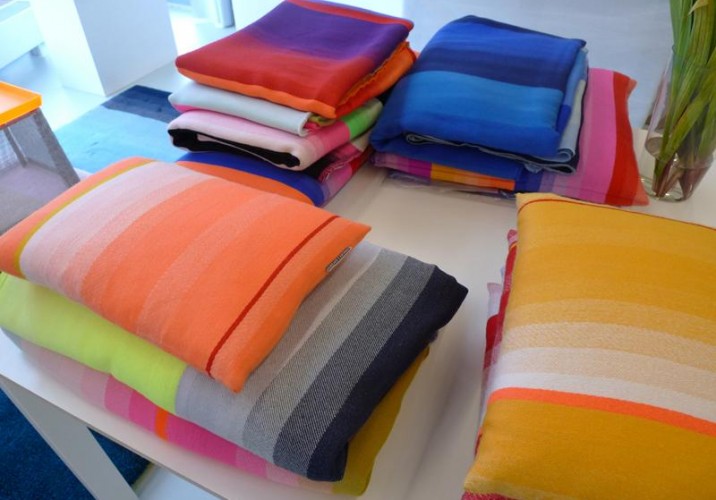
In any case, the partnership works. Over the past 10 years, the couple has produced, mainly on commission and in collaboration with venerable Dutch manufacturers, a portfolio of exquisitely crafted, instantly covetable objects — soft, vividly striped merino pillows and throws, delicate glass vessels, gridded silk scarves, and last year for the Milan Furniture Fair, a series of five pieces exploring different modes of decoration. (Their steel-frame and aluminum armoire, a sleeper hit from that series, will be presented at this year’s fair by Established & Sons.) Their work is defined by an eye for graphics, an impeccable sense of color, and a somewhat peculiar sense of humor. (On our visit to their studio this fall, we found among the detritus an unresolved centerpiece fashioned from a pile of potatoes.)
A year ago, they moved into their current space, a light-filled, two-floor studio inside a new development overlooking Amsterdam’s harbor. A look inside it reveals much about the way they work; the surfaces are covered with sketches, paper models, prototypes, and failed experiments. “We work more like artists,” says Baijings. “We start with materials and colors and then try to create a shape or a design. It’s a different approach than starting with a word or a concept or an idea.”
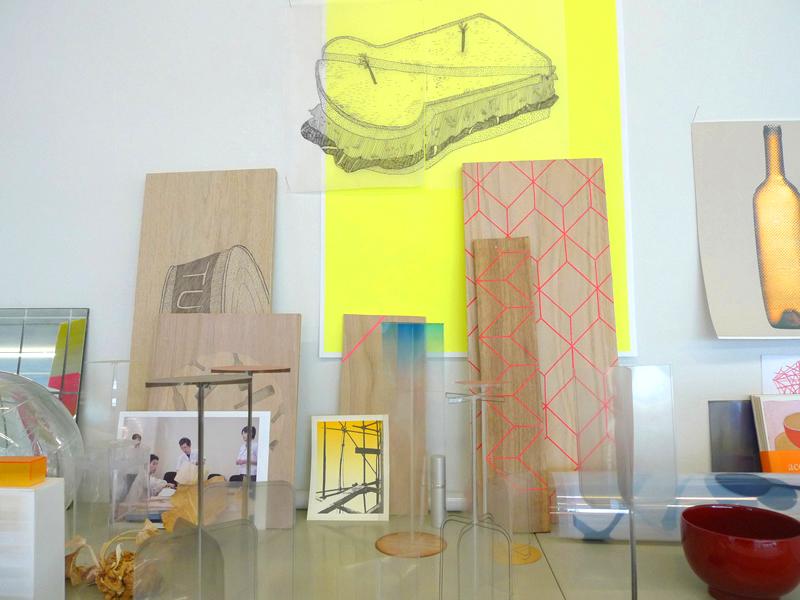
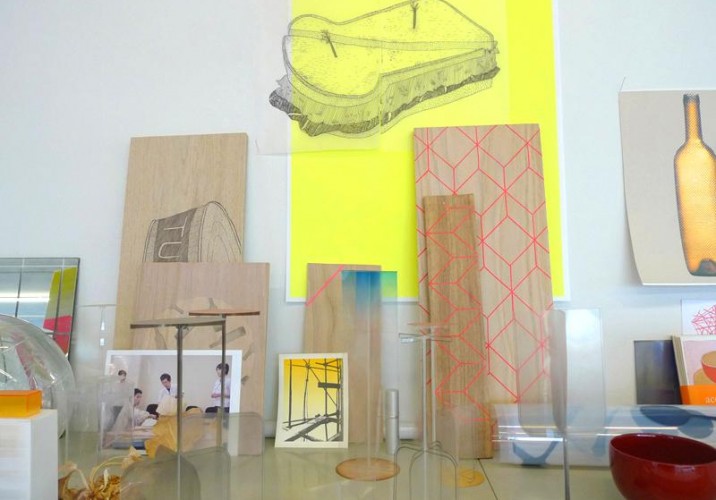
A typical vignette in the Scholten & Baijings studio includes graphic tests and models for their latest furniture collection, plus strange ephermera like a tiny silver spray bottle that contains a distilled spirit for perfuming almost anything edible.
Because the studio looks out through massive plate-glass windows onto the boardwalk along Amsterdam’s harbor, Scholten and Baijings use the front area as a sort of showroom as well. People walking by are welcome to peek in; in the window when we visited were the couple’s Colour Plaid pillows and throws, produced by the Dutch weaving mill De Ploeg for Thomas Eyck.
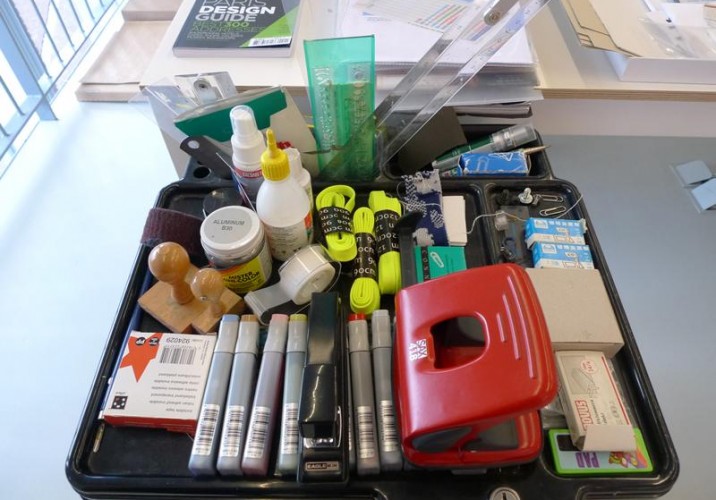
The designers’ toolbox.
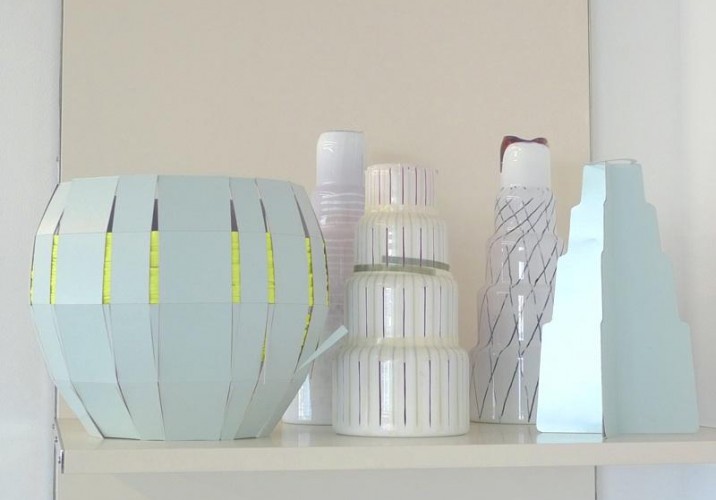
Paper models and prototypes for their six-piece Table Glass series with Royal Leerdam Crystal, for which the glassblowers employed a technique known as overlay. A transparent crystal layer is blown and overlaid with white opaque glass. After cooling, the lines are then cut manually using a small diamond disk.
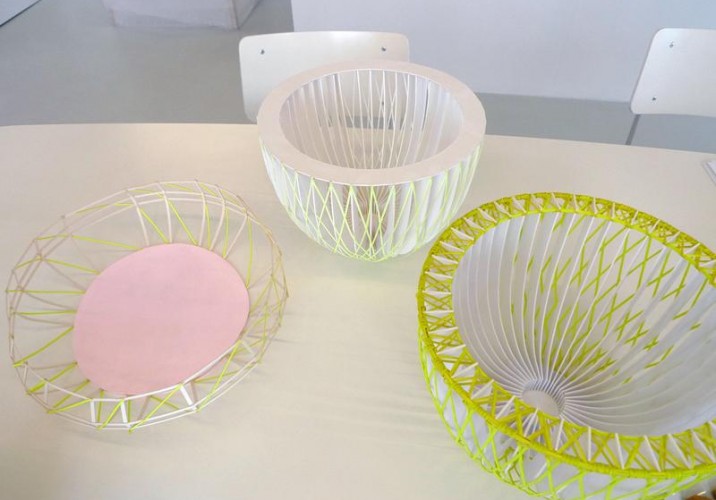
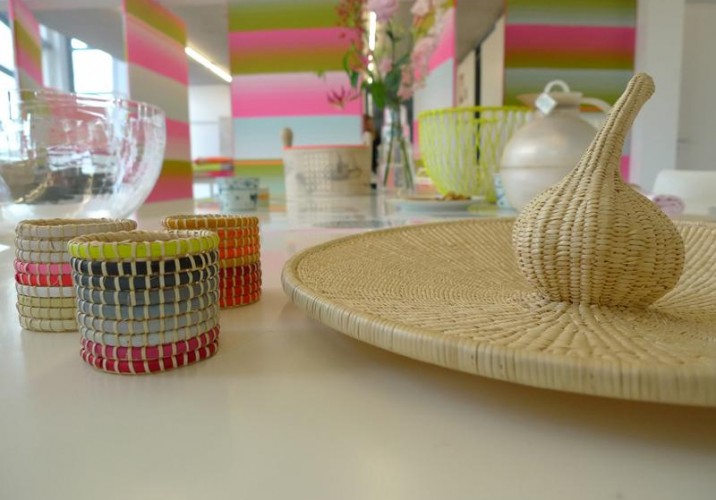
Models for the woven willow series with Thomas Eyck. “We’ve always loved working with color, but for us, the big start was when we designed the woven willow collection,” says Scholten. “Wicker is normally very brown or blond and it has quite old-fashioned connotations. We wanted to make it contemporary. Dyeing it was our natural instinct.”
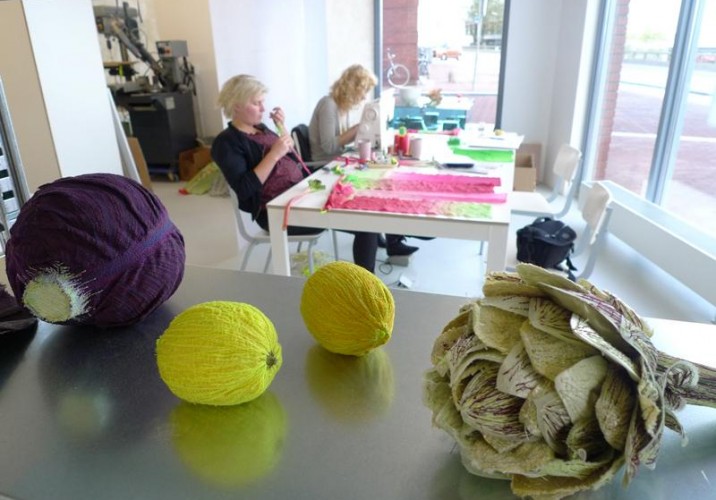
It takes 440 yards of wicker and two weeks to mold one Garlic Queen (shown at right) from their woven willow series, and the pieces are created using a 16th-century technique known as fynscheenwerk. Only one woman in The Netherlands is skilled at this technique, and she normally uses it to make tiny replacement furniture for the 17th-century puppet houses on display at the Rijksmuseum.
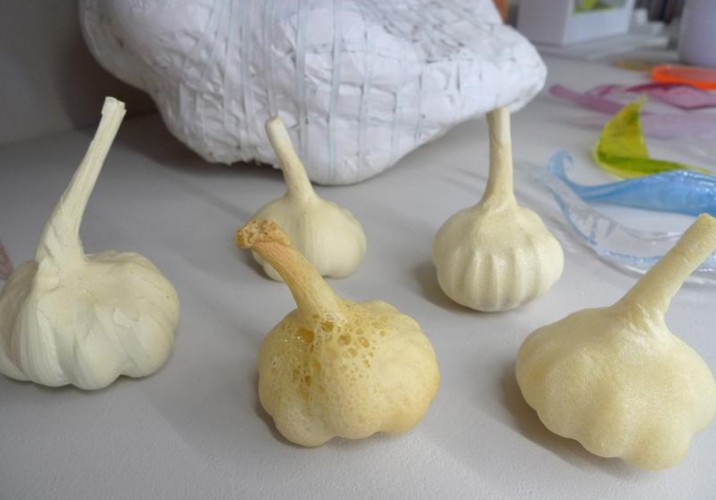
To create the core of the Garlic Queen, Scholten and Baijings went through several bulb models in search of the perfect shape.
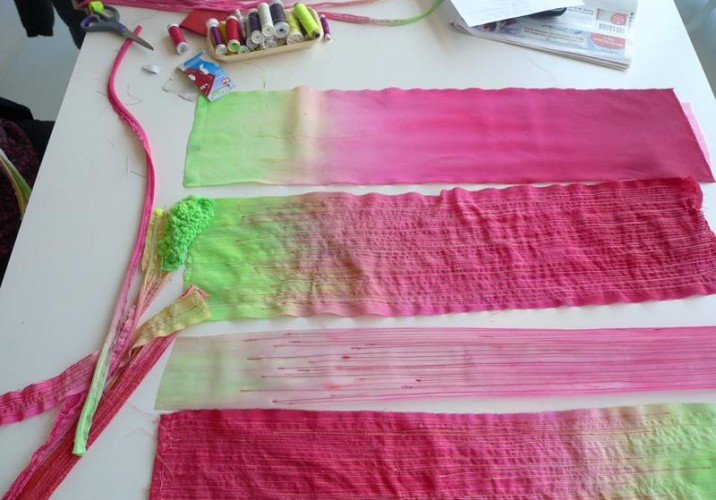
Scholten and Baijings’ Vegetables textile series — the only product produced from start to finish in their studio — was shown this winter by the Vivid Gallery in Rotterdam. Shown here is the raw material for making rhubarb.
Veggies being sewn by the duo’s Design Academy Eindhoven interns. “We were working on the Vegetables series in front of the window of our atelier,” says Baijings, “so passersby could see that the sample vegetables would go bad after a few days.”
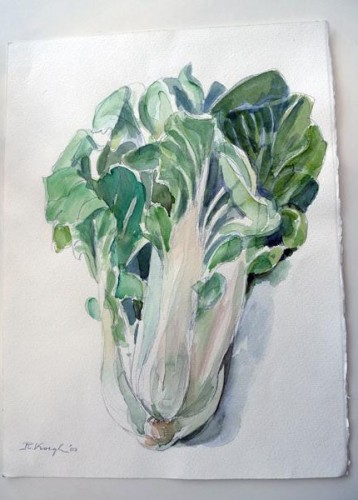
“An artist who lives in the building next door came by to give this watercolor painting to ‘the girls behind the sawing machine’ (sic) — to provide them with a fresh cabbage!”
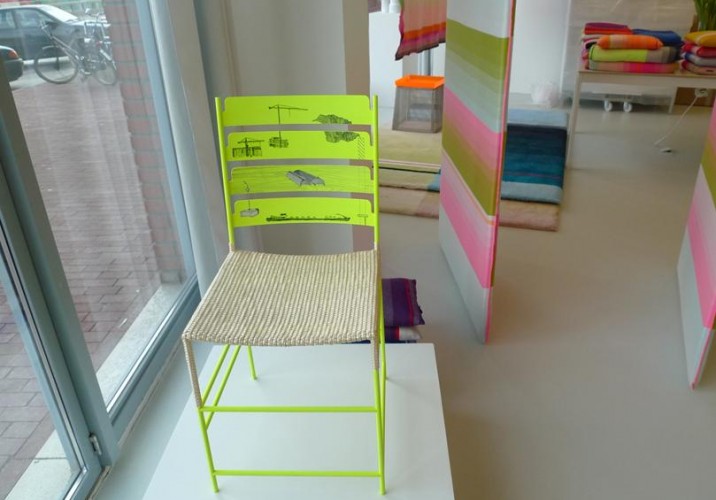
For last year’s Milan Furniture Fair, Scholten & Baijings were commissioned by the Zuiderzee Museum to create “Conversation Pieces for the Interior” using five furniture archetypes from the museum’s collection. The couple used high-contrast graphics, saturated colors, and quirky personal details to give the items a contemporary feel. This bright yellow slatted chair, known as a knopstoel, depicts construction cranes and Centraal Station — i.e. the view from their new studio.
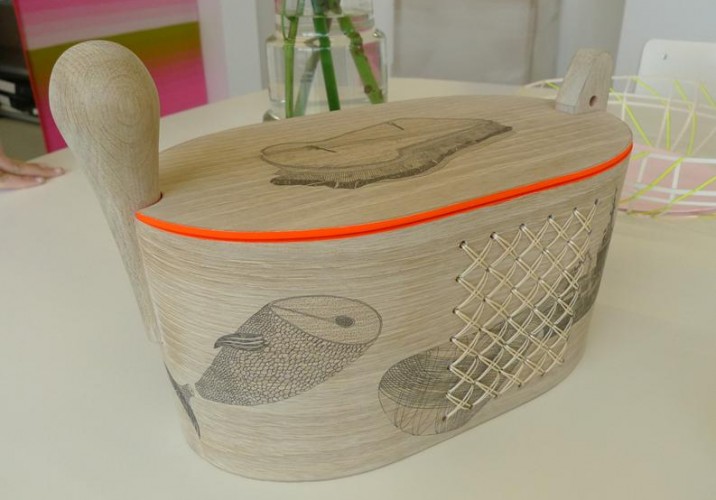
Part of the same series, this wooden travel case — known as a butte — was inspired by an antique version which showed whaling scenes. “Fishermen would have taken this on a trip with all of their personal belongings in it,” says Baijings. “And the boxes would have drawings of all the things they would have seen on such a trip. Ours shows the life of a tuna fish: dolphins, a ship with a net, a factory, a can, a sandwich.”
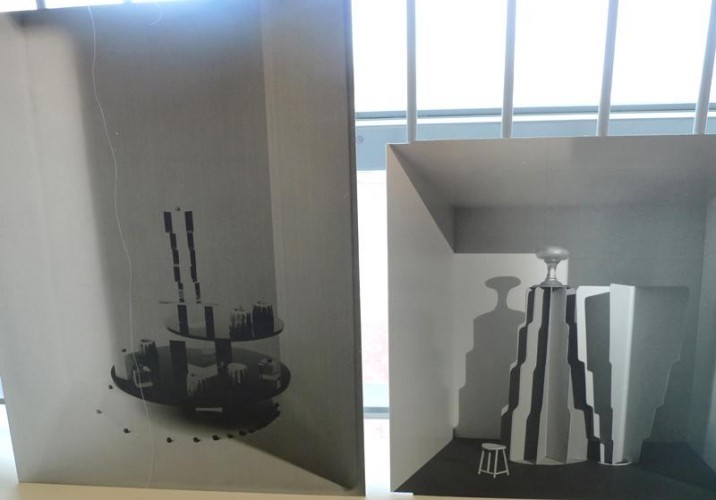
For the tilt-top tables in the series, Scholten & Baijings worked with artist Mathieu Meijers. And for the aluminum Amsterdam armoire, they commissioned these still-lifes from the Amsterdam-based photography duo Scheltens & Abbenes.
The still-lifes are screen-printed on the inside of the doors. The armoire’s glass-jug feet were blown by the Leerdam-based artist Bernard Heesen.
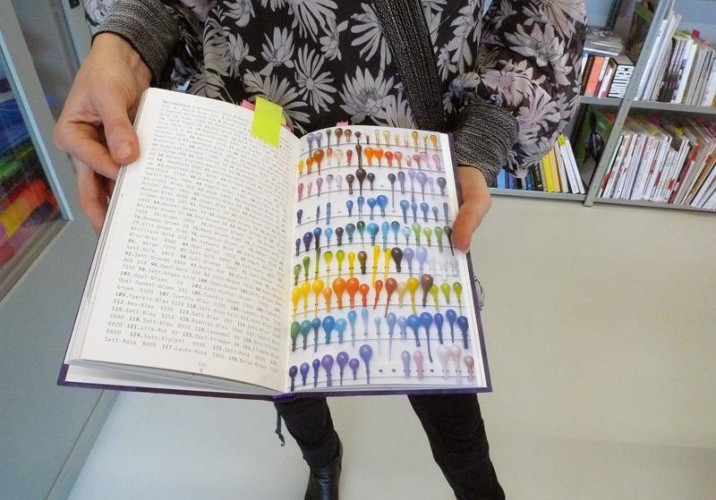
Baijings showed us a book on Heesen’s work. “We’re huge fans,” she says. “It’s much more romantic and bombastic than our own, but his sense of color is stunning and his feel for form is super personal.”
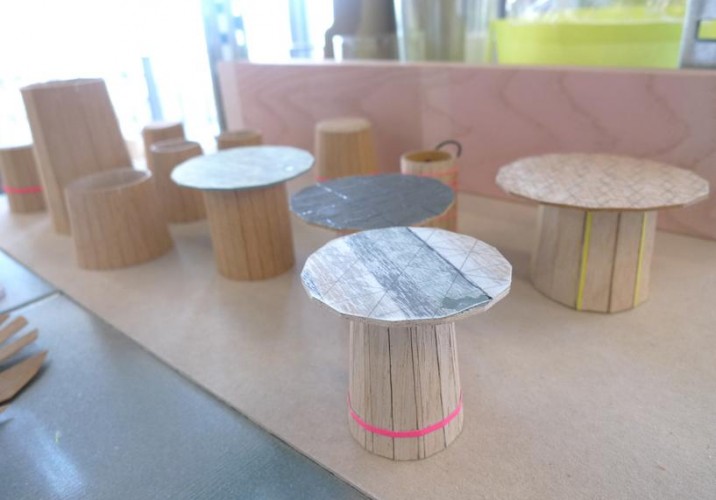
Models for the designers’ Colour Wood table series for Karimoku New Standard, a new brand founded by the Japanese label Karimoku. The tables are made from thinned wood — the smaller trees that are felled in a forest to let large trees grow — and finished with the couple’s signature graphics.
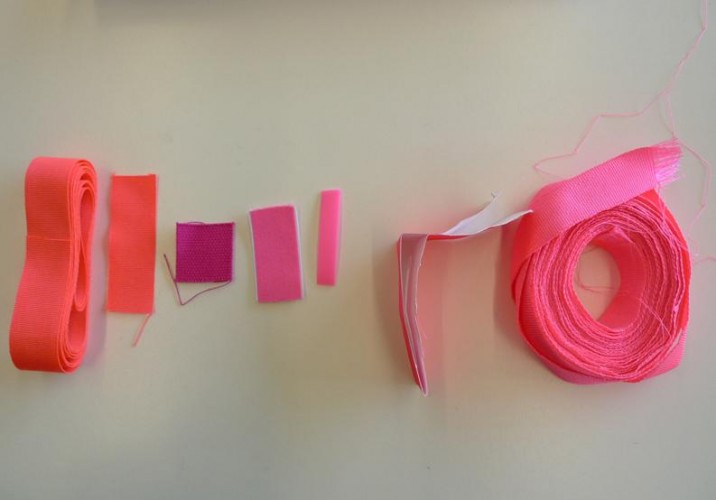
Neon ribbon bound for the bases of the Karimoku New Standard side tables.
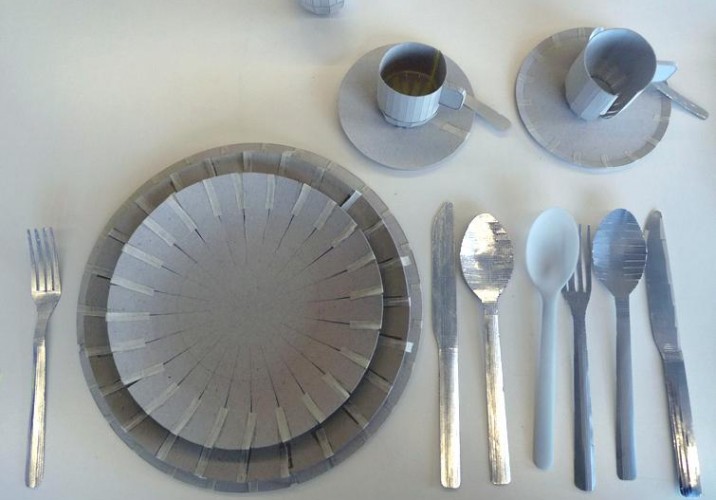
Models for Scholten & Baijings’ Total Table series, which debuted at this month’s Object Rotterdam fair. The duo created an entire tablescape around the idea of paper; the crockery and cutlery both bear the tiny score marks and strips that are the bread and butter of model-making.
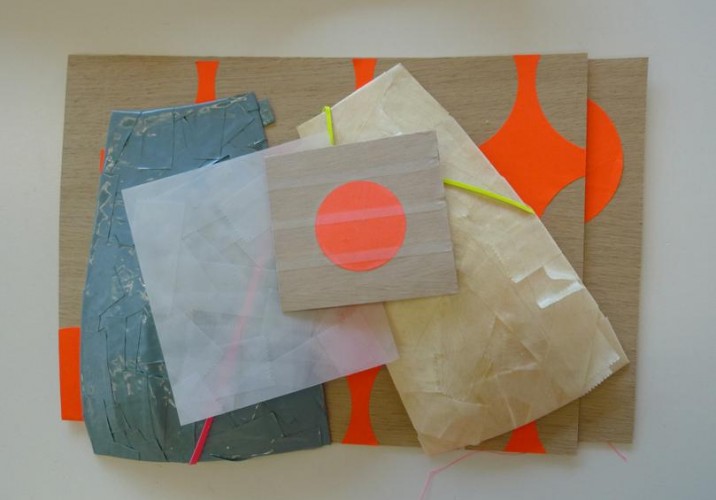
Graphic tests and scraps.
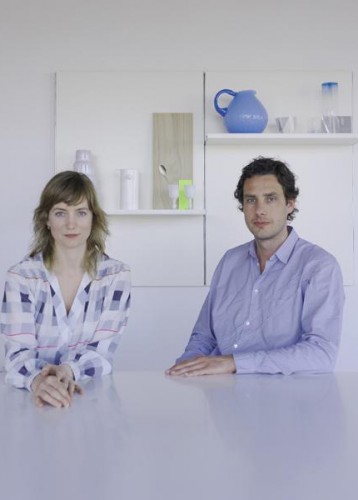
The couple in their studio.
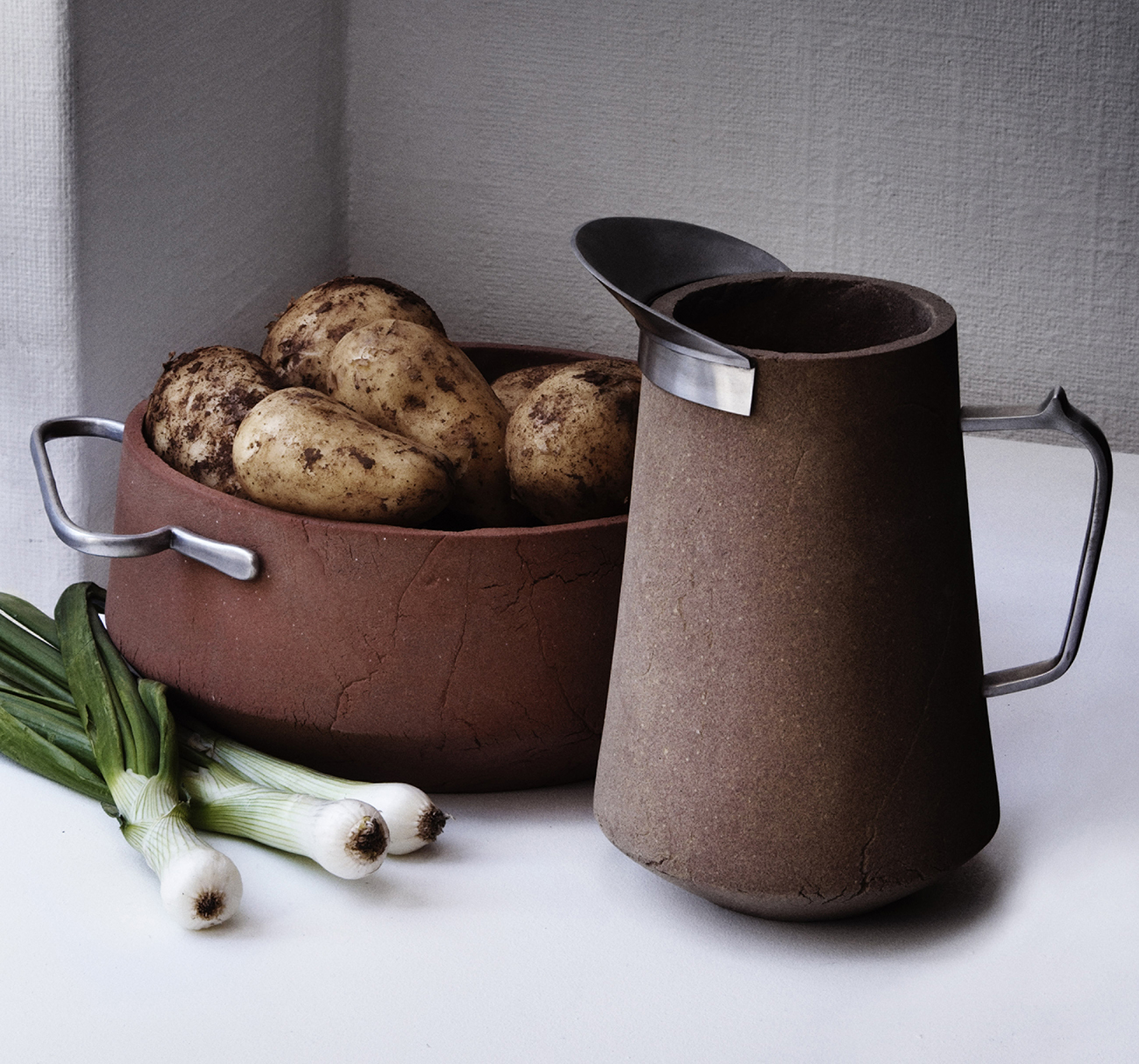
Atelier NL’s Nadine Sterk and Lonny van Ryswyck keep a studio in the airy loft of a ’70s-style church in Eindhoven. They live there, too, but you wouldn’t exactly say that’s where they work. More often than not, the designers can be found doing fieldwork, whether that means scouring the area’s secondhand shops for mechanical knickknacks to inspire their more analog designs — like van Ryswyck’s hand-cranked radio — or digging up clay in the Noordoostpolder, an area of reclaimed farmland north of Amsterdam that until the 1940s was submerged under a shallow inlet of the North Sea.
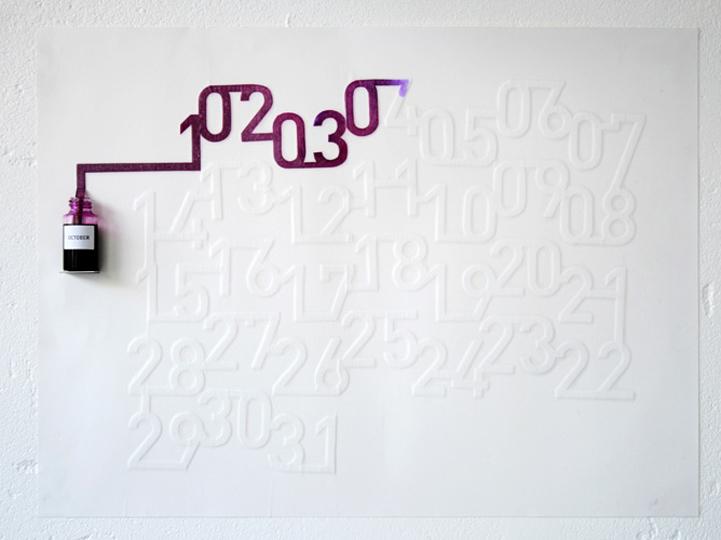
The scientific process behind many of life’s workaday phenomena is something called capillary action, which is the molecular attraction that makes liquid flow through a porous medium, for those in need of a high-school refresher. It’s what makes tears flow through your lachrymal ducts, what gives micro-fiber its super-absorbent properties, and why groundwater naturally spreads into areas of dry soil. It’s also what powers the Ink Calendar by Oscar Diaz.
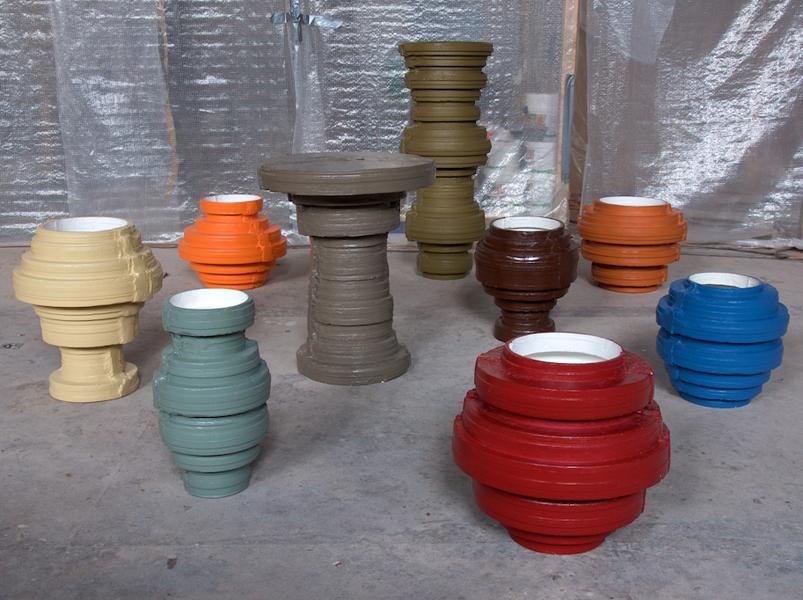
Julien Carretero's work invites metaphor the way cheese fries beg to be eaten — make a bench that's perfectly shaped in front and slowly morphs into chaos in back, and suddenly it could be about anything: humans' ultimate lack of control over the universe, politics, the pressure to succeed, mullets. For the Paris-born, Eindhoven-based designer, though, it's mostly just about one thing.