It takes the Zürich-based fashion duo Ikou Tschüss a full week to hand-knit the blankets from their winter collection — each ringed with dangling sleeves to appear as though it’s hugging the bed — and maybe a day to knit one of their bulky sweater dresses. Even silk shifts are hand-printed and edged with rows of crochet, the pair’s signature trope. Add to all that labor the fact that Carmen D’Apollonio spends the majority of her time in New York, where she’s been the right-hand-woman to Swiss artist Urs Fischer for the past eight years, and it’s a good thing she and partner Guya Marini have help. “Most of our knitting is done by Swiss grandmothers now,” says Marini. The first hopeful wrote to them out of the blue after seeing them muse in a magazine about how they’d love to have their clothes made by ordinary people. “She gave us the idea, and after we told the story in our next interview, we heard from all the grandmas in Switzerland.”
It’s not a typical production setup for a clothing line that sells at the likes of Colette in Paris. But it’s also not such a stretch considering Ikou Tschüss’s pieces employ the classical knitting and crocheting techniques the pair learned as children, having both been raised in Switzerland by Italian parents. “Here you learn to knit in school, and in Italy you learn it from your grandma, you have no choice,” Marini explains. What makes the pair’s clothes so avant-garde is the unconventional way they marry lightweight fabrics with heavy yarns — the very first Ikou Tschüss design was a vintage scarf crocheted all around to ensure it wouldn’t fly off D’Apollonio’s neck as she rode her bike — as well as the patterns, colors, and cuts they dream up during their mostly improvisational creative process.
It was the charm of that old-school/new-wave combination that first caught the eye of Marini’s influential friends back in 2006, when she was living in Paris and styling for Andre Walker and Beat Bolliger. She and D’Apollonio showed the guys at the Public Image showroom their work — which until then had only been made for themselves, or as gifts for loved ones — and they encouraged the fledgling designers to start a line. Marini’s pal Sarah Lerfel from Colette was the first to pick it up. It happened so fast that they had to choose a name on the fly: “Ikou” means “let’s go” in Japanese, “Tschüss” goodbye in German. Their upcoming eighth collection, which they’ll present in November as part of Zürich’s fashion week, will be their largest to date, buoyed by the investment of a new backer. Before they blow up, Sight Unseen decided to pay a visit to their studio to find out how they work.
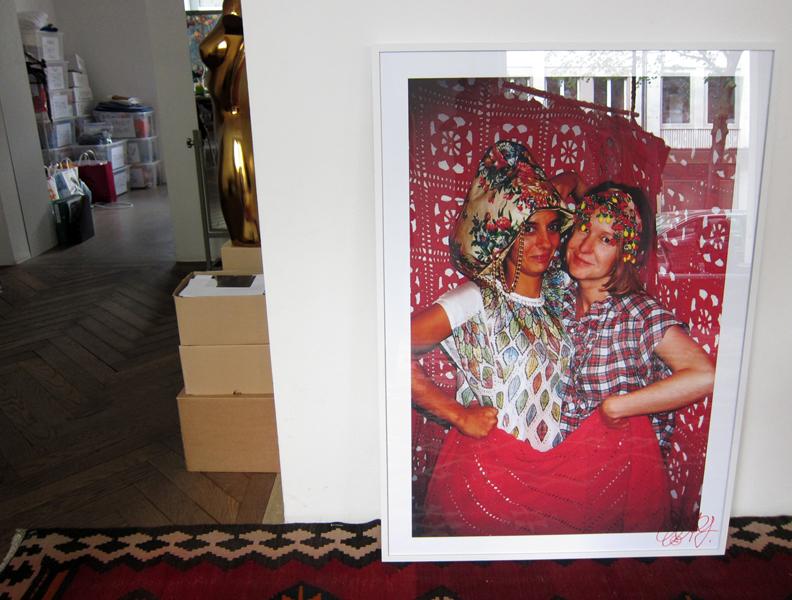
Carmen D’Apollonio (left) and Guya Marini (right), in a portrait taken by their friend Walter Pfeiffer, the Swiss photographer. The designers often collaborate on projects with other creative talents, including their lookbooks, which are art-directed by a different person each season. Pfeiffer did one, as did Urs Fischer.
When Sight Unseen visited, the pair were busy turning the front of their Zürich atelier into a small shop, which opened to the public at the end of April. Their clothes are already stocked at chic boutiques in France, Japan, and Switzerland, but now they can sell directly to friends and passersby.
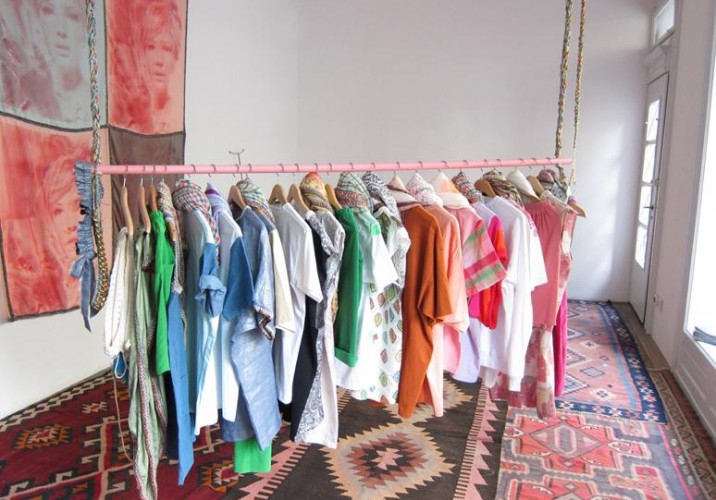
A single rack in the center holds pieces from their Spring/Summer 2010 line, including their latest batch of crocheted scarves, included in every collection. The pair profess an ongoing weakness for bright colors: “We always try to move away from neon, but every summer it’s always back,” Marini says.
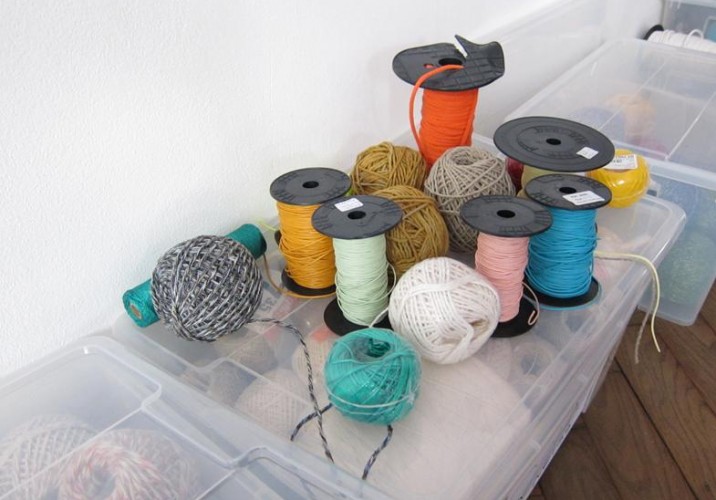
A colorful selection of yarns sits in the corner of the space. Even with the grandmas on board, Marini and D’Apollonio are constantly knitting, whether they’re executing actual stock or experimenting for future collections. “We’re not working like designers,” explains Marini. “We don’t have mood boards. We have a lot of ideas, and once we start something, it’s never going to end up being the same.” A scarf she began knitting for the first Ikou Tschüss collection, for example, spontaneously became a kind of avian hood with a soft, beak-like brim.
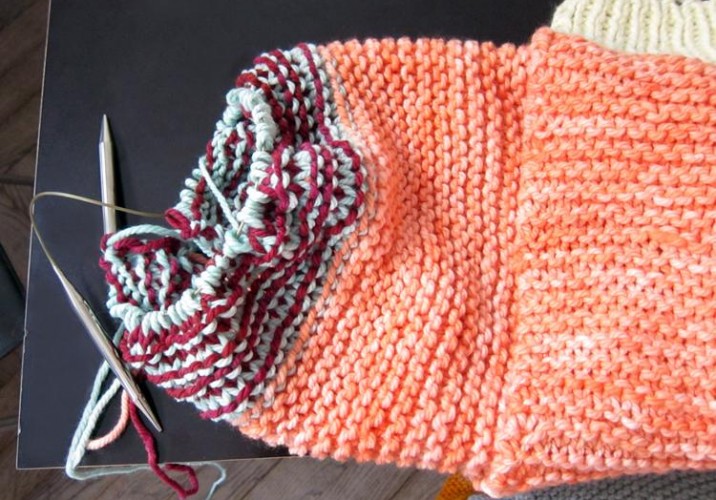
Which may explain how a sweater sleeve like this one…
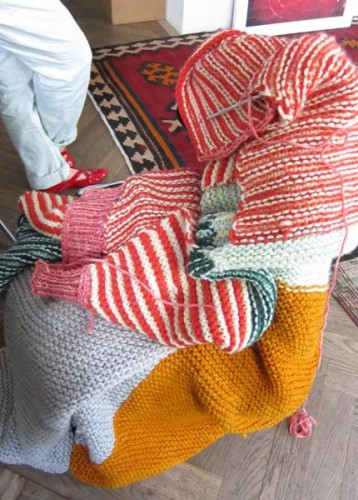
…became a multi-armed bedspread for the pair’s Fall/Winter collection. Marini reports that it takes a week’s worth of full-time knitting to make one.
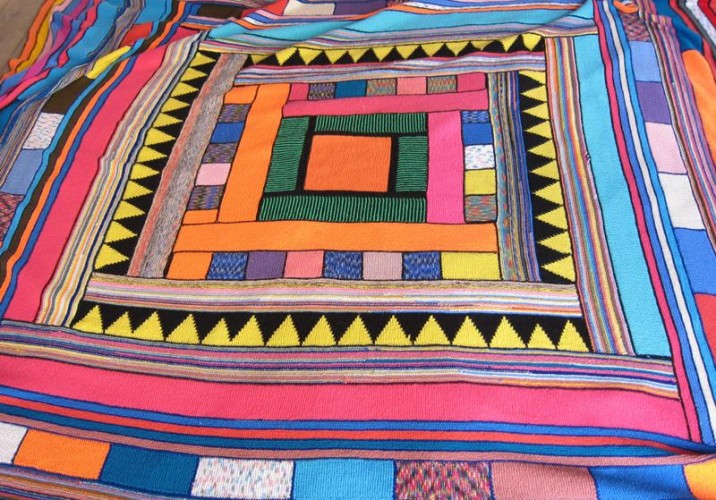
This massive blanket, on the other hand, took months — Marini and D’Apollonio started in the middle and knitted outward together, making it up as they went along. Despite the fact that everyone they know wants to buy one, it was so time-consuming (and thus expensive) to make that only one exists.
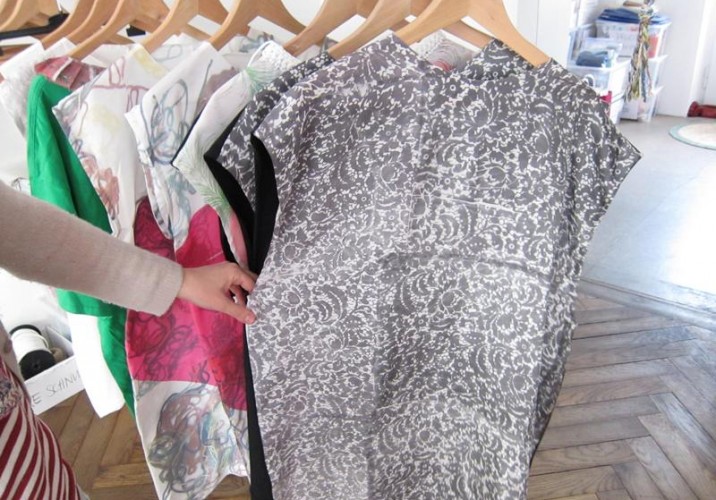
Whenever spring comes, Marini and D’Apollonio turn from bulky knits to silk tops and dresses whose necks and sleeves are trimmed with several rows of crochet. The patterns are the pair’s own designs, applied by hand using a proprietary oil printing method. “It’s a secret,” Marini insists. “It’s something that’s very us, because of the washed/faded effect.” The process is another way of ensuring that each piece comes out slightly different, which is important to the designers.
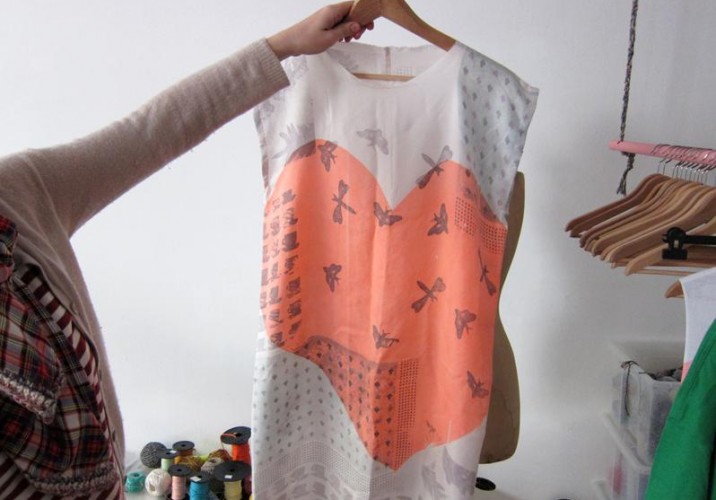
The prints, like the knits, aren’t premeditated and developed the way they would be at a larger label. “Carmen will say, ‘Oh let’s do a heart,’ and then we do feathers on top of it — it comes from nowhere. It’s just the mood we’re in,” says Marini. The rubber band–like pattern in the center of the rack shown here is a print of a photograph D’Apollonio took of her workspace one day when she was working on a new design.
One of the aforementioned heart motifs.
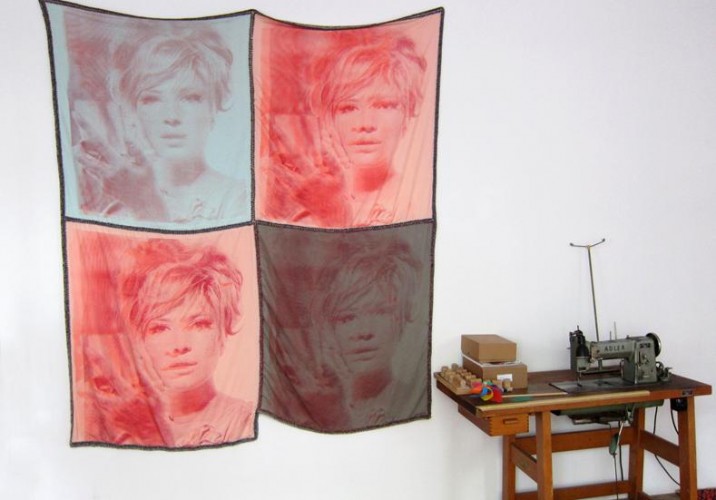
A wallhanging in the shop features the visage of Italian actress Monica Vitti, who starred in many of Antonioni’s films. “She’s our favorite,” Marini says, noting that the pair’s influences more often come from Italian culture than Swiss. “We always put Monica or Lucio Battisti, our favorite Italian songwriter, into our collections. We did Lucio on T-shirts, and Monica on a series of pillows.”
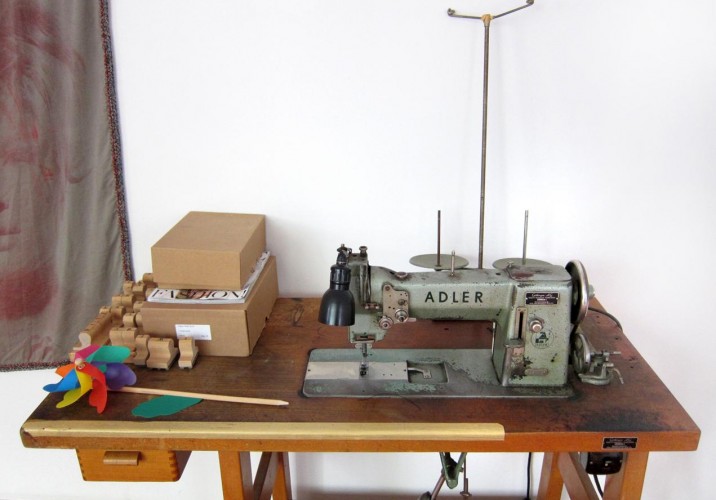
A vintage sewing machine, though not the one used to make Ikou Tschüss pieces — that honor is reserved for the Swiss-made Bernina electronic model on the other side of the room.
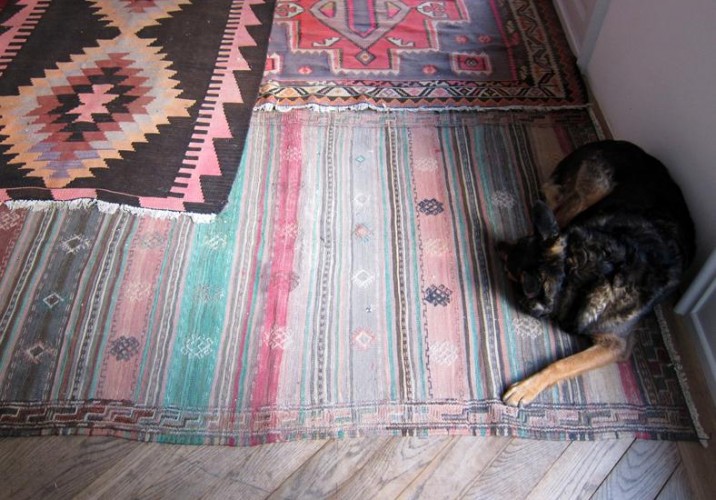
It’s one of several vintage finds scattered around the studio, including the colorful Kilim rugs lining the shop floor. The space is mere blocks away from one of Zürich’s coolest flea markets, and both of the designers are addicts — Ikou Tschüss even has a vintage line, found clothes adorned with crocheted accents in place of the pair’s custom prints. Marini says she inherited the clothing-collecting bug from her mom, who had similar habits; she often raids not only her mother’s archive, but her old boxes full of half-knit sweaters from the ’70s and ’80s, one of which Marini recently finished herself.
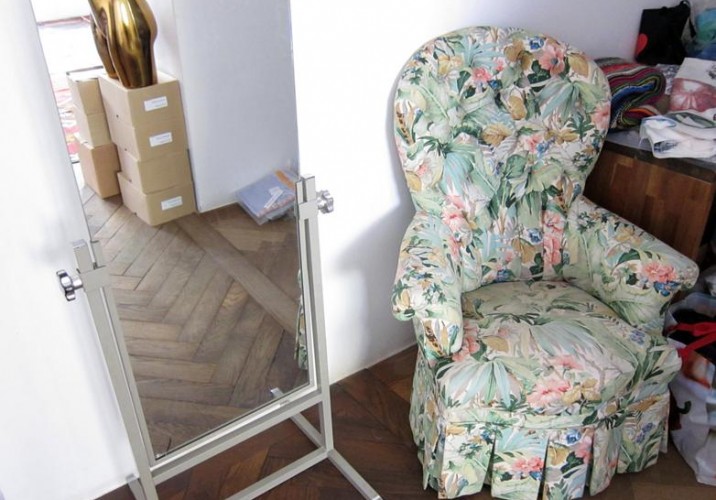
D’Apollonio found this old flowered chair at the flea market.
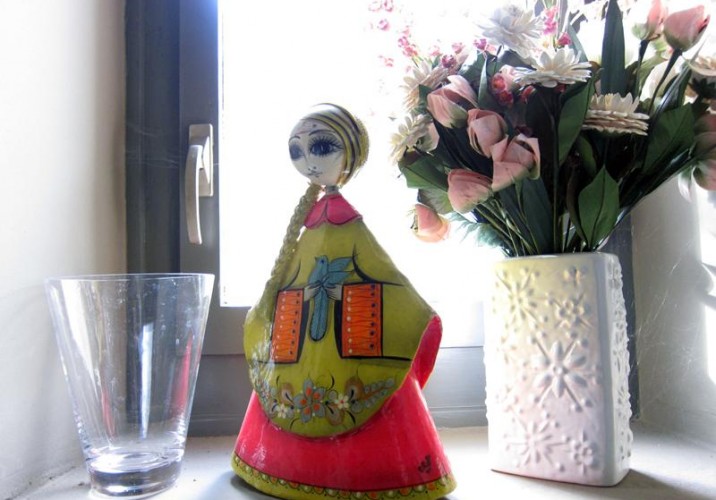
And this doll, too, which Marini calls “our neo-Babushka,” the Russian word for grandmother: “She keeps us happy.”
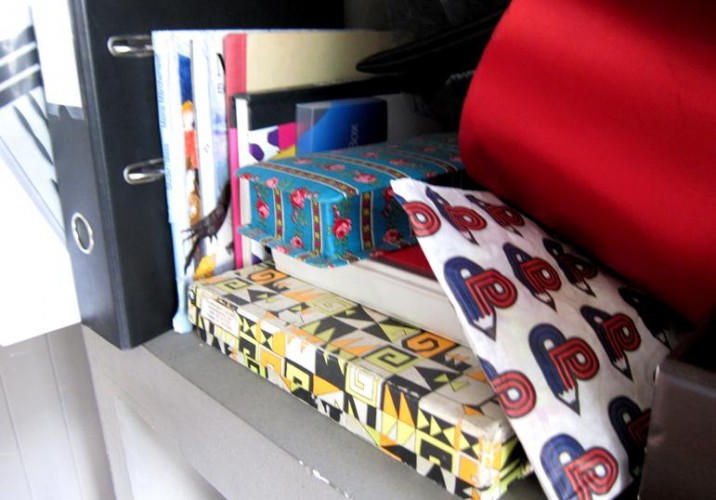
The pair also collect objects that feature colorful patterns, like these notebooks and boxes tucked into one of the studio’s shelves. It holds the serious stuff — ledgers, supplies, etc — but still reflects the character of the brand.
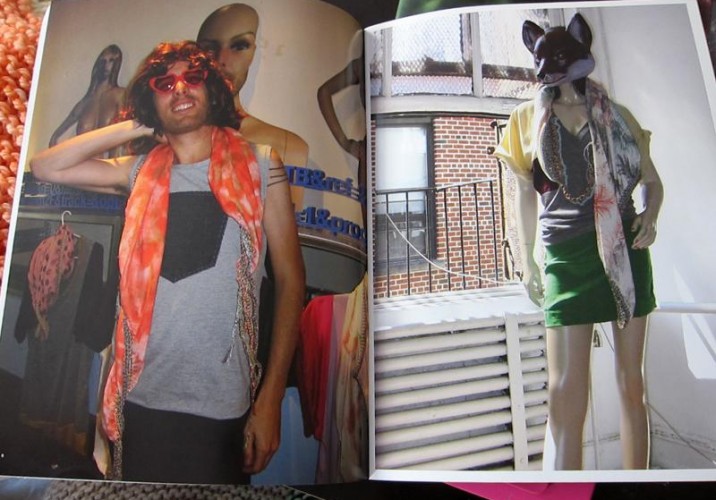
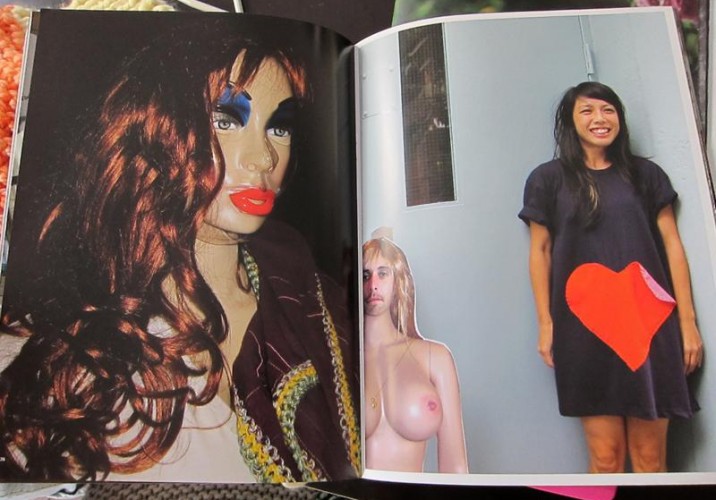
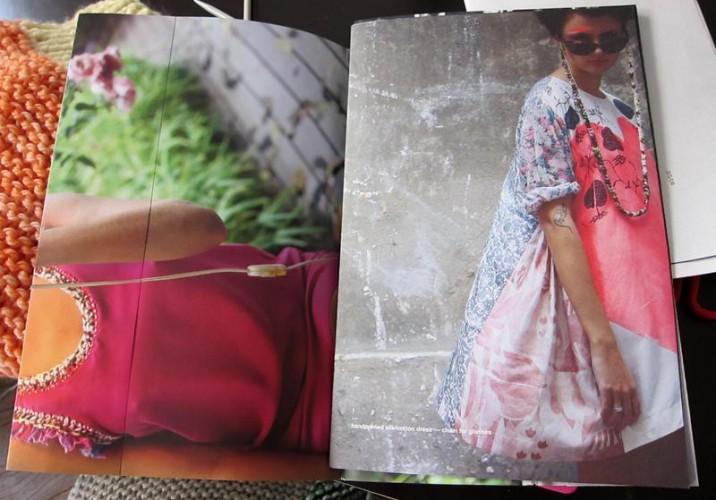
A spread from the Ikou Tschüss Spring/Summer 2009 lookbook, which was art-directed and photographed by Swiss artist Urs Fischer, whom D’Apollonio grew up with and now works for in New York. It included lots of heart prints and the debut of the childrens’ line, Baby Tschüss, inspired by Marini’s having recently given birth.
“It was quite crazy,” says Marini of the project. “Urs photographed his assistant and his housekeeper.”
Their most recent campaign, for Spring/Summer 2010, features the model Trish Goff, who was Marini’s roommate when she lived in New York for a brief spell. But “normally we don’t use models, we use normal people,” she says.
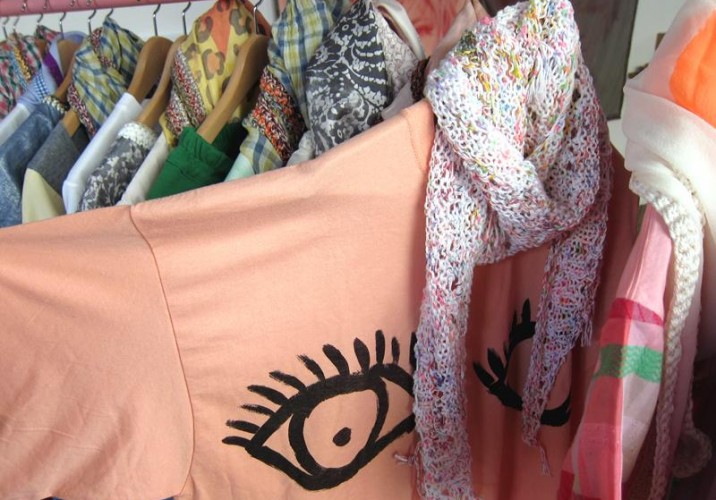
One of the standouts from that collection is this T-shirt, a play on a boy telling a girl she has beautiful eyes. “And then they don’t look in your eyes at all — they look somewhere else,” Marini laughs. “Sometimes we just make things we think are funny.” This particular shirt captured the fancy of one of their grandma knitters, who wanted one for herself. “We’re like, really? She must have been 74.”
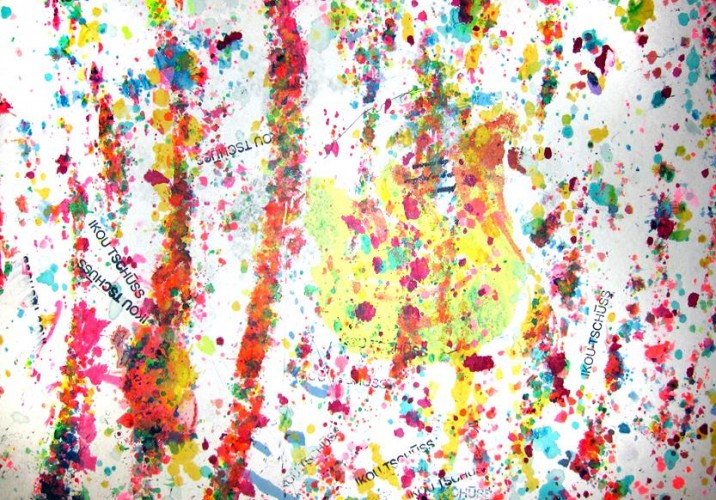
At the end of our studio visit, Marini let us photograph a series of splatter-painted boards over which they hand-dye certain yarns for use in pieces like the color-flecked scarf in the previous frame. Even as the label grows, the process will always be a part of the product for Ikou Tschüss.
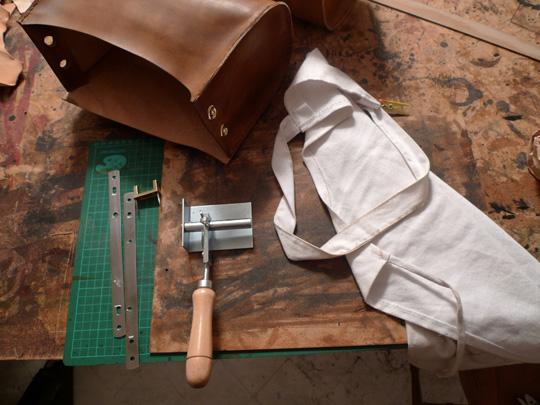
For more than three years, the Argentinean sisters Sol Caramilloni Iriarte and Carolina Lopez Gordillo Iriarte kept a design studio on the second floor of a building in Barcelona, handcrafting an eponymous line of leather bags in relative privacy. Sol, 32, was working part-time as a set designer for films; Carolina, 25, had just finished a year apprenticing under her friend Muñoz Vrandecic, the Spanish couture shoemaker. Called Iriarte Iriarte, it was a modest operation. Then in June, fate intervened.
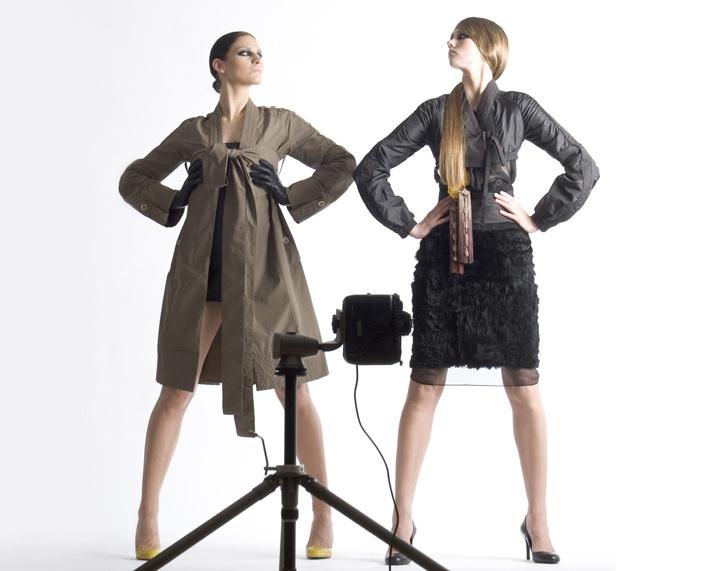
Since graduating from London’s Royal College of Art in 2006 with a master’s degree in womenswear, Eudon Choi has had his graduate collection picked up by the fanatically worshipped Dover Street Market, been a senior designer for Savannah and Sienna Miller's label Twenty8Twelve, and been called a “fabulous individual” by our favorite throwback men’s fashion mag Fantastic Man. All of which makes his decision to move to London in 2003 — after having already completed a master’s in menswear at Yonsei University in his hometown of Seoul — seem like a pretty good move. “London, and womenswear in particular, just felt like a place where I could be more experimental,” says Choi.
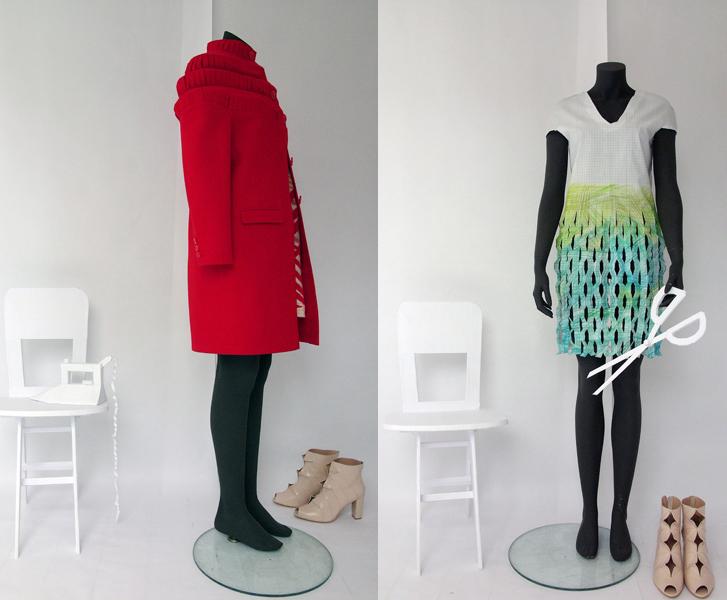
At 22, Alexandra Verschueren has interned for Preen, Proenza Schouler, and Derek Lam. She’s been honored by a jury that included former Rochas creative director Olivier Theyskens and the International Herald Tribune’s fashion critic Suzy Menkes. And in the last six months, her graduate collection Medium has been fêted by Wallpaper magazine and the Mode Museum in her hometown of Antwerp. So why, when she applied to that city’s Royal Academy of Fine Arts straight out of high school, did no one expect she’d get in?