The first time I met Brooklyn artist Jason Rosenberg, I brought him a present. It was nothing fancy. Earlier that day, I’d gone to the doctor and left with a prescription tucked inside a tiny plastic pharmaceutical bag, printed with a picture of a pill and the name of a generic medication. Lest my gift-giving skills be called into question, I should explain that I was headed that night to Kiosk, the New York shop where Rosenberg was hosting a Plastic Bag Happening: The idea was to bring a bag and either exchange it for one of the many Rosenberg has collected over the years, or to have the artist, equipped with his vintage White sewing machine, transform the bag into something totally different — a hat, a pencil case, a coin purse, a wallet. I walked away with two slim sacks from Systembolaget, Sweden’s chain of state-sponsored liquor shops; Rosenberg, when I visited him in his Greenpoint studio last month, was still holding on to the bag I’d brought, though where to find it in his heaps of pseudo-organized boxes, bins, and file folders was another story.
Interactions like this happen all the time with Rosenberg. Trash comes into his life in unexpected ways, providing him with a constant source of joy and inspiration for his work, which in recent years has taken the form of paper collages cut from the ephemera of everyday life and loosely taped into place. Rosenberg graduated from New York’s School of Visual Arts, and for a while his medium was oil paint. “But I was always making collages alongside my paintings, and eventually the immediacy of working with paper and sticking things together — even accidentally sometimes — began to excite me much more,” he says. “There’s so much more room for error. With collage, you just let it happen.”
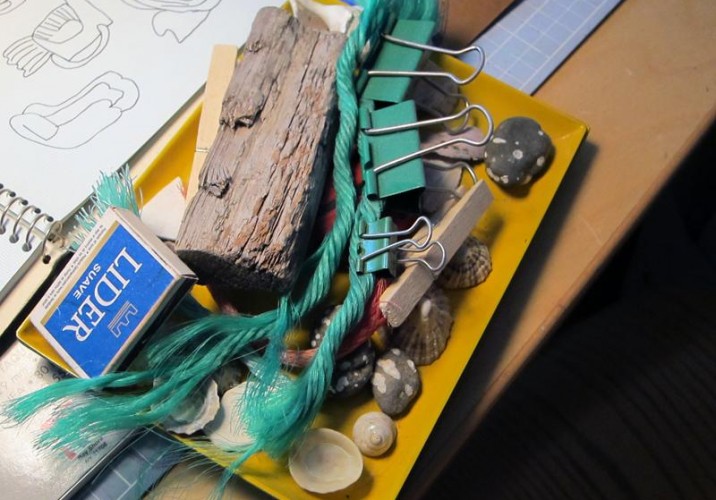
Of course, no collage could happen without an endlessly replenished stockpile of materials, and Rosenberg is a consummate collector of things. Estate sales, flea markets, and eBay are his bread and butter, but even more, Rosenberg has trained his eye to see the beauty in what most of us throw away — ticket stubs, shopping bags, broken rubber bands, pencils, posted envelopes, and bulldog clips are just some of the items I found lying around his studio. “I don’t have to spend much on supplies,” he says. “I’ll spend a good amount of money on something if I really want it, but usually the thing I want is the thing about which people will say ‘Oh, just take it.’ I’m looking for weird shit. Of course it’s always nice to find an Eames chair, but I’m much happier if I find, like, a pile of notebooks from 1975.” On a rainy day in July, Rosenberg invited me to take a look around his studio and its overflowing coffers. This is what I found.
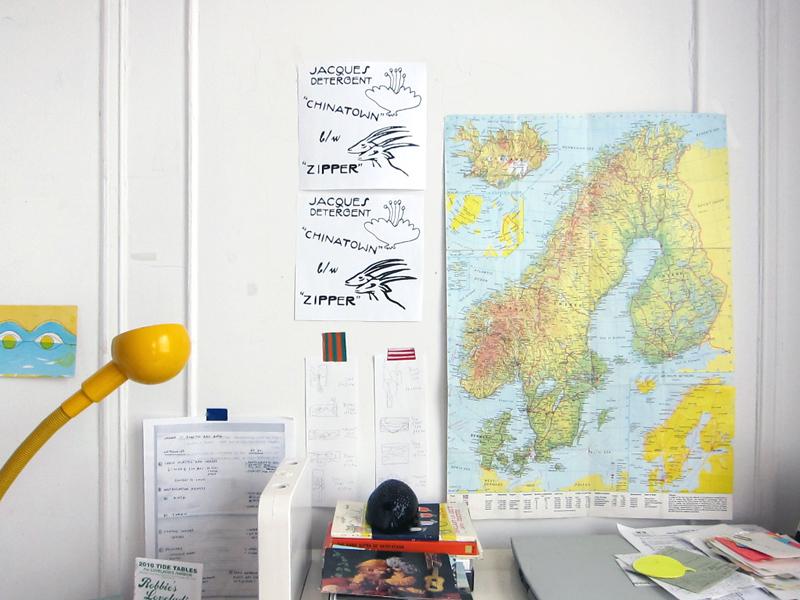
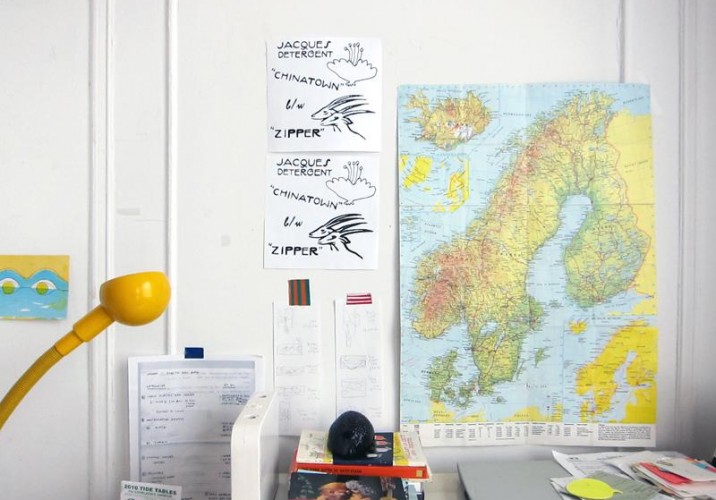
Rosenberg works out of a sun-filled studio at the street-facing end of the railroad apartment he shares with his boyfriend, Gil, who’s a surfer, musician, and assistant to the color theorist Donald Kaufman. Although Rosenberg doesn’t fancy himself a musician, he’s the synth player in their band, Jacques Detergent. (“That’s day-ter-GEANT,” he says with a French flourish.) When I visited, Rosenberg was working on their record cover — an early draft is pinned to the wall — and preparing for a solo exhibition in Oslo this month called “Wallhangings of Today.”
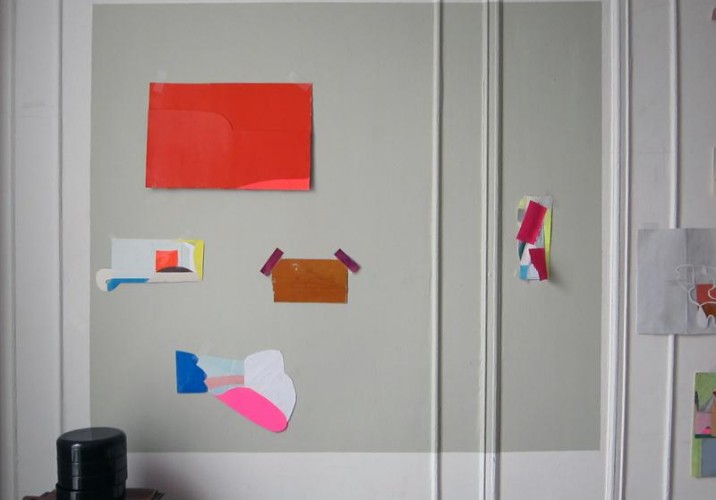
“This is the main work,” he says with a laugh. “They may look unfinished, but they’re not.”
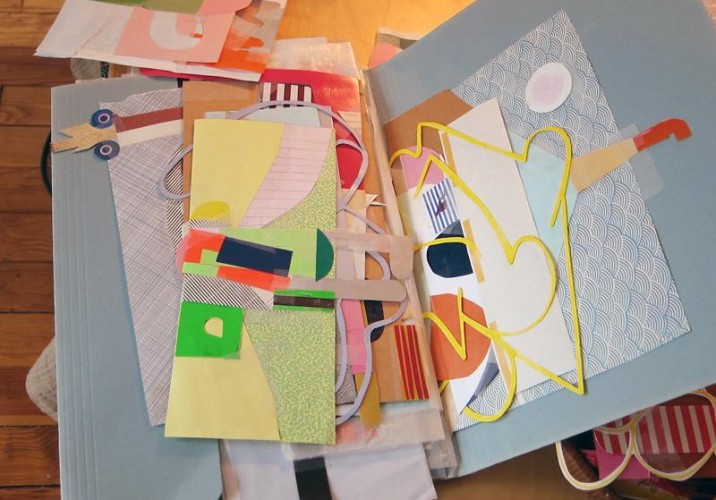
On his desk, Rosenberg keeps folders filled with unfinished pieces and paper he’s dying to use. “Definitely the first thing I do when I’m in a European city is go to the stationery or office-supply store. But most of it is found or from things you wouldn’t necessarily buy for the paper — the inside of envelopes, packaging from a Bendel’s box, a yellowed page of a book. It’s not really the kind of thing you’d buy in a store.”
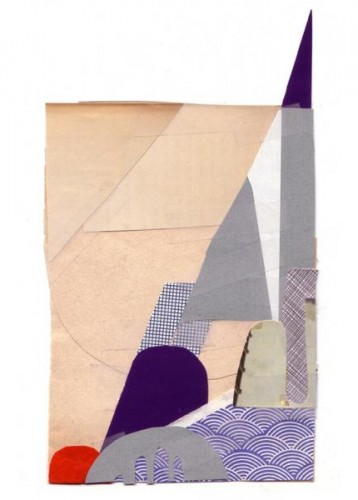
A 2008 piece called “Peak.” “The process for collage is just living with the stuff,” Rosenberg says. “Things come together on their own, which is always nice. You come into the studio one morning and two things are next to each other and they’re perfect. All you have to do is tape it. There’s a lot of adding and subtracting, but usually something tells me when a piece is done.”
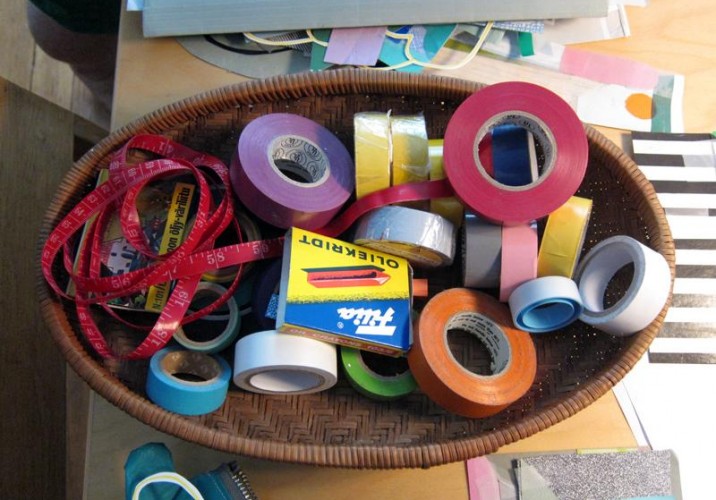
His secondary material is removable tape. “Even the finished pieces are usually held together with it,” he says.
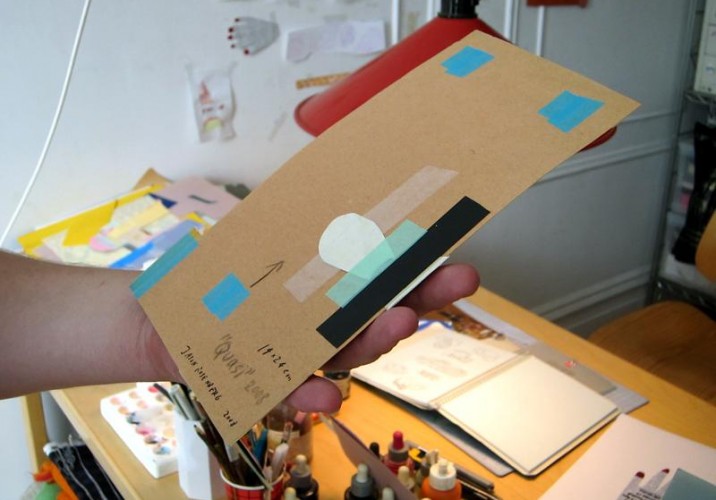
Rosenberg tends to find the backs of pieces, where he dates and signs them, as beautiful as the fronts. Though he concedes: “Most people don’t give a shit.”
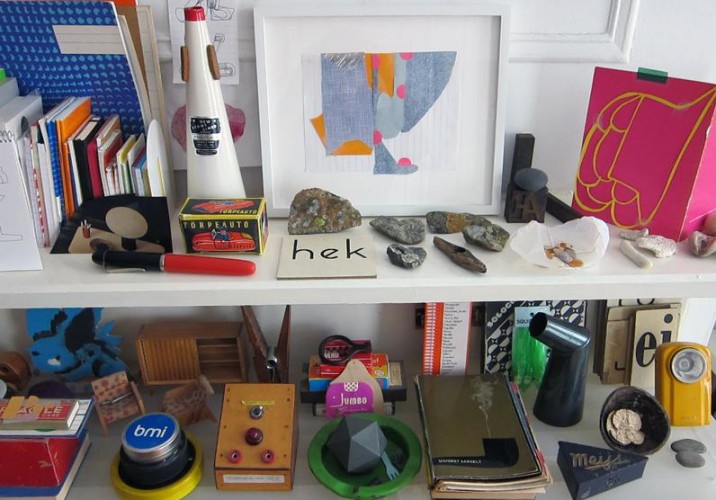
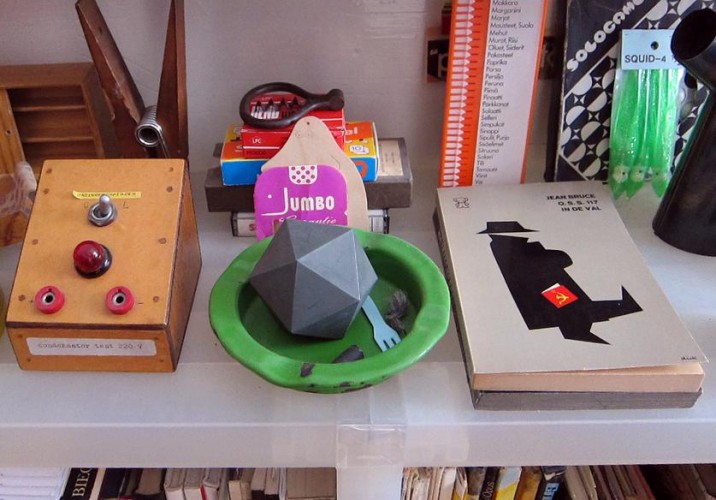
He spends much of his time traveling — on surf trips to Hawaii or Costa Rica with Gil or on nature-inspired jaunts to Iceland and Norway, two of his favorite countries — and from each trip he returns with countless objects. Currently on display are rocks from Iceland, an old battery tester picked up from an Utrecht flea market, a notebook collection that holds his sketches and watercolors (top left), a Finnish grocery list, a French pocket flashlight, a framed collage, and on the bottom right, a stack of book covers by the Dutch artist Dick Bruna.
Bruna, who also often worked with paper cutouts, is one of Rosenberg’s biggest inspirations. “Before he started doing Miffy, his father had a paperback book company and Bruna designed all of the covers. They’re basically detective novels in Dutch, so I eventually started ripping the covers off of the books. I really didn’t need to have a huge shelf of books I can’t read.”
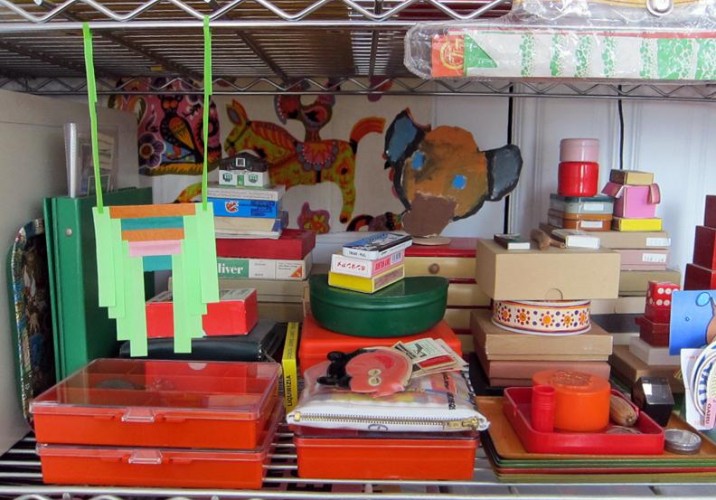
On the shelves behind his desk are small boxes filled with collections. “I’m never quite sure what’s in each one until I open it one day,” says Rosenberg. “One has random photos of cats on a farm, one has broken rubberbands, cat whiskers, pieces of lichen, pinecones, wooden houses, candy wrappers, on and on. It’s a good place to look for inspiration.”
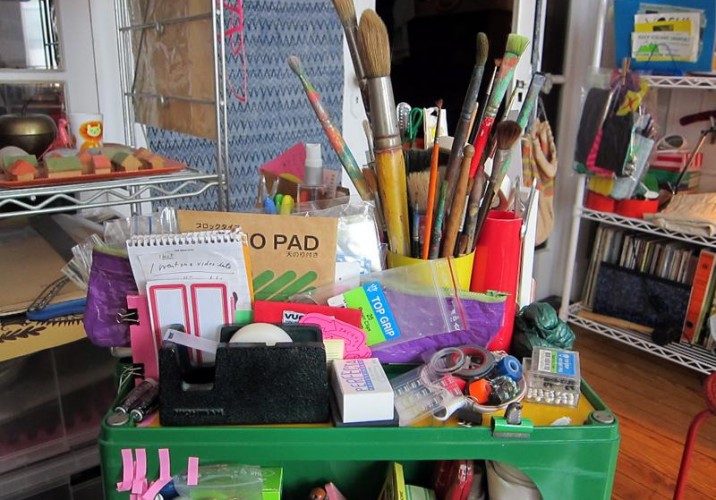
Supplies are kept close at hand. Earlier this spring, Sight Unseen asked Rosenberg to design a mobile for our ICFF exhibition. Rosenberg began hunting for various pencils to hang from chicken wire and suddenly realized he had dozens. “Instant collection!” he says.
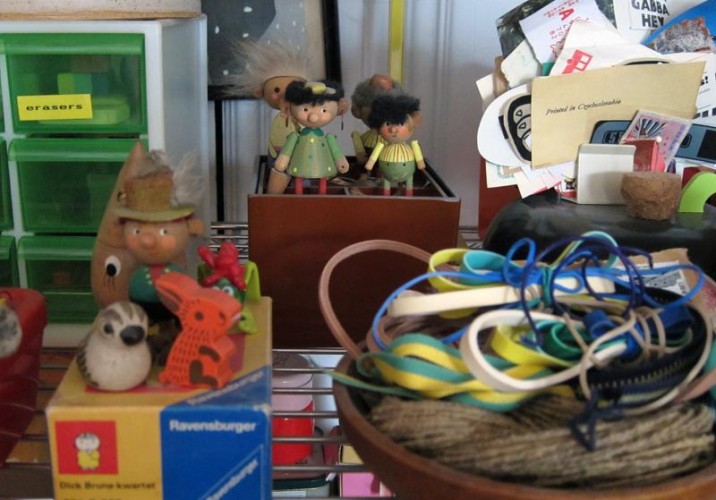
In the back are four of Rosenberg’s Swedish trolls. He also has a Finnish troll collection, but when I visited he’d just sent them to his parents’ house as they were beginning to take over the studio. The difference between Swedish and Finnish trolls? “Finnish trolls are made of natural materials, like reindeer fur and leather and dried mushrooms,” he says. “They’re such a normal part of life in Scandinavia.”
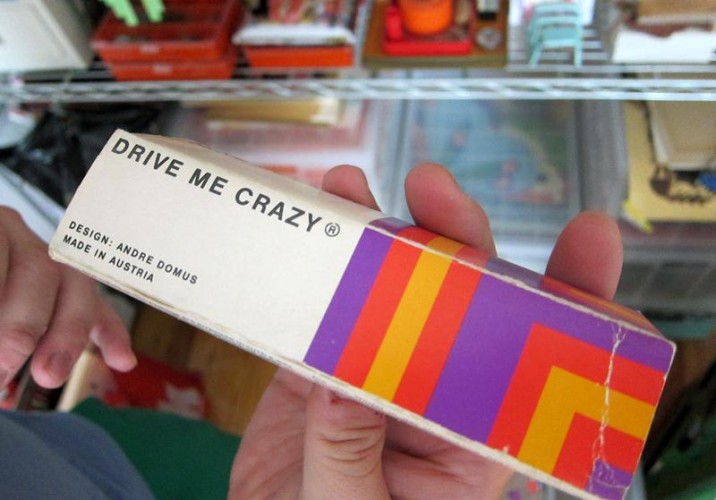
“This is just a weird game. I have no clue what it is, I just think it looks nice,” laughs Rosenberg.
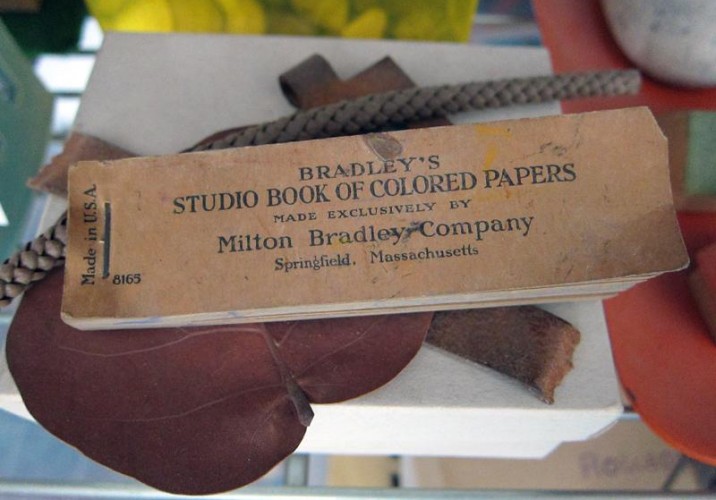
A color-sample book found at a New York flea market, “or maybe in the garbage?” Rosenberg says. “I find a lot of things on the street.”
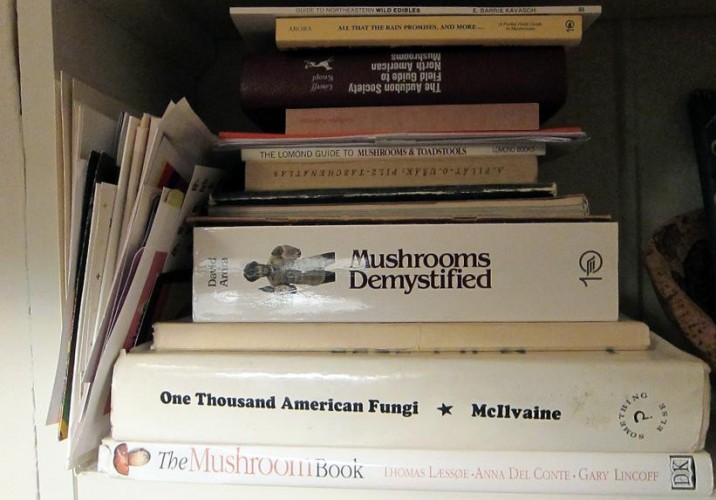
Rosenberg’s works are often geometric in form, but more and more his shapes are influenced by his love of nature. “I love going to European cities,” he says, “but now all I want to do is go into the mountains, or fishing or mushroom hunting. That’s what we do here — every weekend we go into the forest in New York or New Jersey.”
“I’m way into mushroom subculture,” he says. “The New York Mycalogical Society, which was actually founded by John Cage, has walks every weekend.”
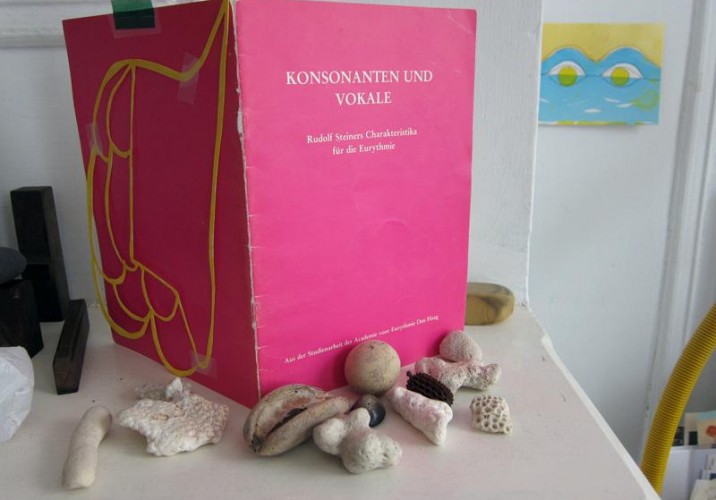
A recent collage Rosenberg made using a Rudolf Steiner book he found on the street in Amsterdam. On its left panel is a recent experiment with paper line drawings. The rocks he picked up on the beach in Oahu in February.
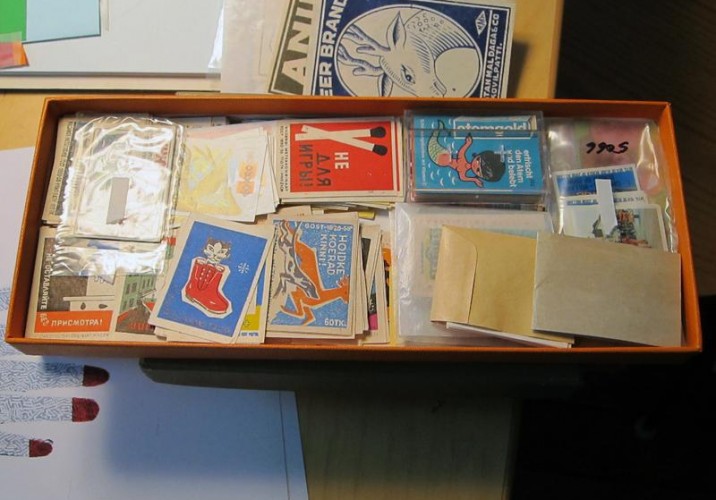
Old matchbook labels from Europe, picked up on eBay.
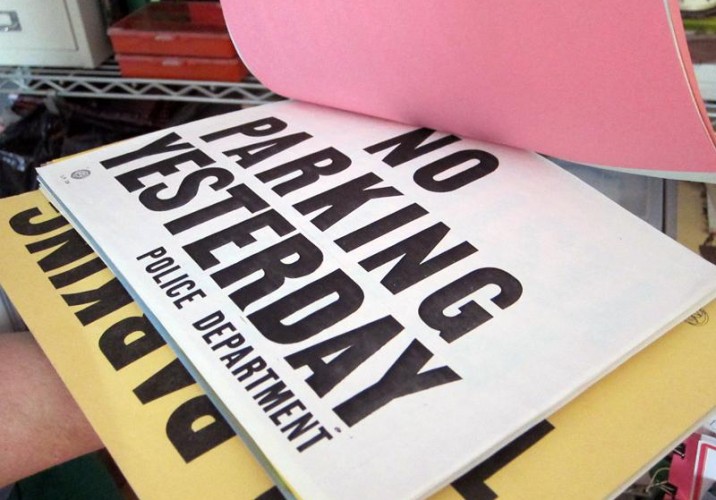
“This is an instant collection I found at an amazing estate sale a few weeks ago, at a brownstone uptown,” Rosenberg says. “They were selling everything in the house, but the kid had been collecting all of these No Parking signs from around New York for years. The amazing thing about this is that he took all of the parking signs for all of the days, scanned them, and then made one that said No Parking Yesterday, which is so brilliant. This was with all of this stuff in the basement. He’d made all of these greeting cards, too. He was really into Xeroxing.”
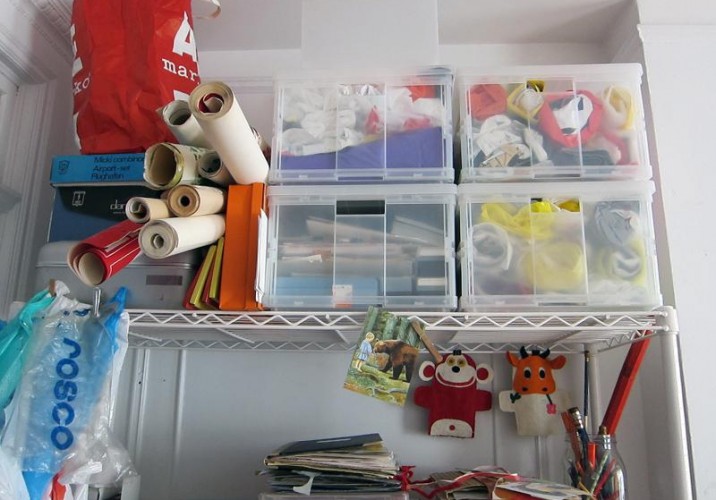
Rosenberg’s plastic-bag collection. “I could take it down but you’d be drowning in plastic bags,” he says. “The Plastic Bag Happenings at Kiosk and in Finland made the collection so much better.”
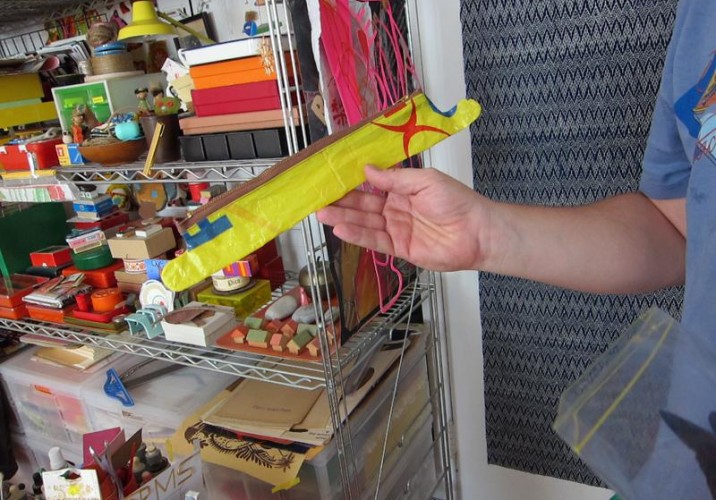
From the bags, Rosenberg has been sewing useful objects to sell at Kiosk. He often makes them submarine-shaped like this one to accommodate items like pencils and knitting needles. “I’m working on quilting the plastic to hold things like cameras.”
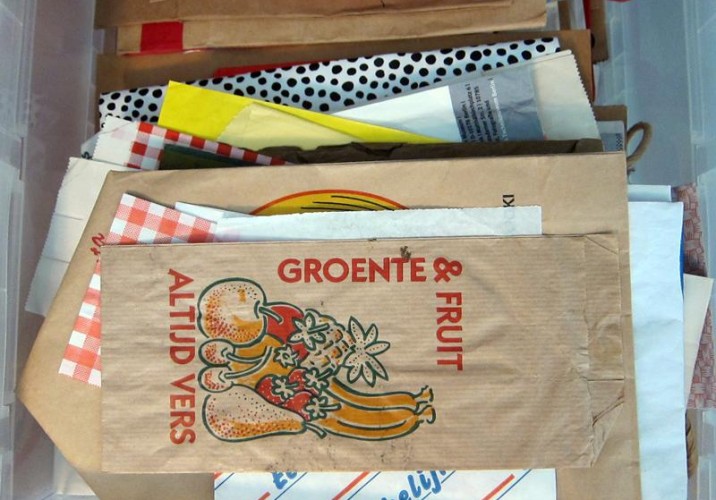
Rosenberg recently began collecting paper bags as well. “The plastic-bag collection includes things people have given me, but this is all me, which is really sad,” he laughs.
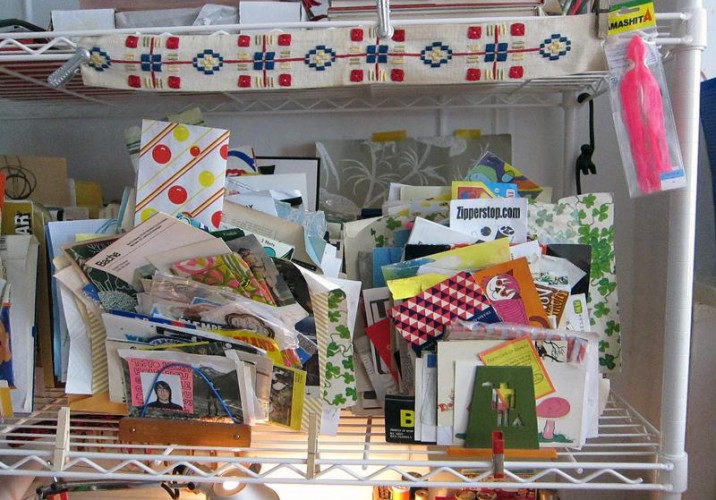
More paper ephemera. “When I travel, I collect every paper thing that could possibly pass through your hands,” Rosenberg says. “They all have beautiful textures to them. I keep them all and they somehow make their way into my work.”
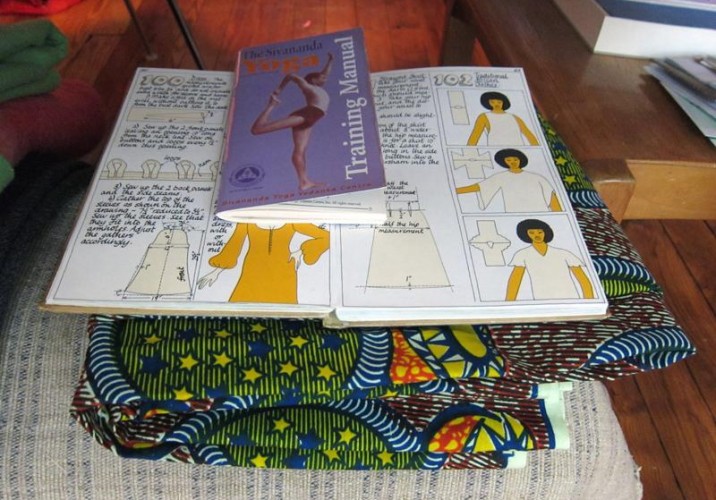
A batik fabric from Senegal underneath a guidebook to sewing traditional African clothes. “Our godson James’s birthday was this past weekend so I made him a dashiki out of this,” Rosenberg says.
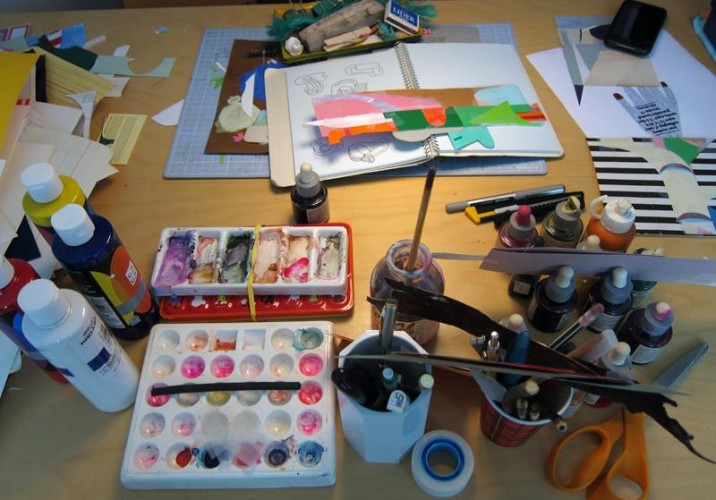
Rosenberg’s desk. At the bottom is a set of watercolors his mother, also an artist, bought for him. “I guess I grew up in a colorful house,” Rosenberg says. “Didn’t everyone?”
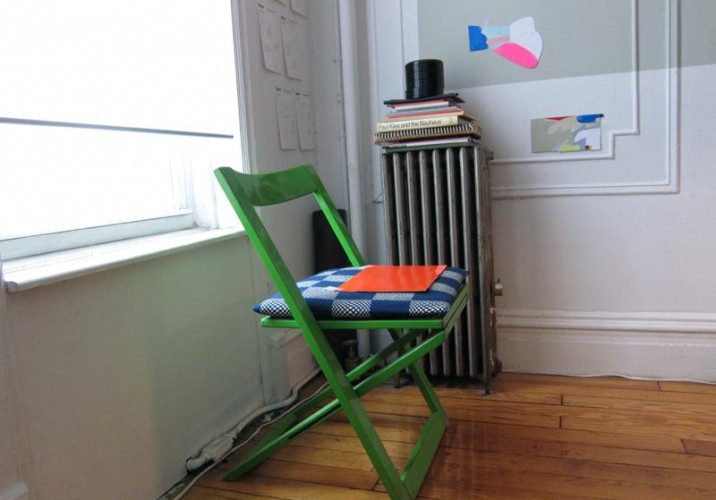
In the corner, a rare moment of calm. Of his often cluttered working space, he says, “I try to tone it down. I’ve tried to make my studio a serene place. I often think, wow, how nice for these artists whose studios have tables that are like empty. But it just doesn’t work for me. I need constant visual stimulation.”
In March of 2008, Jason Polan set off into Manhattan armed only with a white notepad and a black Itoya Fine Point .6 pen. He had one goal: to draw every person in New York. It would seem an insurmountable task if not for Polan’s habit of documenting most anything that crosses his path, tagging each conquest with a thick scrawl detailing its circumstance, such as “Plant outside of a medical center on Orange and Magnolia Streets, April 25, 2010, drawn right after I tripped on the sidewalk,” or “Philly Cheese Steak, Pat’s Steaks, June 4, 2010.” In the service of his blog Every Person in New York, Polan — whose illustrations often appear in The New York Times and Esquire — has over the past two years drawn more than 10,000 of the city's residents.
When he was an art student in the '80s — in Kassel first, and then Berlin — Markus Linnenbrink worked primarily with grays and blacks. “I had no idea what to do with color,” he admits. “And honestly, I was a little afraid of it.” Which is ironic, considering that for more than a decade, the German-born, Brooklyn-based artist has built a body of work that centers around thick streaks of color — painted in stripes on gallery walls, poured in puddles on the floors of art-fair booths and installations, and dripped in lines down the face of his canvases. “Somehow a field trip to Italy where we spent three weeks painting outside got me into the idea of color, but I had a long period where I would mix, like, red and green. I feel like I had to walk through a lot of dirt and mud to get to the brightness.”
When Hamburg-based artist and textile designer Katharina Trudzinski decided to take a second residence in Berlin this spring, she found an inexpensive live-work space on the fringes of the up-and-coming Neuköln neighborhood — the city’s equivalent of Bushwick, Brooklyn — and saved two months’ rent by promising the landlord she’d renovate. But it was imagination, not thrift, that inspired her next move: After stripping the wood paneling from the walls and ceilings and tearing down a few ill-conceived door frames, she began painting the detritus and incorporating it into her sculptural installations and high-relief paintings. Made from constellations of scraps, street finds, and everyday junk cloaked in perfectly calibrated hues, her work — some of which becomes inspiration for the pieces in her clothing line — is meant to dialogue with its surroundings. “It’s not my intent that the materials should be cheap, I just like to use things that are around me,” she says. “I like to start with what I’ve got.”