First-time travelers to Amsterdam — perceptive ones, anyway — need only to spend a day navigating its cobbled streets to notice what makes the experience so singular. The buildings are old and narrow, and many seem perilously cockeyed. With their decorative facades and fanciful gables, they resemble oversized gingerbread houses. And when you walk by them, you witness a sight even more peculiar than all of the above: an unobstructed view straight into the living rooms and kitchens of the people who live inside, who refrain from hanging curtains even at ground level. As a locally based friend explained to me on a recent visit, the Dutch may value privacy just as much as the rest of us, but they also take a certain pride in proving they have nothing to hide. This was the thought running through my mind the day that Renny Ramakers, co-founder and director of the influential Dutch design laboratory Droog, let me wander around inside her home unsupervised, snapping hundreds of voyeuristic photos of her possessions while she worked calmly away at her dining table.
Ramakers probably had better things to do that day than attend to a journalist with an amateur camera who seemed strangely eager to ask questions about her tattered cookbooks and travel souvenirs, busy as she was transferring the contents of Droog’s ill-fated New York store to a glitzy new Las Vegas location and prepping for the launch of a game-changing initiative during the Milan fair. But the open-curtain policy prevailed, and she was not only a gracious host but a jovial one, hobbling up and down the stairs on a recently healed knee injury just to tell me more about the staggering view of the city rooftops she gets to take in from her nightly bath. Being an editor of Sight Unseen, after all, I hardly cared about the interior of the duplex Ramakers and her husband converted from what was once two classrooms of a 1923 school building — I was more interested in what the objects she kept inside it revealed about her life, work, and general perspective. While I didn’t get quite enough time to hear all her stories, the slideshow at right does offer a nice peek at how she lives, and the things she lives with.
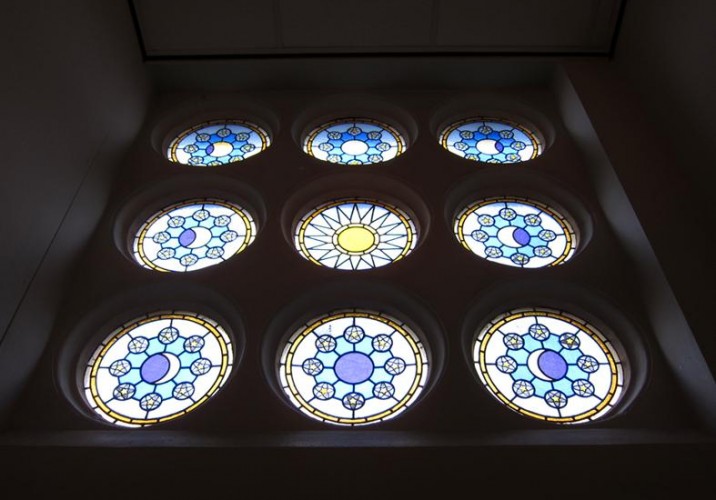
Above the entry door to Ramakers’s building, a former school built in the 1920s, a series of stained-glass windows depict the phases of the moon.
Just inside Ramakers’s own house hangs a photograph by the Spanish artist Dionisio Gonzalez, who creates surreal panoramic photo illustrations by shooting Brazilian favelas and stitching those images together with random slices of modernist architecture.
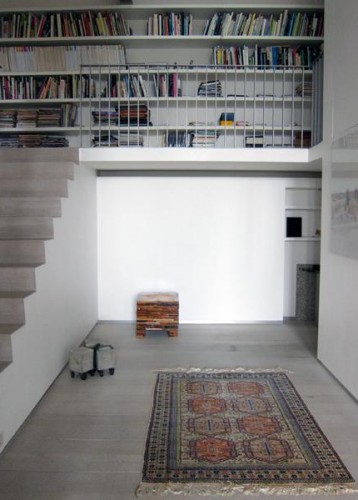
The entryway also features a Stacked Scrapwood stool by Piet Hein Eek…
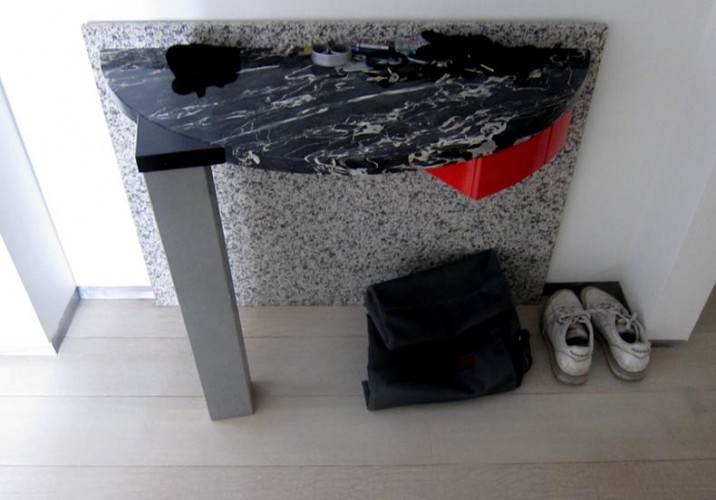
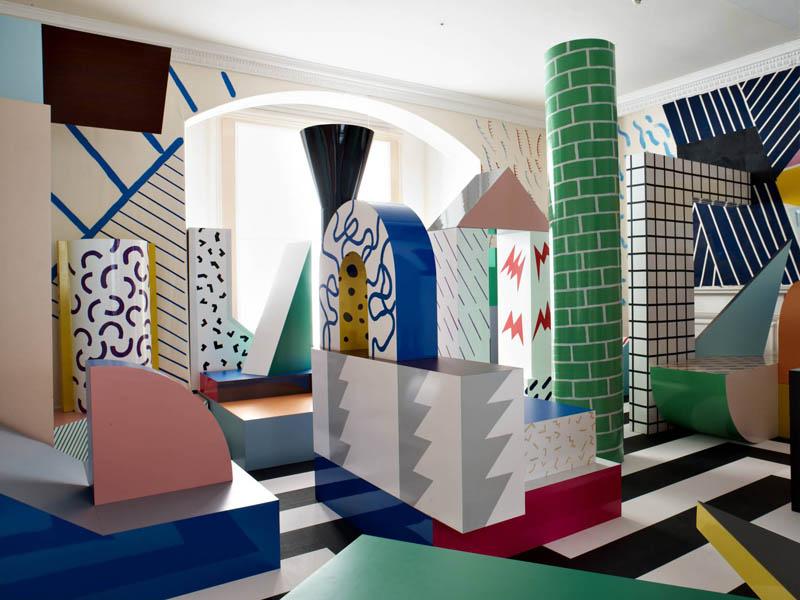
…And a Belvedere hall table designed by Aldo Cibic for Memphis in 1982. “We bought in the ’80s. It was in an exhibition, and they were offering a discount to purchase it. It’s not worth much more than it was then — there have been a lot of Memphis collectors since, but when I look at auctions, it’s about the same.”
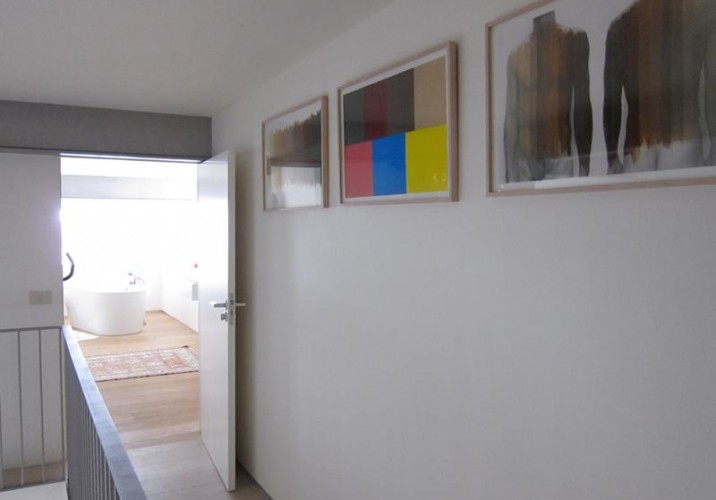
Upstairs is one of the interior’s standouts: A lofted bathroom with half-height walls and strategically placed cutouts that afford bathers panoramic views of the city through the house’s perimeter windows. “I take a bath every night before I go to bed,” Ramakers notes.
The bathroom is also home to her red hula hoop, and other fitness accoutrements.
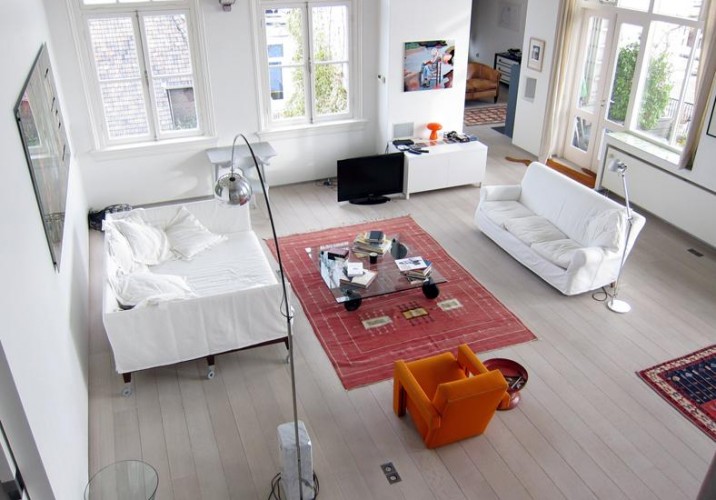
A view from the stairwell of the living room below, with its Arco lamp and giant daybed. “Two months ago I had a knee operation and this was my island,” says Ramakers of the sofa. “I’d sit here with my laptop and books all day long.”
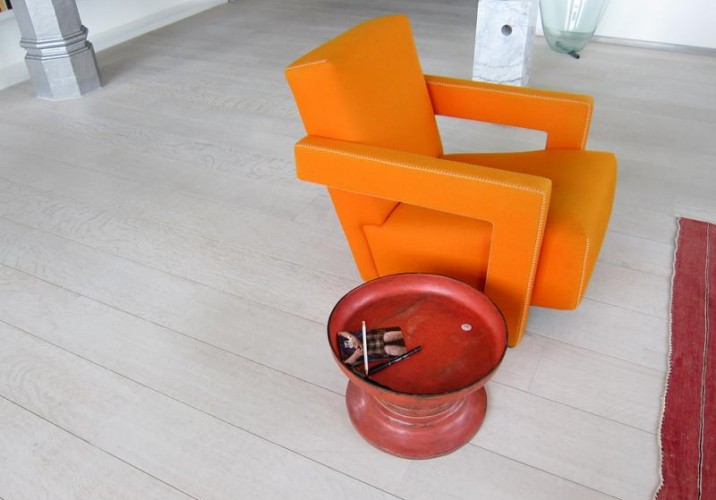
The red table Ramakers bought on a trip to Thailand. “It’s from Burma, where they use it in the temples,” she says. “I buy a lot of things on my travels, like the carpets I bought in Lebanon and Morocco.”
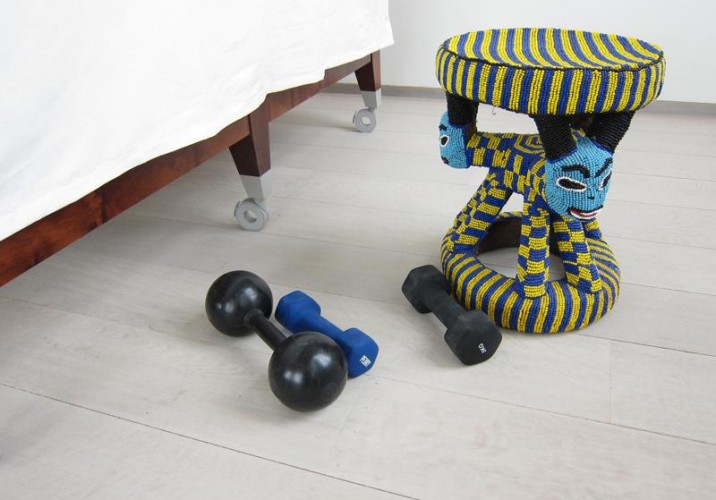
“This table is from Dakar,” Ramakers says. “I found it in a shop completely covered in dust — you could hardly see how beautiful it was. I cleaned and disinfected it.”
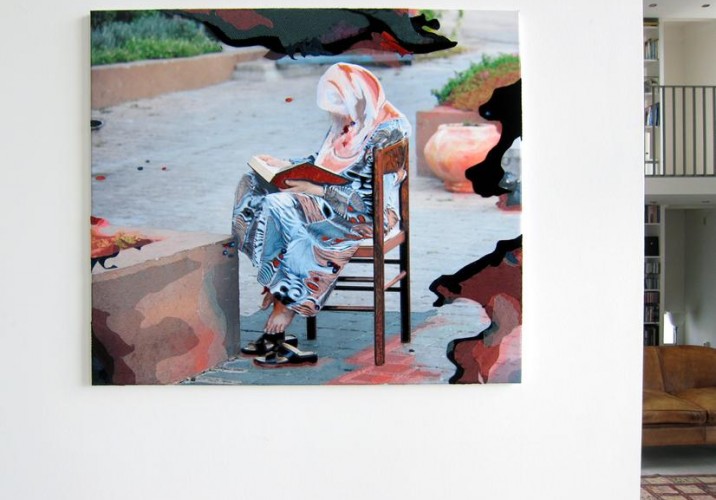
This artwork is by Berend Strik, who embroiders photographs. “We have two pieces of his,” says Ramakers, while adding that “I don’t buy much art. I’m not a collector. If I see something I like, I buy it, but a collector has a big collection in the cellar or the attic or whatever, whereas I only have those things you see here.”
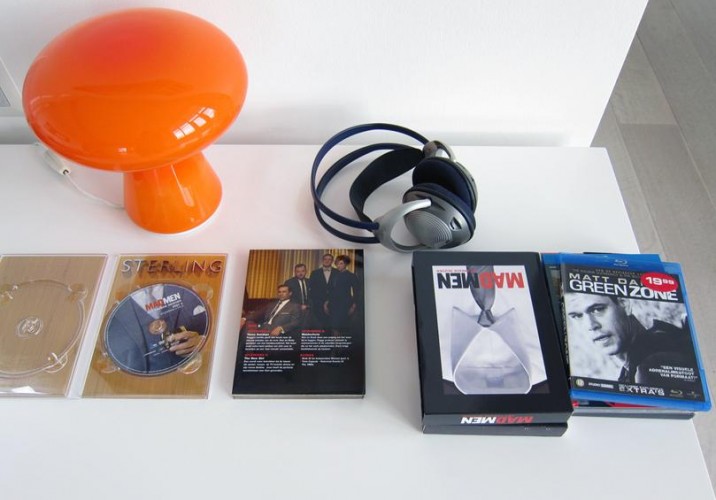
Below the painting, a slightly more prosaic example of Ramakers’s cultural interests: a series of Mad Men DVDs.
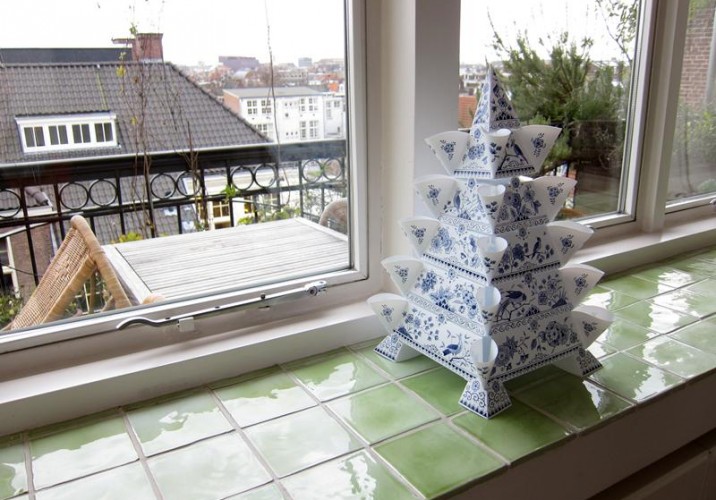
Another example of high-meets-low is this DIY Delft flower pyramid made from paper, variations on which can be found in souvenir shops around Amsterdam.
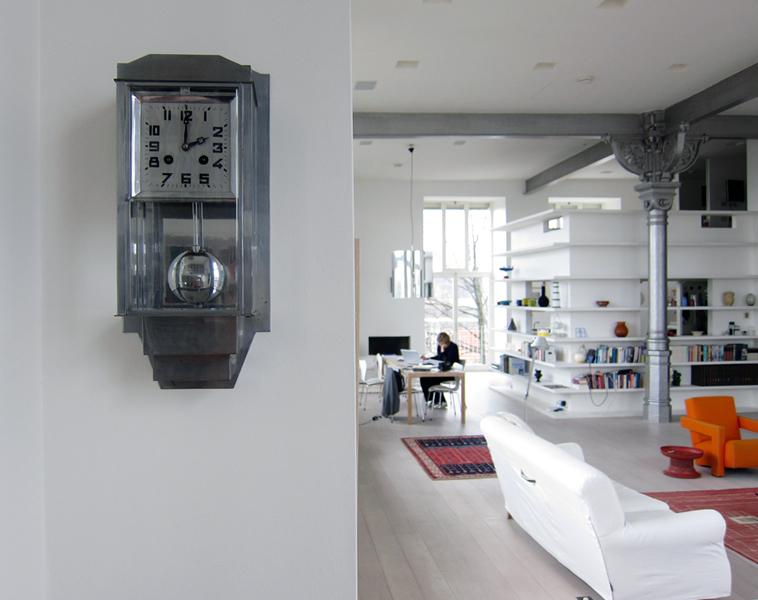
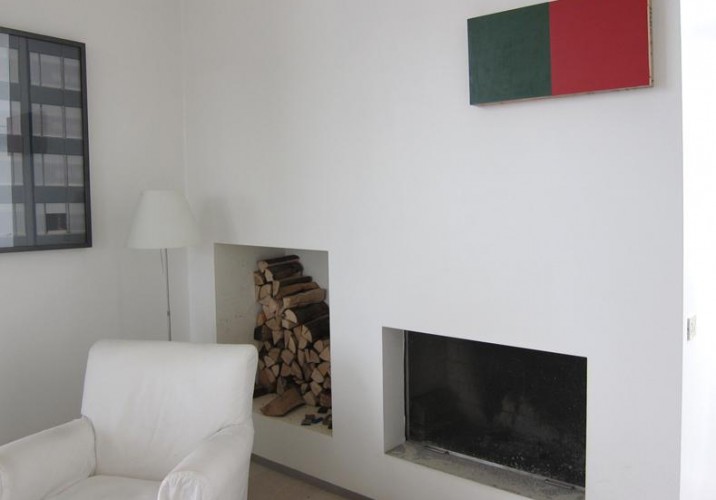
A view of the house — with Ramakers at work at the dining table — from the so-called “winter room.” It has a fireplace and a few of the couple’s dozens of themed bookshelves, including one full of hundreds of travel guides. The clock on the wall is an antique, from the ’20s.
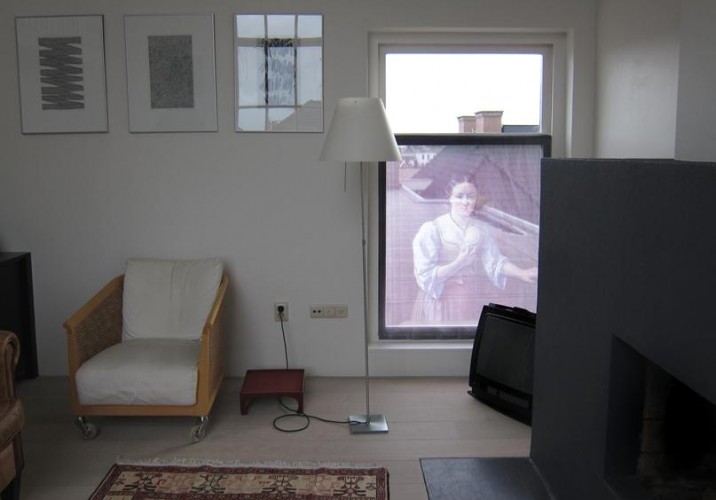
In the same room, a window screen printed with a 17th-century Dutch painting. “They made curtains for the town hall in Utrecht, and this one was a misprint,” Ramakers explains. “A friend of mine who was a curator at the museum gave it to me. I really wanted to have something on the window because I didn’t like the view, and she didn’t even know — it was exactly the same size as my window, too.”
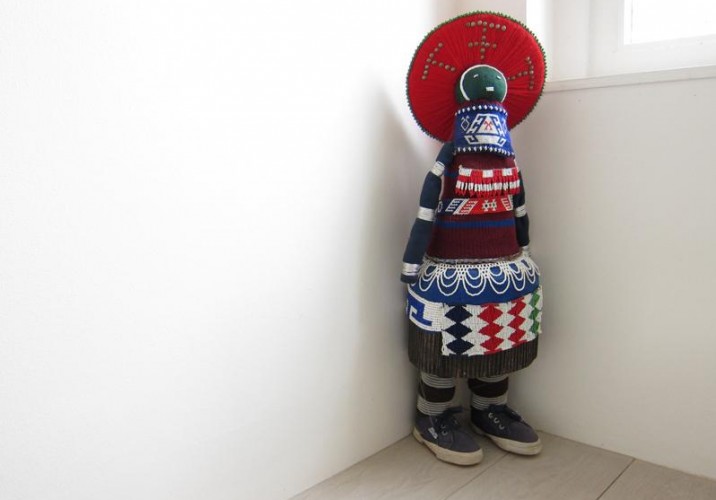
“This is from Africa’s Gold Coast,” says Ramakers. “It’s dressed like the tribe who made it, but then there are the shoes — I like the shoes.”
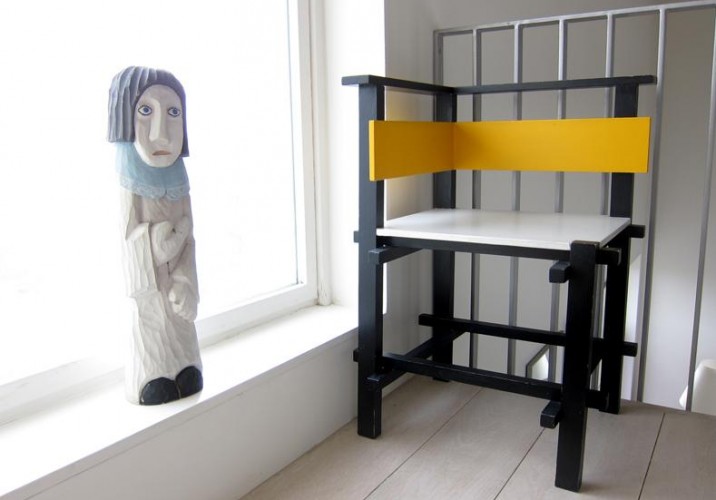
An old statue from Poland, on the left, has lost its rosary, while the chair is a clever homemade copy of a Van Doesberg/De Stijl original. “A friend made it for us,” says Ramakers.
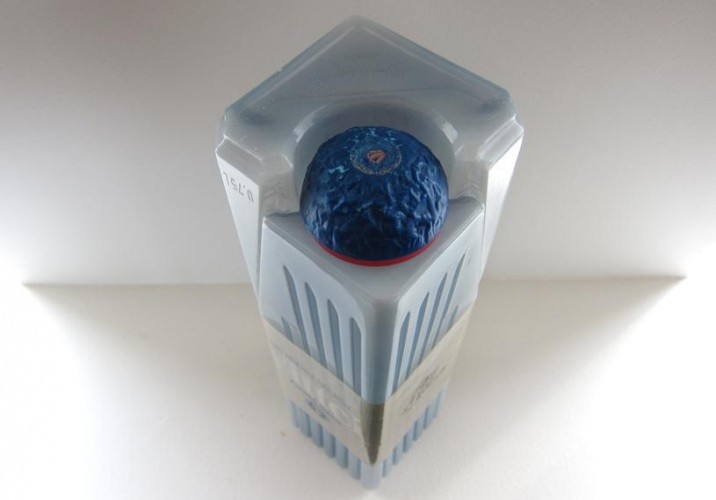
“This is a prototype given to me by Gaetano Pesce,” she says of a plastic Vittel bottle perched on a windowsill. “It was full of water, but now it’s empty. It’s getting old.”
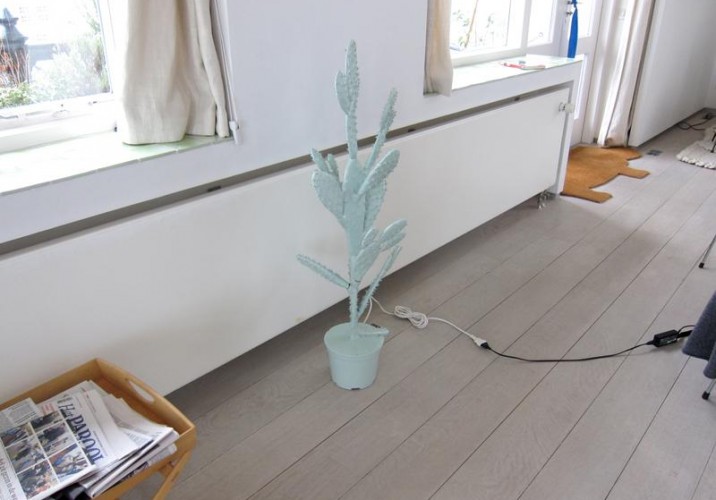
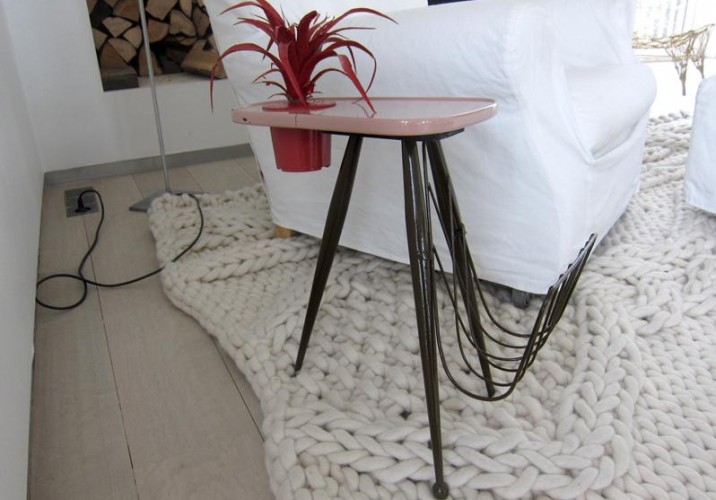
A cactus lamp by the Amsterdam-based artist Franck Bragigand, who collects disused, discarded objects — “the rubbish of society, as he calls it,” says Ramakers — and paints them in order to restore their worth.
The artist collaborated with Maarten Baas for Droog in 2006, on a special edition version of Baas’s Hey Chair Be a Bookshelf. This reworked ’50s side table is also by Bragigand, sitting atop a knitted wool carpet by Christien Meindertsma.
Both are situated in Ramakers’s modernist mini–sitting area adjacent to the dining table and kitchen, where she can retire to read after dinner, next to the fireplace.
Just outside the kitchen, a shelf full of cookbooks. “I love cooking,” Ramakers says, before pointing out the small striped volume in the middle. “After high school, my parents sent me to a special school for one year where you learn cooking and taking care of children, because they saw that I was useless in those respects. This is a textbook I used. I still remember a lot of the tricks I learned there.”
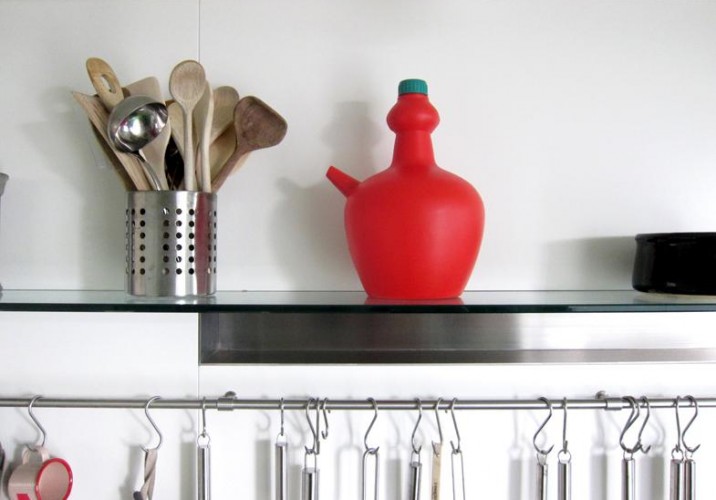
The red plastic jug on the top shelf is an anonymous everyday object from Indonesia. “It’s for water, and it was a present,” says Ramakers. “I never use it, but I like this mysterious side of an object, where you can’t tell whether it’s art or not.”
“This is my mother in law’s,” she says of this set of pewter jugs. “It’s old. She used to have a shop, and this was for measurements — she keeps everything. I use this a lot.”
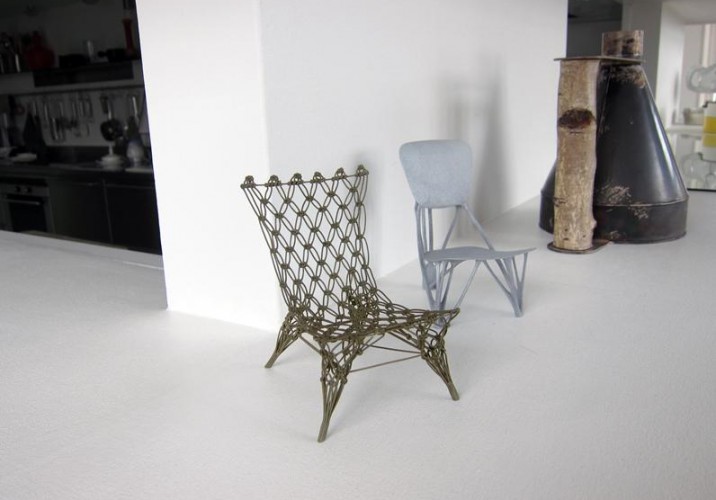
On a shelf outside the kitchen, Ramakers keeps collectibles like these — a miniature Bone chair by Joris Laarman, and a Knotted chair by Marcel Wanders, with a jug by Andrea Branzi in the background. They were all gifts: “I don’t buy many things,” Ramakers admits. Opposite this shelf is a full-size Knotted chair.
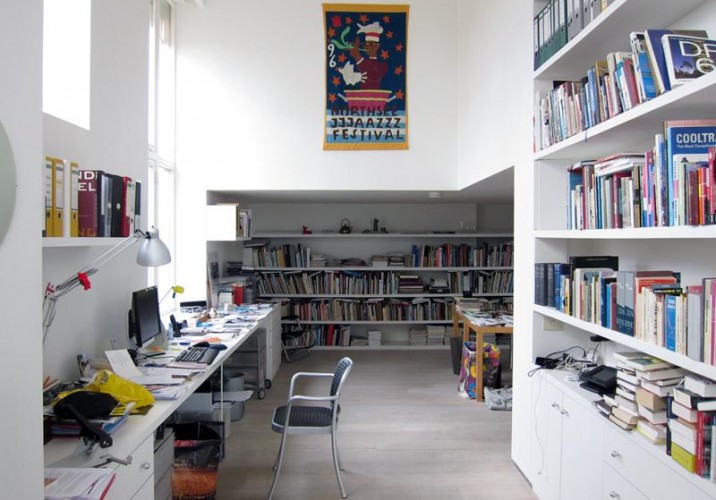
Adjacent to the kitchen is the home office, where both Ramakers and her husband keep desks. They often work here together in the evenings. Mr. Ramakers was the former director of Mojo Concerts, the Dutch events agency, and apparently an erstwhile designer as well.
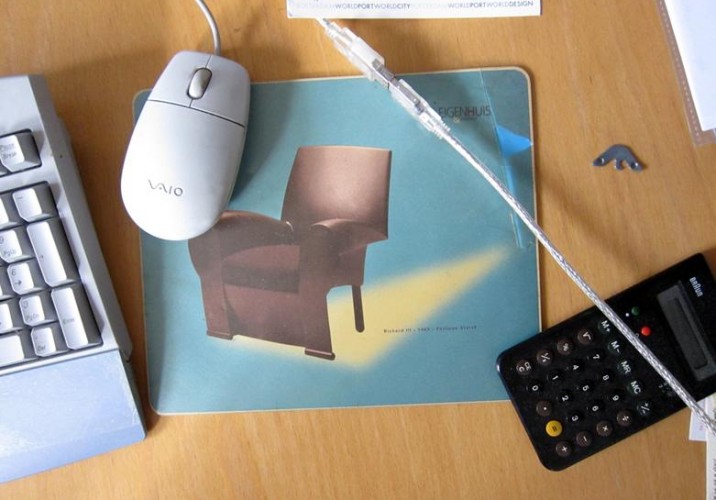
On Ramakers’s own desk is this mousepad, featuring Philippe Starck’s 1985 Richard III armchair, with another design classic at right: Dieter Rams’s iconic Braun calculator.
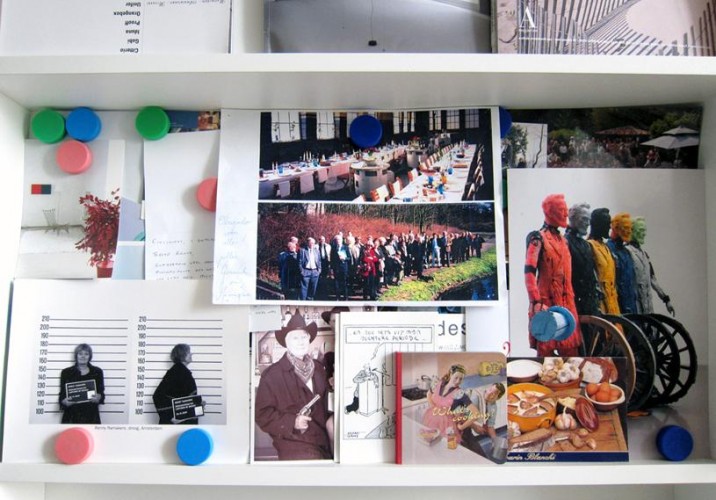
A small inspiration wall behind her desk is pinned with photos and other ephemera. On the lower left is a fake mugshot of Ramakers from an event in 2009.
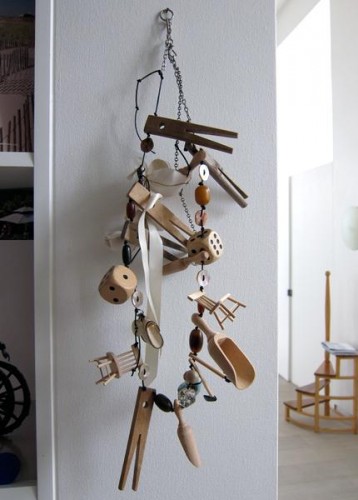
“This is by a friend, a Japanese artist living in Amsterdam,” says Ramakers. “I don’t wear it; I like it hung here.”
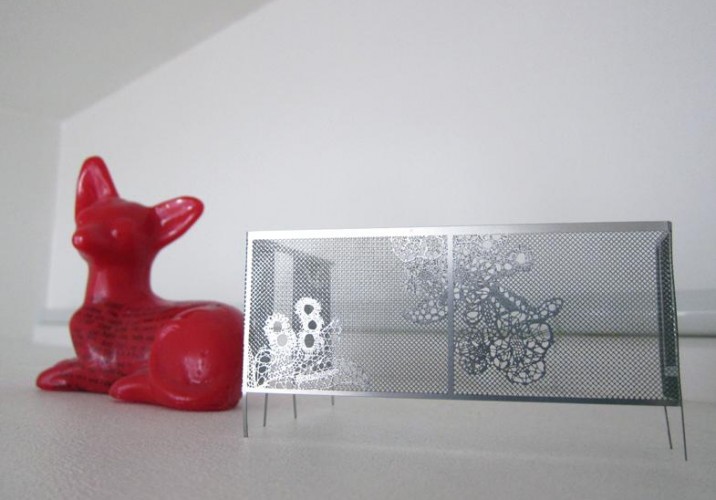
On the right, a miniature of Demakersvan’s Lace Fence. On the left, a Porcelain Dog from Front’s Story of Things exhibition. “We had an exhibition with Front years ago, and they slept at my place, and gave me this. They ask people what they love in their home, and then they tell the story on the object.”
At Fair Folks & a Goat, a new retail gallery and tea salon hybrid on New York’s Upper East Side, everything inside the gracious late 19th-century studio apartment is for sale. Well, almost everything — a small candy dish that reads “When I count my blessings, I count you twice” was a gift from co-owner Anthony Mazzei’s mother and “it’s a million dollars,” he jokes, while the vintage paperbacks lining a wall of shelves constitute an actual lending library. Here, the props and merch blend into a seamless backdrop for a new kind of social gathering. “We wanted to create a space for young people to have a home away from home, where instead of alcohol and loud music it would be more like a physical incarnation of a magazine, with design, art, fashion, and culture,” says Mazzei.
The story of Stefan Scholten and Carole Baijings began, like many Dutch stories do, in a church. In the late ’90s, Baijings was working for an agency whose headquarters were located inside one of the country’s many abandoned houses of worship. Scholten, a graduate of the Design Academy Eindhoven, had a burgeoning design practice nearby. Scholten was asked to design a small bar for the agency’s office, and “the rest is history,” says Baijings.
Faye Toogood, the London-based interiors stylist and creative consultant, has designed exhibition stands for Tom Dixon, windows for Liberty, displays for Dover Street Market, and sets for Wallpaper. But in all of her career, she’s had only one job interview. At the tender age of 21, having just graduated from Bristol University with degrees in fine art and art history, Toogood was called for an interview with Min Hogg, legendary founding editor of the British design bible The World of Interiors. “I had found out about a stylist job and decided I would go for it, even though I didn’t even know what that meant,” says Toogood. “I went in and it was the strangest thing. She asked me, ‘Can you sew, and can you tie a bow?’ I actually couldn’t sew, so I lied and when I got the job, I had someone do it for me.”