In search of inspiration, the Chicago-born designer Stephen Burks has often traveled to places like Peru, South Africa, Haiti, India, Australia, and Kenya. But the idea for his latest project began a bit closer to home: “Three or four years ago, I met this basket salesman at a street fair in New York,” remembers Burks. “His name was Serigne Diouck, and I told him I was interested in his technique.” The two became friends instantly, and Burks soon learned that the baskets were constructed from spiraled sweet grass, stitched together with colorful strands of recycled plastic and made in Diouck’s birthplace of Thies, a tiny village outside of Dakar. Their collaboration, though, was longer in coming. “Since 2006, I’ve been shooting this documentary of my work in the developing world,” says Burks. “Finally in 2009, the Sundance Channel came forward and wanted to produce a pilot. We did a four-day shoot in Senegal with Serigne where I did a bunch of experiments around these traditional baskets.”
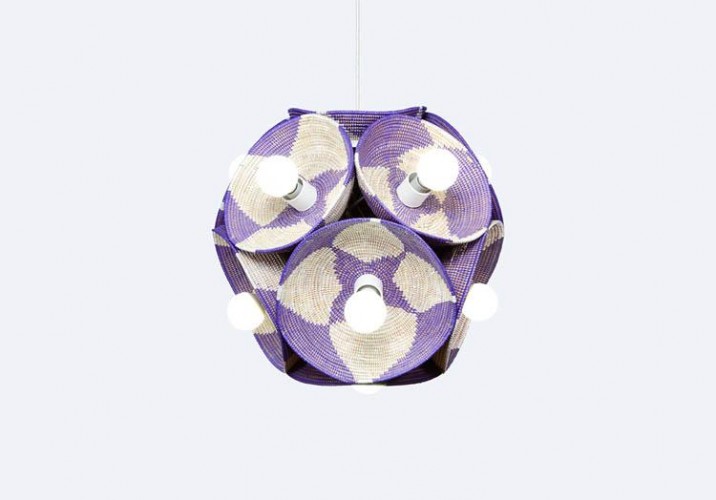
One of the products to come out of the shoot was the Starburst lamp, a cluster of Diouck’s baskets turned into readymades and strung together with bulbs until they resembled some sort of third-world Castiglioni lamp. On a studio visit last fall, Thelma Golden and Naomi Beckwith — the curators of New York’s Studio Museum in Harlem — spied the Starburst and commissioned Burks on the spot to create the museum’s first-ever industrial design exhibit around the theme of those hybrid experiments. The resulting show, called Stephen Burks: Man Made, opened this spring at the museum.
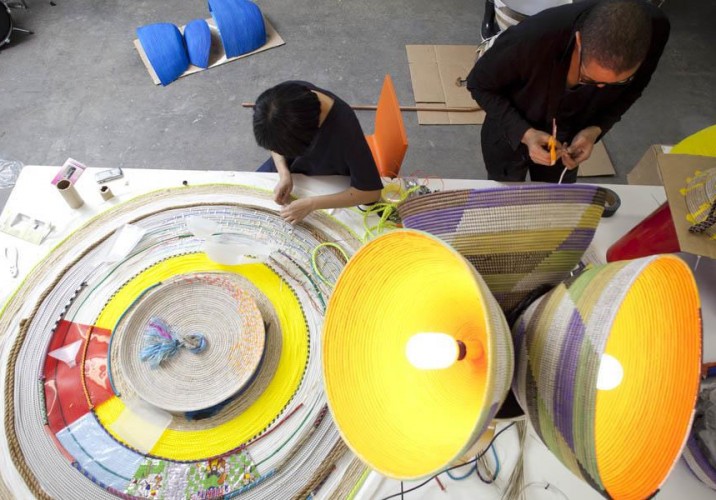
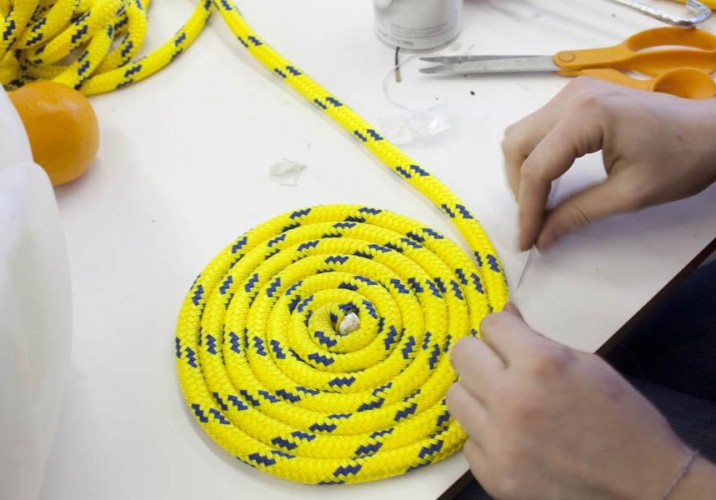
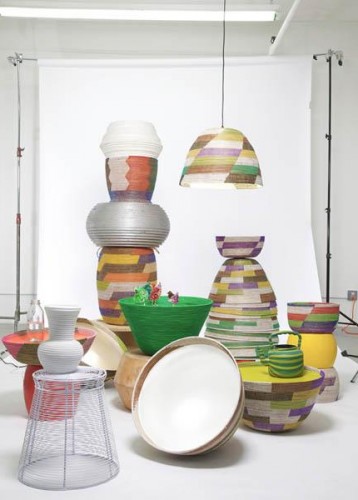
The objects on view were created in two parts: The baskets were designed and woven when Burks visited Diouck’s village again in December of last year, and they were then transported back to Brooklyn to be completely reinterpreted by Burks and his studio. “There are what we call the baskets reinvented, which is where I’ve taken a basket and put a mirror or a light into it,” Burks explains. “Then there are the baskets reinterpreted, where we used the same spiraling sewing technique to make something completely new — like a beanbag chair made from a spiral of technical climbing rope. Finally, there are the baskets abstracted: For those, we used the basket as a mold and formed materials inside those shapes. The point of the exhibition is to illustrate the fact that people working artisanally in the developing world are capable of making contemporary design products. They don’t have to be relegated to their traditional crafts. They can move beyond that into a universe of products with a broader contemporary appeal — that’s what the show is really about.”
Burks documented the making of the exhibition, both in Senegal and back in Williamsburg, and he recently shared the photos with Sight Unseen. Click through the slideshow at right for a closer look at Burks’s process and what went into his first-ever solo museum show in New York.
The Starburst lamp Burks originally created using Diouck’s Afromarket Place baskets. Burks’s interest in working with traditional craftspeople dates all the way back to 2005, when he began consulting for Aid to Artisans. His work with the organization eventually led to the creation, with metalworkers in Cape Town, of his wound-wire TaTu stools for Artecnica. “A lot of organizations are involved in trying to sustain craft traditions as a means of economic development in these countries,” says Burks. “But my interest is to tie it into contemporary design. It’s not just about stylistically sampling what we see in other countries, although I welcome that. It’s also about engaging actively with these people and feeding it back in a way so that real micro-economic development can occur.”
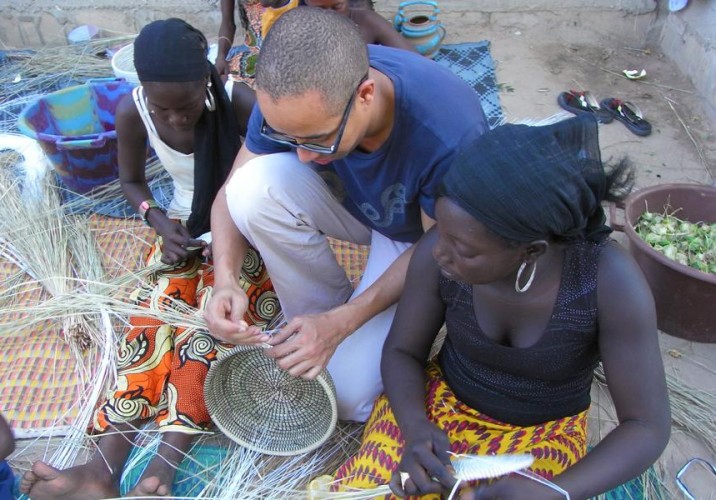
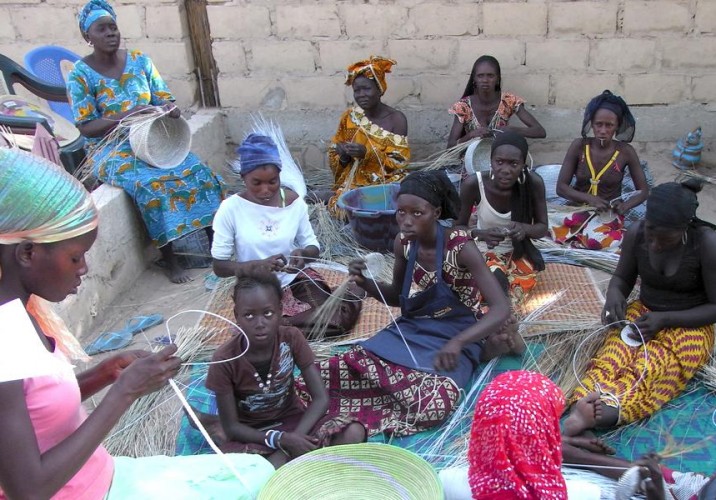
“Believe it or not, I arrived in Thies with drawings and tried to get certain things adhered to in terms of form and pattern and color, which we struggled with. It’s not easy to communicate professional techniques to people who don’t have an education in design. But there is an immense amount of knowledge they have in terms of how they weave the color and the pattern and the form simultaneously. They’ve been doing this without drawings forever! So some things we developed here and taught them, and some things we developed there.”
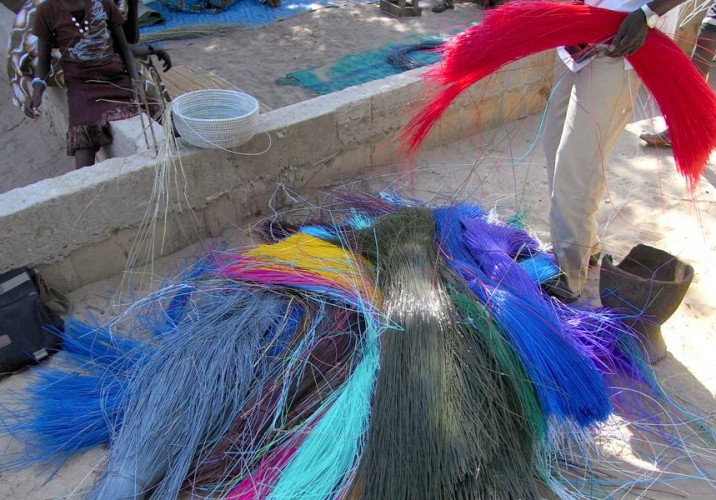
Reams of recycled plastic, used to weave the basket fibers together. Burks brought some materials, like fabric and rope, to the village for experimenting, but for the most part, he tried to let the women work as they were used to. “In general with these sorts of projects, I like to say that we use the hand where the hand is most useful, and we use the machine where the machine is most useful. There are certain materials that are toxic that we didn’t want to introduce to their village and there are certain expenses in transporting those materials back and forth that we didn’t want to incur. That’s in part why the project was done both there and at home.”
In Thies, the weaving is done mostly by women. “In the village, there are a number of compounds arranged by family,” says Burks. “My compound was made up of all family members of Serigne. When I was there, it was more like a classroom where I was with my video camera at the front with them facing me, but I don’t know if they usually work that way. Some women were working in sweet grass, and others were experimenting with the fabric and rope and materials I brought.”
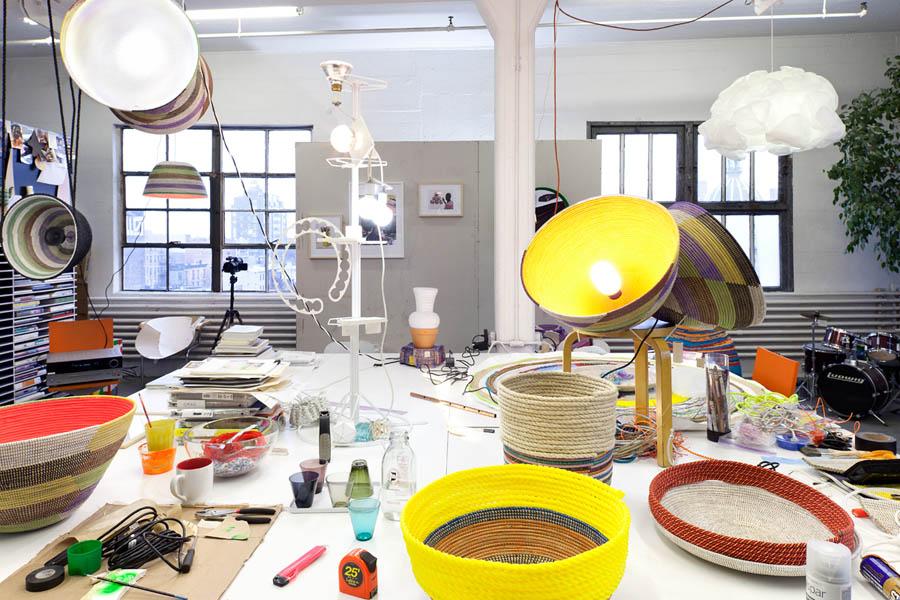
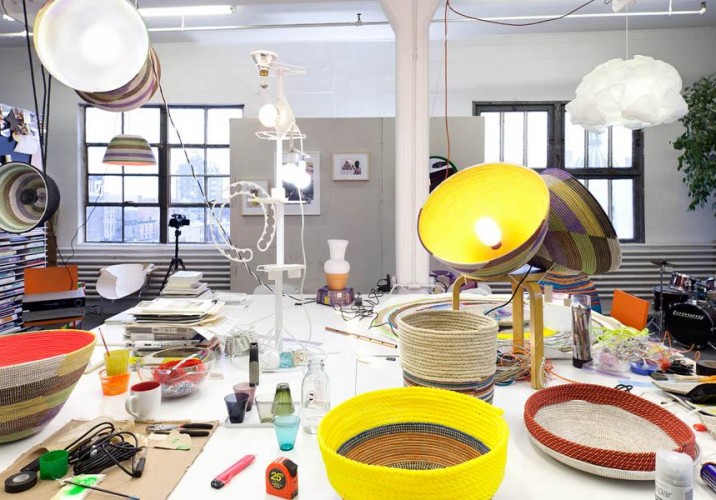
Back home, Burks began experimenting with different assemblages. On the left, one of Burks’s assistants sews Material Palette, which gathered together all of the material samples used in the exhibition: manila rope, bungee cord, climbing rope, recycled plastic, paint, etc. “Because the exhibition is the Studio Museum’s first design show, we wanted to educate people about what it is that designers do and what our process is,” explains Burks. On the right is Burks’s triple basket lamp affixed to a vintage Alvar Aalto stool. “For me, part of the project in terms of the more sculptural pieces was to make a statement about the design/art world as well. I liked the idea of the basket taking a position of superiority over these design collectibles,” says Burks. Half-hidden on the right is another assemblage, which plopped a glass bowl and basket atop a Sori Yanagi Elephant stool.
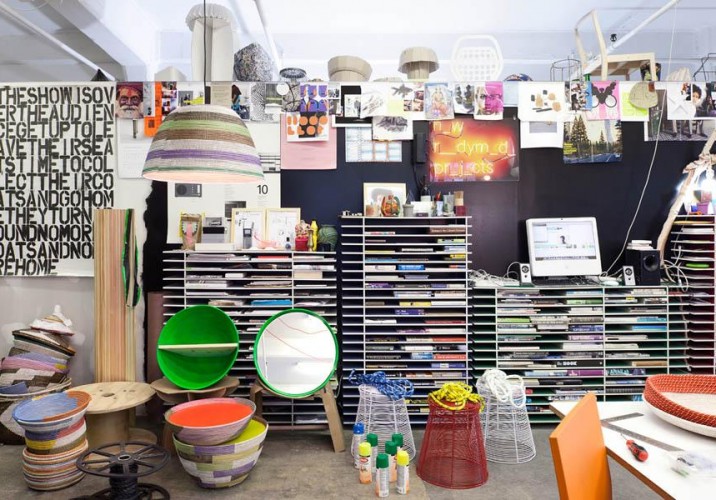
A better view of the Aalto piece and an assortment of the baskets that served as raw material for the exhibition. Hanging in the right corner is one of Burks’s basket abstracted objects: a pendant lamp made from the recycled HDPE of milk jugs and water bottles that Burks found in the streets of Brooklyn and cleaned for reuse.
The studio used the Senegalese spiraling technique to create seat pads out of climbing rope for Burks’s TaTu stools, which also made it into the exhibition.
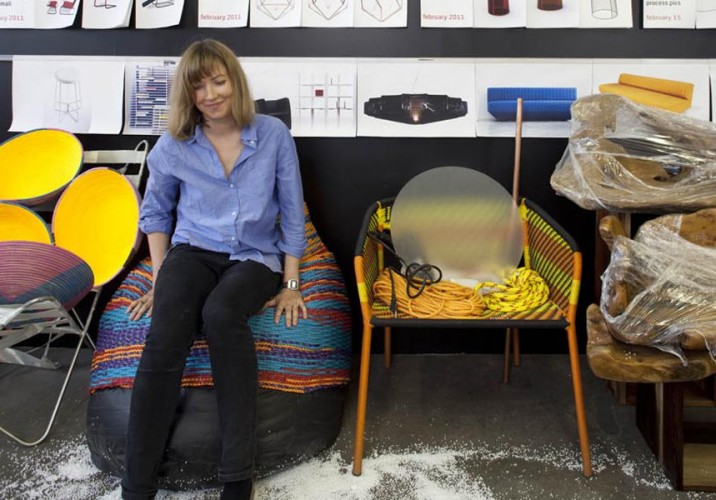
In front of the studio’s current projects wall, Burks’s assistant Anna sits atop the beanbag-like Rope chair from the exhibition. To her right, a diffuser from one of the exhibition’s lamps sits in a chair from Burks’s 2009 M’Afrique installation at the Moroso showroom in Milan. For the installation, Burks also traveled to Dakar, where he devised these chairs of hand-woven polyethylene cord pulled over a galvanized, powder-coated steel frame.
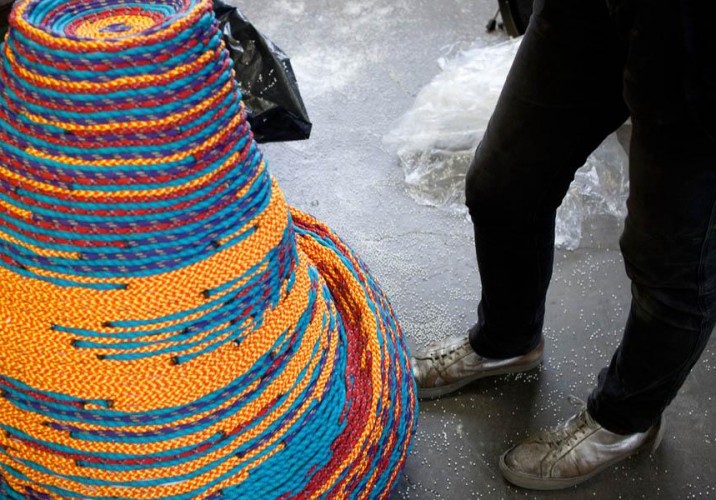
A closer look at the Rope chair, and Burks in his signature metallic Common Projects sneakers.
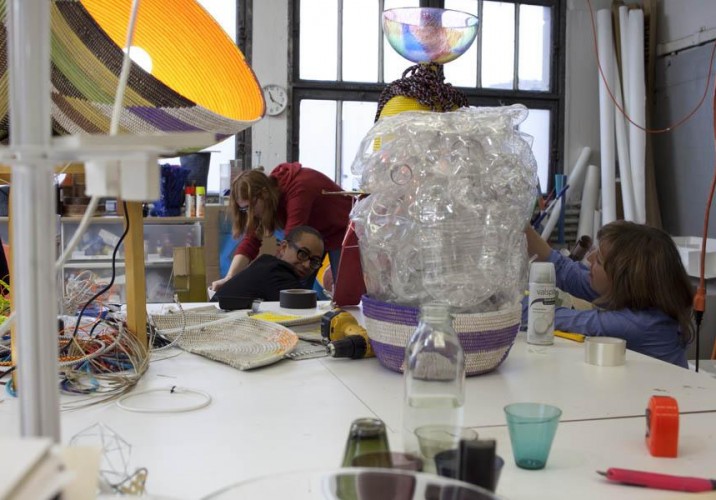
A glimpse at the making of table made from recycled PET bottles. In the background, you can see the glass bowl that sits atop the Yanagi composition, which Burks hand-painted with a Sharpie.
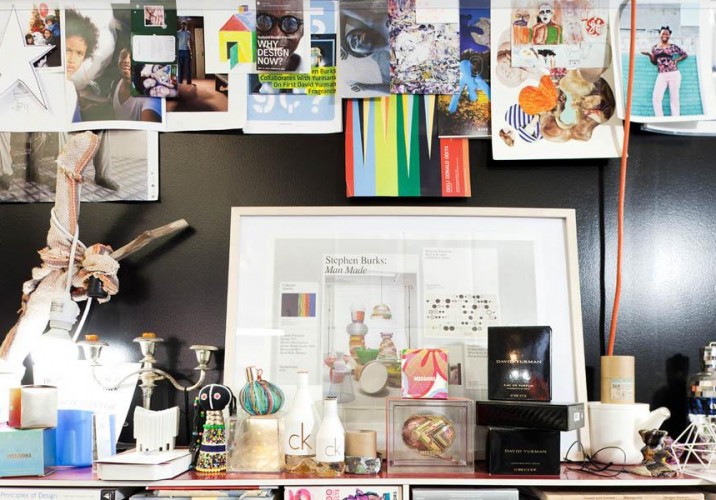
The exhibition at the Studio Museum included not only Burks’s prototype objects but also concept sketches and inspiration shots like the kind that hang in Burks’s Brooklyn studio. The images also made their way into the exhibition catalog, which was designed with Burks’s longtime graphic designer Alex Lin. For the catalog, Burks wanted to achieve the kind of singularity that comes from his signature half-crafted, half-manufactured objects. To that end, Lin collaborated with Burks to create 20 variations of the same catalog, with signatures arranged in different orders and different colored gaffing tape binding the spine of each.
The exhibition items before being shipped out: TaTu stools with rope piled on top, basket mirror, soft baskets made from a combination of sweet grass and rope, etc. In the background is Burks’s Horizon shelving, which the studio uses as a library.
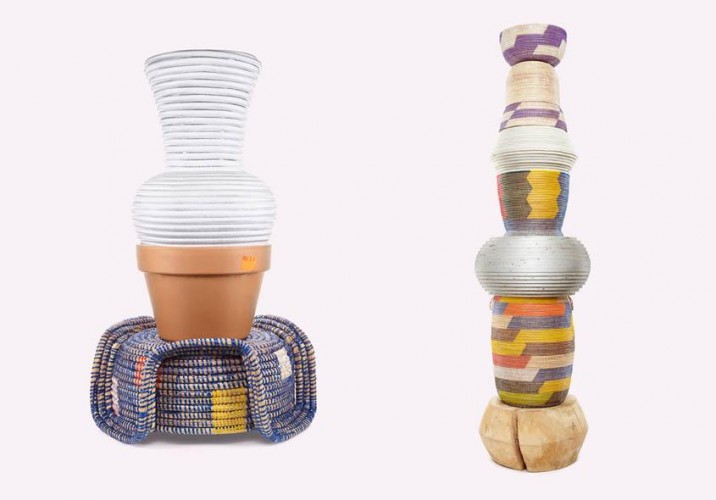
For the exhibition, Burks also made a series of assemblages, which he calls Material Composition 3 (Crown) and Material Composition 1 (Totem). On the left is an inverted basket, a terra cotta pot with its price tag still on, and the first prototype the studio made of one of the exhibition’s rope vases. On the left is a solid oak base, two baskets, a tabouret made from plywood, and a foamcore study of that tabouret. “It was important for me to make a few gestures that are immediately outside of what we think of as industrial design,” says Burks. “My inspiration comes not only from my background of working with European brands but also from my travels. In Africa, crowns and totems are part of the cultural landscape, and I wanted to reflect that here.”
Stephen Burks: Man Made is on view at the Studio Museum in Harlem until June 26.
For centuries, Swiss design was synonymous with watches, army knives, sewing machines, and other precision utilitarian objects. Then came the rise of Swiss graphics and typography in the 20th century, when the grids and sans serifs of talents like Josef Müller-Brockmann and Jan Tschichold created a legacy that dominates the tiny country's design reputation even today. But inside the 10,000-square-foot universe of the Museum Für Gestaltung Zurich’s collection archives — behind whose doors normally only curators and students are allowed — every chair, teapot, and cigarette lighter is either a product of or an influence on Switzerland’s industrial design history, which the museum strives to promote through the five to seven temporary exhibitions it produces each year.
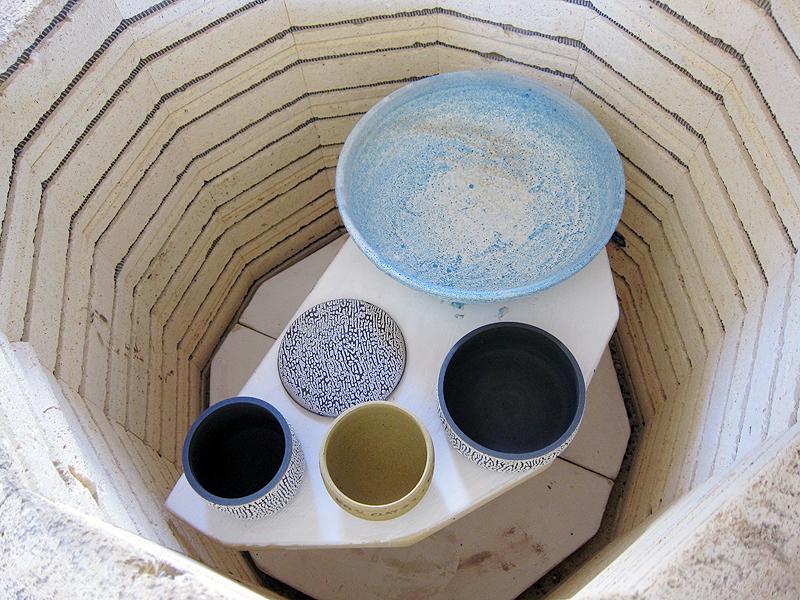
To identify yourself as a potter in this day and age sounds strangely old-fashioned. A ceramicist, yes; a ceramic artist, sure. And yet there really is no other way to describe Adam Silverman, the Los Angeles–based studio director for Heath Ceramics, who jokes that he keeps a banker’s hours behind the wheel he runs from the back of Heath's Commune-designed retail facility.
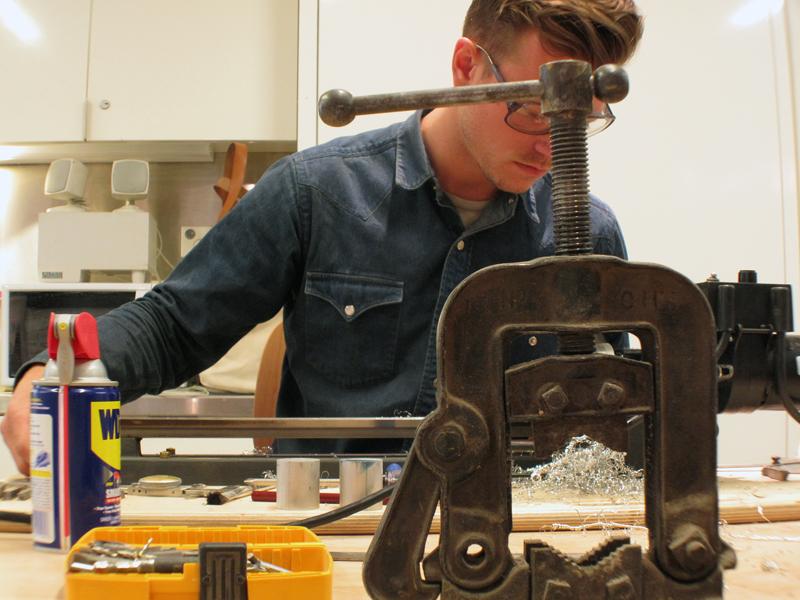
The brief itself was simple: Design and build something to sit on. It was the execution part that was hard. From April 16–21, four sets of young American furniture designers each took a turn in the open studios at New York’s Museum of Arts and Design, each with a single purpose: to build and assemble a chair from start to finish, between the time the museum opened at 9AM to the minute the last straggler was ushered out the door at 6. The designers could use any materials they chose, and they were allowed to make preliminary design studies or prototypes before arriving at the museum, but the bulk of the construction work had to be executed on the museum’s 6th floor — in full view of school tours, visiting tourists, families, and itinerant design geeks who wanted a peek at the action. But the exercise wasn’t some reality show–like competition to pit designers against each other or to see whose design would reign supreme. The event was part of The Home Front, a museum project curated by Surface editor Dan Rubinstein, who spearheaded the whole thing in order explore in-depth the business of being a designer in America today.