Tag Archives: Studios

  1. 02.09.12
    Studio Visit
    Correll Correll, Fashion Designers

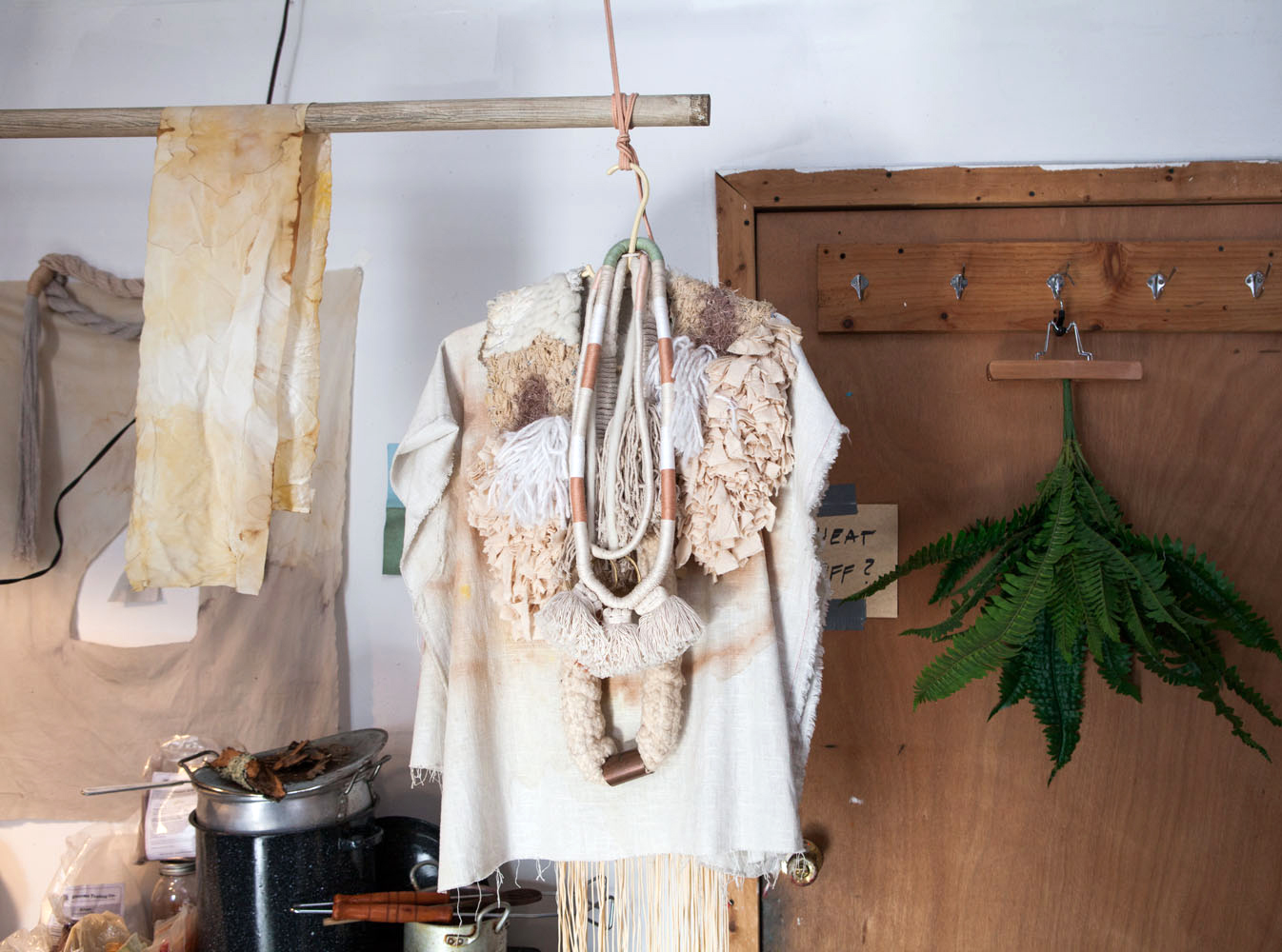
    You can learn a lot about Daphne and Vera Correll’s clothing line, Correll Correll, just by looking at who they employ: No unpaid interns, for one. When their sunny Chinatown studio is at full production capacity — as it has been in the weeks leading up to their Ecco Domani Award–sponsored Fall/Winter 2012 presentation this Friday — it’s staffed almost entirely by proper assistants. It’s not really fair, Vera reasons, to get by on free labor when the labor itself is what sells the clothes. “They look precious because you can tell we spend a lot of time on them,” she says, pointing to a recent jacket made using one of their signature techniques, where more than 40 different kinds of yarns and vintage fabric strips are woven together into a textile befitting what Vera refers to as a “shepherd from the future.” Each of the jackets takes a day’s work to create, and the sisters can make 30 or 40 such garments in a season. “Our clothes go through so many levels of work, all this sewing and knitting, and people can see that,” she says.

  2. 02.03.12
    Studio Visit
    Emily Counts, Artist

    Portland is a place where, so the saying goes, the ’90s are alive and well. And it may very well be the only place that could have spawned an artist like Emily Counts, who deals with the self-reflective nostalgia of outdated technological innovations once found in her childhood home: dial-up telephones sculpted in porcelain and stoneware, a life-size fax machine, an interactive Mac SE computer made from walnut, casting epoxy, glass, porcelain, copper, and electrical wiring that acts as a two-way mirror after a button is pressed on the keyboard, lighting up the sculpture’s interior. “I’m interested in the mystery of these inventions that we seem to take for granted in our everyday life,” says the 35-year-old Seattle native, who we first spotted on photographer Carlie Armstrong’s blog Work.Place. “For me, there’s a thin line between technology and magic.”

  3. 02.01.12
    The View From Here
    Another Country, Semley, England

    When Paul de Zwart founded Another Country a little over a year ago, the name wasn’t meant to be quite so literal: A small furniture company that focuses on affordably priced, well designed, but not overly trendy wood pieces, Another Country initially wore its Made in the UK status like a badge of honor, crafting small runs by hand using FSC-certified timber from a tiny workshop in the Dorset village of Semley, two hours east of London. De Zwart, who co-founded Wallpaper with Tyler Brûlé in the mid-‘90s, had originally devised the idea for Another Country after searching in vain for an affordable three-legged stool that might fit as well in the country home he was refurbishing as it would in his London flat. The proportions and rounded peg details of the stool De Zwart ended up designing in collaboration with Dominic Parish — a furniture-maker in Semley and now De Zwart’s business partner — eventually informed a 10-piece collection that debuted to fanfare and high praise during 2010’s London Design Festival. Fast-forward to now, and the brand is thriving, having just released a second, more angular furniture series and recently expanded into small goods like pottery, candlesticks, clocks, and desktop accessories. But ask De Zwart where the hub of Another Country’s production now sits, and the answer might surprise you.

  4. 12.21.11
    Sighted
    Okolo Visits Tobias Rehberger’s Studio

    For the team behind the Czech curatorial studio and blog Okolo — Adam Štěch, Jakub Štěch, and Matěj Činčera — their work is informed as much by the fact that they’re based in Prague, with a front-seat view of all things fascinating in Eastern European design, as it is by the fact that they love to travel. Adam Štěch has toured the region documenting amazing modernist homes, one of which he covered for Wallpaper this fall and more of which you’ll see on Sight Unseen in 2012, and the trio recently produced a print magazine devoted entirely to the city of Vienna. They also traveled to Frankfurt in November, visiting a succession of designers’ studios and photographing them for the Okolo website, slotting them in between posts about new work by Tomáš Král and the deconstruction of a Phillips auction catalog. One of our favorites was the studio of artist Tobias Rehberger, known for his striking graphical sensibility and his affinity for design and architecture, recently witnessed in the award-winning series of spaces he created in partnership with Artek; we’ve reposted it here with additional images and text that Adam prepared exclusively for Sight Unseen. Meanwhile, look out for a more extensive collaboration we’re preparing with Okolo for later this winter.

  5. 11.15.11
    Excerpt: Book
    Where They Create, by Paul Barbera

    Because he’s been doing it since he was 16 — when he used his very first camera to shoot the art studio of a friend’s father — documenting the workspaces of creatives is second nature to Australian photographer Paul Barbera. So much so that he can now identify his own memes: piles of rubbish on a table, trash cans, air conditioners, outdated technology. “How many fax machines have I found that are covered in dust but powered up, just in case I get a fax?” laughs Barbera, whose new book Where They Create and three-year-old website of the same name are full of such telling references. Then there are the potted plants, which are perhaps his greatest weakness: “Whether they’re dead, alive, half-alive, someone’s put ashes into them, or the pot’s cracked, I love it — there’s such variation in that stupid little element.” It’s an inexplicable yet undeniable urge that we’re quite familiar with around here, searching for flashes of personality in unexpected details, which is why we felt drawn to Barbera’s work in the first place (he’s a Sight Unseen contributor). It’s also why we decided to excerpt a chapter of his book, the one devoted to the New York–based designers Cmmnwlth, in this post.

  6. 10.28.11
    At Home With
    David Saunders of David David, Fashion Designer and Artist

    If you were somehow unfamiliar enough with the London fashion scene that you’d never encountered the work of David David, née David Saunders, a primer in his background certainly wouldn’t help much. Saunders is best known for a whirlwind rise to prominence that began with a job as head sculptor in YBA Tracey Emin’s studio, stumbled into a fashion line that won him a coveted spot in London’s Fashion East runway show, and now entails an obligatory mention of fans like Kanye West, Agyness Deyn, and M.I.A. each time it comes up in conversation. It’s not that it’s much ado about nothing — we were huge admirers of Saunders’s line by the time we ended up in his flat last February, a block away from our favorite London boutique Darkroom — but all that star power conveys very little about a charmingly blithe collection consisting of a handful of wearable silhouettes festooned with hand-drawn kaleidoscopic graphics, except maybe how he ended up with it in the first place.

  7. 10.25.11
    Up and Coming
    A Drawn Interview with Mieke Meijer

    If you read Sight Unseen often enough, you know that we’re supporters of all things creative, collaborative, and multidisciplinary. Matylda Krzykowski may be known for her curating talents (which we’ve featured here once or twice before), but she’s also a designer and a blogger — in other words, she’s someone who gets as few hours of sleep each week as we do. Being such a like-minded individual, we invited Krzykowski to contribute a guest post for Sight Unseen in a format similar to the one she employs on her own site, Mat and Me: Interviews that invite personalities from the design world to respond to questions with small, charming pencil drawings rather than mere spoken words. She in turn posed the challenge to Mieke Meijer, an Eindhoven-based product designer who recently contributed to the first in a series of projects at the new Depot Basel space, an open-ended design workshop in an old Swiss grain silo for which Krzykowski sits on the curation board. We’d been following Meijer’s work ourselves ever since we spotted her Gravel Plant project in Milan last year, which channels the geometries of industrial buildings into a system of storage modules whose functions are as myriad as their randomized profiles. Posted here is a selection of the drawings she submitted, plus photos that Krzykowski shot while visiting her studio last month.

  8. 09.02.11
    Studio Visit
    Uglycute, Furniture and Interior Designers

    For Uglycute, it all began with a Bruno Matthson knockoff. It was 1999 and Swedish design was having a moment, but not, it seemed to the group’s four fledgling members, for the kinds of edgy experimental crafts and artistic hybrids being made by the emerging scene at the time — Wallpaper magazine and its ilk were still peering into the long shadows of Sweden’s old modernist icons. And so architecture grad Fredrik Stenberg and artists Jonas Nobel, Andreas Nobel, and Markus Degerman vented their frustration in the only way they knew how: by mounting a show around a sarcastic simulacrum of Matthson’s Eva chair made from a clunky particle-board box and cheap nylon straps. Complemented by a set of primitive clay pinch pots and a crude plywood table, the installation served as a launch pad for the group, and its subject matter — elevating cheap materials in order to question traditional norms of beauty and value — lent their firm its distinctive name. “It was meant as a new take on formalistic values,” says Nobel, who with the other three partners has since built a thriving practice known for its work with museums and clients like Cheap Monday.

  9. 07.15.11
    Excerpt: Magazine
    David Lynch’s workshop in The Chronicle #2

    It wouldn’t be totally wrongheaded to view The Chronicle — a new biannual publication produced by the cultish Copenhagen ready-to-wear brand Rützou — as a fashion designer’s mood board, come to life. For each issue, the creative team — which consists of Rützou’s designer, founder, and namesake Suzanne; her husband, creative director Peter Bundegaard; and editor-in-chief Frederik Bjerregaard — selects a thematic framework and then collates together visual inspiration to support it. Called “Poetic Realism,” the first issue was abstract and moody, with photographic essays on pattern or urban decay and collages of the magazines’ own diverse inspirations, including Luigi Colani, Matthew Barney, Ernst Haeckel, melancholy, and a Mott Street acupuncturist in New York’s Chinatown. The latest issue, called Sense and Sensibility, more literally serves as a scrapbook for creative inspiration: “Sketches, abstractions in watercolor, visual logbooks, black-and-white imagery, personal portraits, simple doodles, this vast collection is a glimpse into a range of international artists’ creative processes and their final work,” the team writes. By international artists, they mean the likes of Marc Newson, Julie Verhoeven, and David Lynch, who offers a glimpse into his Parisian printmaking lair in the excerpt we’ve reprinted today on Sight Unseen.

  10. 07.12.11
    Sighted
    Philippe Malouin’s studio on Yatzer.com

    On occasion, the editors of Sight Unseen spot a story about creativity told from a viewpoint that’s not unlike our own. This one, posted yesterday on the design blog Yatzer, peeks in on the studio of Québec-born, London-based designer Philippe Malouin. Malouin is known for taking his time with a project — after painstaking research, his recent chainmail-like Yachiyo rug for Beirut’s Carwan Gallery famously took 3,000 hours to produce — and in the article, writer Stefania Vourazeri probes the young designer about his thoughts on permanence as well as the influence of art on his designs. “Production for the sake of production is not that interesting to me,” he explains.

  11. 07.07.11
    Studio Visit
    Doshi Levien, Product and Furniture Designers

    If you’d expect anyone to spend their days working amidst a snowdrift’s worth of process and ephemera, it’s London designers Doshi Levien. What you see piled atop the shelves and pinned to the walls of the couple’s Shoreditch studio, after all, is the product of two very different yet equally prolific minds working through their own approaches to the same tasks — Nipa Doshi being the Bombay-born lover of handicraft who collages, paints, and draws her way towards ideas from the ground up, and her Scottish husband Jonathan Levien, who spent his childhood in his parents’ toy factory and developed the more exacting methods of an industrial designer, prototyping proclivities and all. While both enjoy surrounding themselves with collected objects like Italian ice cream cups and Chinese pencil boxes, it’s impossible to understate the importance of the couple’s divergent interests to their work’s unique point of view; the designs that made them famous, after all, were daybeds and sofas for Moroso that combined industrially produced furnishings with hand-embroidery and textiles sourced from Indian artisans. It would be a cliché way of characterizing the pair if it weren’t so overwhelmingly true, even by their own admission: “After ten years of working together, I see it as an essential ingredient in what we do, almost a layer in the approach without which it would feel naked,” says Levien.

  12. 06.20.11
    The View From Here
    Boym Partners, Doha, Qatar

    To move the studio of Boym Partners from New York City to Doha, Qatar, would seem an act of sacrilege, like relocating Ai Weiwei from China to Portland, Oregon, or Ed Ruscha from Los Angeles to Munich. After all, as co-principals of the New York–based firm since 1995, Constantin and Laurene Leon Boym have made their mark in part by commenting on the cultural iconography of American life. And yet a year ago, the couple quit their DUMBO studio, picked up their 14-year-old son Bobby and their cat Ozzy, and moved everything into a high-rise apartment that sits 17 floors above the Doha Bay. The occasion was Constantin being named director of graduate design studies at the Virginia Commonwealth University in Qatar, but in the year since their arrival, it’s become clear that their work there is not just about getting a fledgling design program off the ground but rather about helping create a whole design culture from scratch. “Design here is still largely considered to be a more decorative, applied discipline,” Constantin told me via Skype from the new studio last week. “You decorate a hotel, a restaurant, or a villa. Design as a critical tool for exploration doesn’t really exist.” Adds Laurene: “You have to remember that people lived in tents in this very spot 20 years ago, and now we have a W Hotel across the street.”

  13. 06.08.11
    Sighted
    Work.Place, by Carlie Armstrong

    On occasion, the editors of Sight Unseen spot a story about creativity told from a viewpoint that’s not unlike our own. In this case, it wasn’t a single story but rather a whole new blog: Work.Place, a sort of hyperlocal version of Sight Unseen that peeks inside the studios of Portland, Oregon’s best and brightest creative talents. The site is the solo effort of talented local photographer Carlie Armstrong, who documents a community of potters, patternmakers, illustrators, print shops, woodworkers, painters, comics, bicycle-builders — and even a floating workshop and gallery built inside a restored naval vessel parked near the city’s Sauvies Island — from behind the viewfinder of her Twin Lens Reflex camera. We recently spoke to Armstrong, who explained the reasoning behind her labor of love: “I wanted to give voice to some of the artists here in Portland who aren’t necessarily promoting their own work, and also to illuminate the personalities behind such great projects. I think there is a more complete connection to craft or art when you see the genuine nature of the creator or creative space behind it.”

  14. 05.27.11
    Studio Visit
    Study O Portable, Product and Jewelry Designers

    You can learn a lot about Dutch designer Bernadette Deddens by just looking at her. First there are the shoes, which — depending on the day and the whims of London’s weather — she very well may have made herself. One pair of sandals constructed from $25 worth of pale leather and black cording could be mistaken for Margielas, yet are no less awe-inspiring for the fact that Deddens actually nicked the look from Tommy Hilfiger. After all, who makes their own shoes, anyway? Then there’s her jewelry, which is almost always her design, unless it’s a collaboration with her husband Tetsuo Mukai, with whom she formed Study O Portable two years ago. The jewelry is their way of giving people a form of creative expression that can be carried outside the house and into the wider world, as Deddens so poignantly demonstrates — hence their otherwise peculiar studio name.

  15. 05.05.11
    The Making Of
    The American Design Club at MAD

    The brief itself was simple: Design and build something to sit on. It was the execution part that was hard. From April 16–21, four sets of young American furniture designers each took a turn in the open studios at New York’s Museum of Arts and Design, each with a single purpose: to build and assemble a chair from start to finish, between the time the museum opened at 9AM to the minute the last straggler was ushered out the door at 6. The designers could use any materials they chose, and they were allowed to make preliminary design studies or prototypes before arriving at the museum, but the bulk of the construction work had to be executed on the museum’s 6th floor — in full view of school tours, visiting tourists, families, and itinerant design geeks who wanted a peek at the action. But the exercise wasn’t some reality show–like competition to pit designers against each other or to see whose design would reign supreme. The event was part of The Home Front, a museum project curated by Surface editor Dan Rubinstein, who spearheaded the whole thing in order explore in-depth the business of being a designer in America today.

  16. 05.02.11
    Up and Coming
    Brunno Jahara, Product Designer

    If you think about it in the context of design, Brazil is a lot like America: A vast, relatively young country with a tiny cadre of contemporary designers struggling both to step out of the long shadow of their mid-century forebears, and to create objects in a near-industrial vacuum. But you won’t hear Brazilian designer Brunno Jahara complaining — having lived in dozens of European countries, worked under Jaime Hayon at Fabrica, and run a freelance business from Amsterdam before moving back to São Paulo a few years ago, he credits his native country as being the catalyst for his newfound success. “In Brazil I have all the freedom I didn’t have in Europe, because there’s a whole historical background over there that holds you to making things in a certain way,” says the 32-year-old.

  17. 04.08.11
    Q+A
    Carwan Gallery Launch: Paul Loebach

    Through April 15, Sight Unseen will be showcasing the work of half a dozen designers and design firms exhibiting together at the Milan Furniture Fair under the umbrella of the soon-to-launch Carwan Gallery in Beirut. When we asked Brooklynite Paul Loebach which of the four products he’ll bring to the show had the most intriguing backstory, he immediately nominated his Watson table, a sandwich of carbon fiber and wood with double-helix legs that took him two and a half years to develop. Like the rest of Loebach’s oeuvre, the table reinterprets historical craftsmanship techniques using cutting-edge technologies, evoking yet another novel property from a material as old and as simple as wood. “I named the table after the guy who discovered DNA,” Loebach says. “I felt like a scientist doing this project, so I named it after one.”

  18. 04.07.11
    Q+A
    Carwan Gallery Launch: Lindsey Adelman

    Through April 15, Sight Unseen will be showcasing the work of half a dozen designers and design firms exhibiting together at the Milan Furniture Fair under the umbrella of the soon-to-launch Carwan Gallery in Beirut. Today’s subject is Lindsey Adelman, who works out of a tiny studio in the back of Manhattan design store The Future Perfect but creates her sprawling, modular chandelier series at Urban Glass, a Brooklyn atelier that’s created work for the likes of Louise Bourgeois, Eva Zeisel, and Robert Rauschenberg. “Building visual tension is a theme that’s always interested me,” says Adelman. And in her latest work Catch, which features slumping glass orbs blown through oversized brass links, it’s the tension between “the fluid fragility of the glass and the strict, flat, weighty links. Mashing together the feminine and the masculine — something interesting usually happens,” she says.

  19. 04.05.11
    Q+A
    Carwan Gallery Launch: Philippe Malouin

    Through April 15, Sight Unseen will be showcasing the work of half a dozen designers and design firms exhibiting together at the Milan Furniture Fair under the umbrella of the soon-to-launch Carwan Gallery in Beirut. First up is Montreal-born, London-based Philippe Malouin, whose projects merge a highly conceptual framework with a practical, process-based approach and visually pleasing geometries. His Gridlock series, for example, shrunk the construction of architectural cross-bracing down to a domestic scale, employing it to make lamps and mobiles, while his new Yachiyo rug uses an ancient Japanese chain-mail technique to create an indestructible floor covering that takes 3,000 hours and an army of interns to produce. Here, Malouin explains how — and why — he did it.

  20. 03.31.11
    Sighted
    Photographer Tim Barber on the UO Blog

    In a recent interview with the New York–based photographer Tim Barber, who’s known for his edgy portraits of artists and other downtown tastemakers, the folks behind the Urban Outfitters blog evoked some rather unconventional subject matter: UFOs, ghosts, chicken carcasses. Credit the fact that not only did the former Vice Magazine photo editor shoot UO’s playful new spring catalog, but he’s also currently judging a Weirdest Photo Contest for the retail giant. Of course, in his work with clients like Nike, Woolrich Woolen Mills, T magazine, Italian Vogue, and Stella McCartney, Barber has displayed a more serious side as well. We wanted to show both of them, so we went through his portfolio and chose some new photos to accompany our excerpt from the UO interview — instances where Barber has documented the private spaces of creatives, a la Sight Unseen.

  21. 03.28.11
    What We Saw
    DesignMarch 2011 in Reykjavik

    What Iceland may lack in sunshine — getting, on average, less than half the amount of rays New Yorkers enjoy annually — it easily compensates for in natural beauty. When it’s light outside, the landscape is an almost otherworldly sight, with blackened crags of lava softened by bright heaps of moss and glaciers melting into never-ending expanses of steel-blue sea. When it’s dark, there’s a symphony of northern lights to behold. With all of that visual stimulation surrounding them it’s no wonder Icelanders are aesthetically gifted, with a fashion sense that rivals Stockholm’s in its cacophany of colors and textures and a community of designers that needn’t look further than their own backyards for inspiration. When Sight Unseen was invited to Reykjavik this past weekend to attend the opening of Iceland’s third annual DesignMarch festival, that was precisely what struck us most: Whether the work we saw directly referenced the country’s landscape and culture or just told a story about its current state of affairs — as with one designer we met who had to shutter her architecture practice after the bank crash and start anew — the show felt like a singularly local celebration.

  22. 03.16.11
    Studio Visit
    Christian Wijnants, Fashion Designer

    Christian Wijnants attended the fashion program at Antwerp’s prestigious Royal Academy, and upon graduating, won the Hyéres prize, the Dries Van Noten prize, and a coveted assistant spot in Van Noten’s atelier. Then, two years after starting his own line in 2003, he banked 100,000 euros as the winner of the Swiss Textile Award, beating out Giles Deacon and Charles Anastase. “I never thought I would even be nominated,” Wijnants told i-D magazine at the time, before proceeding to watch his collection trickle into all of the world’s most respected boutiques and department stores. He was just being modest, of course — the man has unmistakable talent, especially when it comes to his imaginative textiles and knits — but there is something surprising about his success, when you think about it: In a country whose fashion scene skews towards all things experimental, nonconformist, androgynous, and/or dark, the cherub-faced designer is known for both his colorful, feminine aesthetic and his charming geniality. He’s almost too perfect to be cool.

  23. 02.23.11
    Sighted
    John Currin’s Studio in Art+Auction

    John Currin’s New York studio, as we’d imagined it, could have gone either way: Classical and lush, befitting a painter who got famous in the ’90s portraying himself as a new Old Master while his contemporaries were overdosing on conceptualism, or strange and wild, bursting with the eclectic ephemera Currin references in his portraits, from vintage porn mags to movie clips to historical tomes. When we spotted an article posted on ARTINFO — which originally ran in Art+Auction magazine — promising a look into this very realm, we were surprised to see something that didn’t particularly fit either mold. Perhaps it’s the fact that, as the article mentions, he’d just moved in and redone the floors, or perhaps he tidied things up for the cameras. But aside from some odd-looking mannequins and a table piled with paint tubes, Currin’s working space didn’t look much like a working space at all. Luckily, writer Daniel Kunitz was able to paint a lovely, erm, picture of what it’s like to be Currin — from his everyday anxieties to his video game habits to the music he listens to when he’s feeling creative. Read the first half of the article here, then follow the jump to the ARTINFO site to learn more about Currin’s artistic process.

  24. 02.21.11
    Studio Visit
    Evan Gruzis, Artist

    Evan Gruzis dropped acid a few years back, and while he was wigging out, managed to scrawl down such revelatory thoughts as “there once was a movie, it was amazing”; “welcome to the temple of showers, please take a shower in one of our many showers”; and “no bother, it’s just the remix.” Having rediscovered the notes recently, he turned them into a series of works on paper by scanning and enlarging them, cutting out the individual letters, then sweeping over the cutouts with the flat, ’80s-style gradient that forms the background for many of his works, including semi-photorealistic still lifes and geometric abstractions inspired by Saved by the Bell and Memphis. Rather than using an airbrush — “blasphemy!” according to the 31-year-old artist — Gruzis builds up the gradients in meticulous layers of India ink, spreading upwards of 20 separate washes across wet paper with soft squirrel-hair paintbrushes until the effect is practically flawless. “It’s about taking a moment that isn’t even remembered and turning it into this layered, highly crafted, highly rendered thing,” he explains of the acid notes, the kind of process that keeps him locked away in his studio six days a week. “It’s about taking meaninglessness and glorifying it. That’s another way of putting what I do: Making absurdity seductive, and making the seductive vapid, so you get caught in this feedback loop.”

  25. 01.28.11
    Studio Visit
    Adam Voorhes, Photographer

    It all started with the pistol, if only because it was “the simplest to do,” says photographer Adam Voorhes. He first studied the gun, looking for ways to segment it, then he took it apart so that its innards were exposed, right down to the bullet casings. “Some objects can be separated like a technical drawing, while others look more organic, like a football helmet with its straps weaving in and out,” he says. The pistol was squarely in the former camp. He took its disassembled parts and built a kind of 3-D installation, each part hanging from a fishing line in proximity, so that the gun would appear to have exploded in mid-air, a bit like the artist Damián Ortega’s axonometric Beetle or this iconic ad from the ’60s. The wires could be erased in Photoshop once Voorhes got the final shot. After the pistol he’d do an Etch-a-Sketch, and an old-school telephone, turning the studio experiments into his best-known series and then selling commercial clients like ESPN and Spirit magazine on the technique. This is how Voorhes works — he is a commercial photographer. He’s not interested in gallery shows. He tests ideas, and then he sells them.

ORGANIZE BY

Newest/Most Popular

Department/Tags


MORE STORIES

Archives