03.26.26
The Weekly
Europe’s coolest new hotel, 1980s Brutalist lamps, and more
Welcome to the new Sight Unseen, a weekly newsletter that delivers the best of the design world — news, trends, shopping advice, interviews, travel recs, and more — straight to your inbox. If you’re not subscribed, follow this link to sign up. Want to partner with us, advertise, or submit your work (guidelines here)? Email us at hello@sightunseen.com.
Haddou Dufourcq Trades Alpine Clichés for Thoughtful Craft in Courchevel
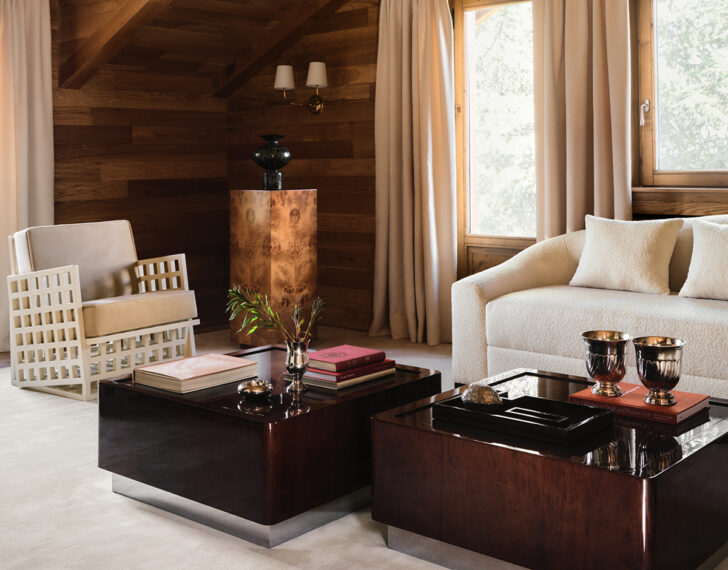
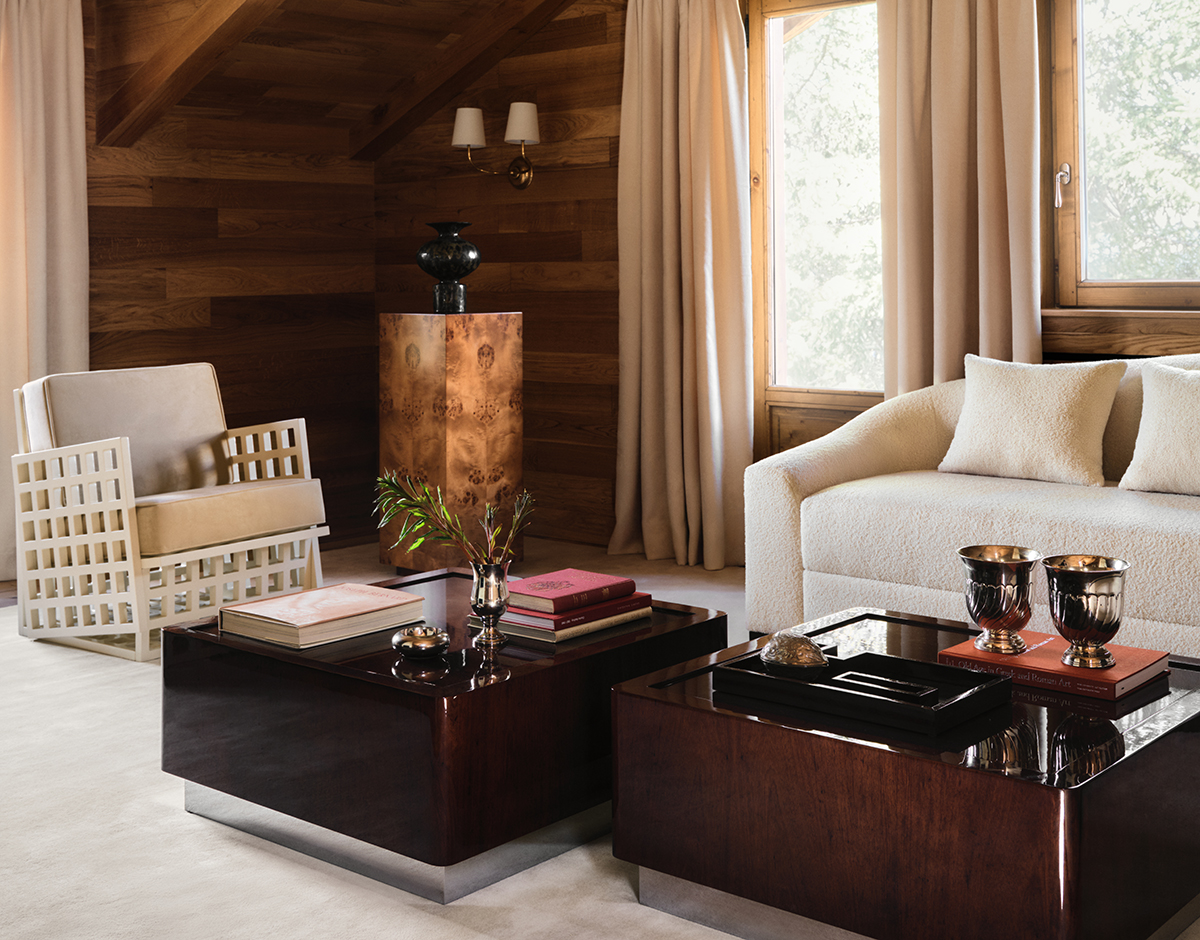
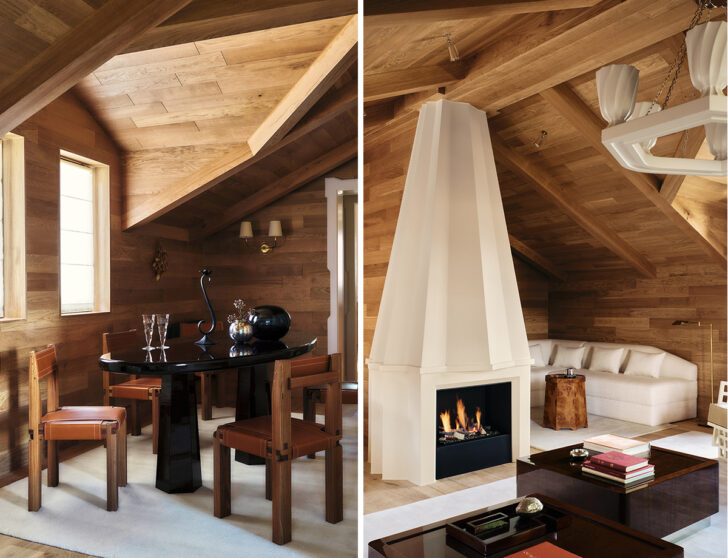 This spacious ski retreat in the French Alps is filled with custom furniture by Parisian duo Haddou Dufourcq. Photos: Ludovic Balay
If I were to invite you to imagine a 3,500 square-foot vacation chalet in the ultra-luxury resort town of Courchevel 1850, where the richest of the filthy rich go skiing, what would you picture? Something with expensive oversized wood cabin furniture and lots of sumptuous furs? Classic iron-gated fireplaces and a generic Alpine vibe? As much as it has always pained me to write about the excesses of the 1%, when I see a talented design studio taking a project that could have been just another luxury villa and actually making it special, defying those expectations entirely, I like to count it as a win — another tiny corner of the world that’s been clawed back from elite mediocrity and used as a well-funded staging ground for creative ideas. The aforementioned Courchevel chalet — pictured, in actuality, above — is the latest private commission from the Parisian design studio Haddou Dufourcq, where the duo got to fill the entire oak-lined space with custom furniture and vintage finds. Joining existing pieces from their Trama collection released last year, including an upholstered lounge chair with a white gridded base and a striking creamy-white lacquered wood chandelier, are new creations like burlwood nighstands and stools, a high-gloss lacquered-wood desk, sleek lacquered-wood and stainless-steel coffee tables, and a room-anchoring sculpted-plaster fireplace, a sort of Valentine Schlegel homage executed in the designers’ own form language. Add a bit more color in, and it would be the ski retreat of our dreams, though I’m still dreaming of owning a New York apartment first!
Quiet Studios Turns a Modest 19th-Century Home in Porto Into One of Europe’s Coolest New Hotels
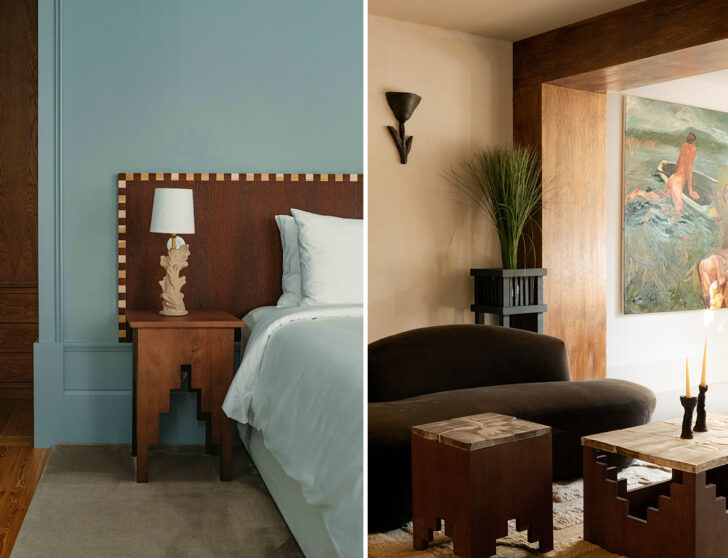
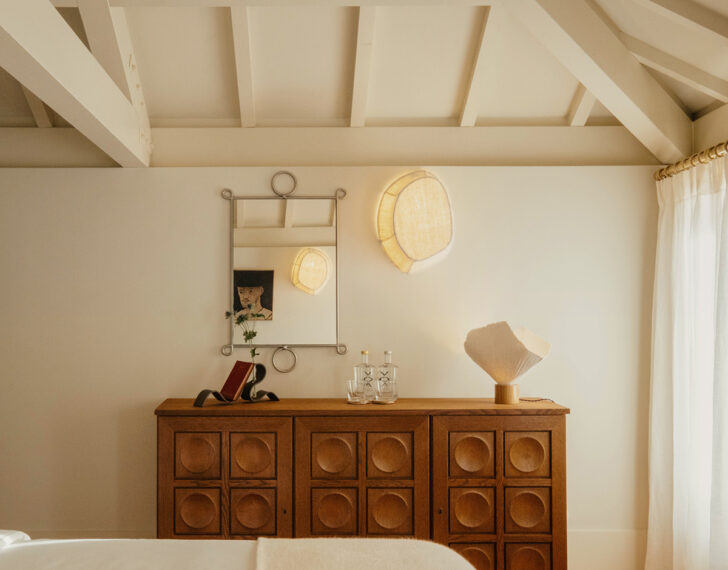
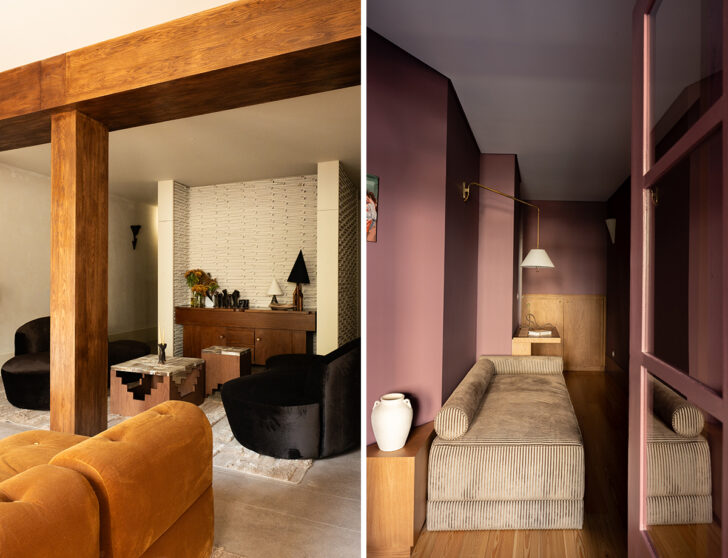 The 8-room Casa Cedo hotel in Porto, Portugal, with interiors designed by Quiet Studios. Photos: Inês Silva Sá and Matilde Viegas
Many smaller cities — like my hometown of Columbus, Ohio — have zero hotels that would be considered true “design hotels” (or good/sophisticated ones, anyway). Meanwhile Porto, Portugal, which isn’t even a third of the size of Columbus, somehow has two. This is thanks in part to Daniela Franceschini of Lisbon’s Quiet Studios, who designed The Rebello back in 2023, and in part to Massimiliano Salé and Jeremiah Healy, who hired her to work her magic on their own charming property, Casa Cedo, which opened this past November. The hotel has only 8 guest rooms — plus a bar, lounge, dining room, and reception that doubles as a flower shop — but its interiors are just as ambitious as any boutique property you’d find in Paris or New York.
The building itself is a 150-year-old single-family home that was restored by local firms Atelier in.vitro and VOF, with a new upper floor and back building added and as many salvaged tiles, beams, and other materials as possible reused in the new spaces. Inside, Franceschini employed richly painted walls, large-scale artworks, and a thoughtful choreography of vintage and contemporary furnishings, among them a 1960s Torbecchia sideboard by Giovanni Michelucci, lights by Project 213A, and a recurring series of wooden tables with ziggurat cutouts and tiled tops that were designed by Franceschini in collaboration with Porto’s Lava Ceramics. Porto may not have the same pull that Lisbon does, but in addition to the stunning Pepto-pink Serralves museum, Casa Cedo adds a compelling reason to make the detour.
Wretched Flowers Brings Movement and Narrative Into Its Beloved Chainmail Tapestries
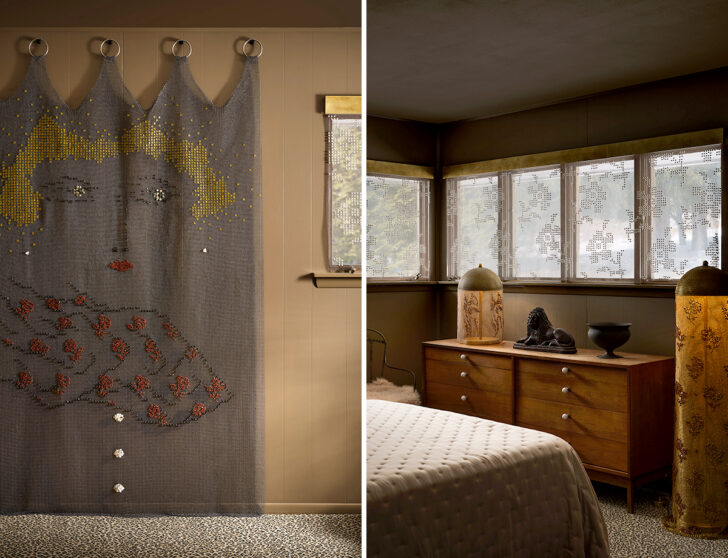 The duo behind Wretched Flowers recently marked the evolution of their chainmail tapestries by installing new figurative panels (left) and window curtains (right) in their Connecticut bedroom. Photos: Joe Kramm
Both Bruno Munari and Alexander Calder built famed bodies of work around the idea that art shouldn’t stay static on the wall or on a plinth, but be freed from those constraints to interact with — and make more of an impact on — the spaces it occupies. Their solution was to make mobiles that twirled captivatingly in mid-air, but for the Connecticut duo Wretched Flowers, the process of freeing their creations from the walls has been a little more practical in nature: They recently added movement to the bead-adorned chainmail tapestries they’ve become known for by way of track systems that let the metal curtains slide, barn-door-style, across closets, windows, or cabinets, or be used as adjustable room dividers (with motorization possible as well).
To mark the launch of these new applications, the pair installed several of them in their own bedroom, where they also debuted a second development: Whereas in the past their bead patterns have always taken the form of florals and nature scenes inspired by historic textile patterns, they’re now branching out to offer all sorts of figurative designs. The first two experiments are a portrait of a woman with an expressive scarf, seen above, and a diptych — spread across two panels, used in their bedroom as closet doors — of a woman walking a pack of dogs, adapted from a work of 1920s typewriter art. This opens up more possibilities for customizing the imagery to a client’s personal story. One client, for example “wanted a bespoke design that spoke to her Turkish heritage, so we found a kaftan from the Ottoman Empire at the Met that we adapted for beadwork,” co-founder Johnny Stanish notes. It’s perhaps this, even more than mechanization, that gives this new wave of products an appealing dynamism.
Somewhere Between Sculpture and Design, Loup Sarion Makes Objects Converse
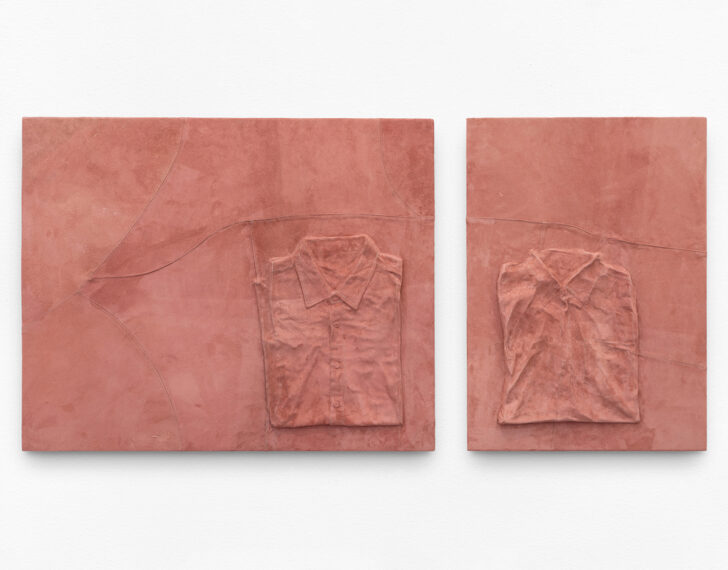
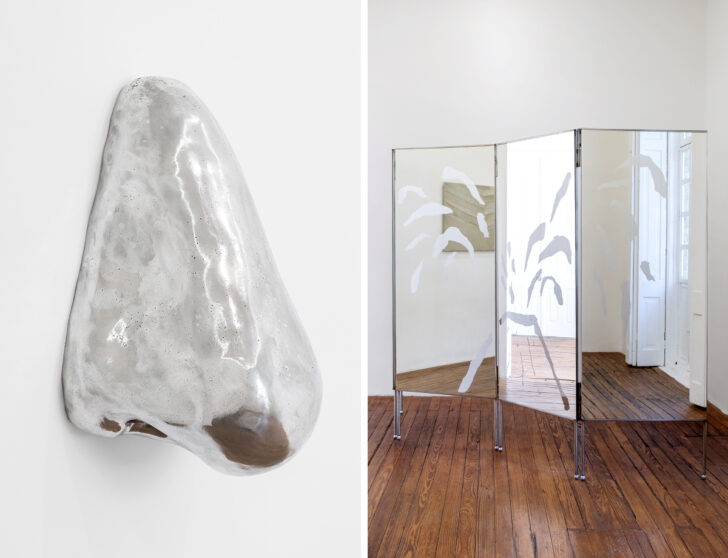 Plaster shirts, aluminum noses, and a mirrored room divider at Loup Sarion’s current show in Mexico City.
If you recognize Loup Sarion’s name from these pages, it’s likely because he’s one half of the design studio Marrow Project, with Rafael Prieto, for which the pair craft structured fabric sconces that resemble sections of bone. Sarion is first and foremost an artist, not a designer per se, but the lights are in line with his oeuvre — many of his sculptures and wall works are fragments of something, like clothing or a human body. And yet he does think about the way objects can activate a space, much like a designer would; here’s how he described the plaster tongues he affixes to the wall: “I prefer to imagine that I plug an element of the body on something that is not a body, and it comes alive,” he told Bomb magazine back in 2018. “I imagine I plug this tongue on the wall and it becomes a face. If you imagine five tongues on the wall you imagine a conversation. [Even] if I were doing something truly abstract — a sphere or if I were to make just squares or triangles — if I were to install them in a space, I would want them to have a conversation. That’s really important to me.”
Trade the tongues for aluminum noses, and you have Sarion’s newest solo show at Galeria Mascota in Mexico City, where there are also fragments of buildings, button-downs, and blue jeans rendered in materials like leather, resin, and concrete. The strongest nod to a consideration of space, though, is a new four-panel metal room divider whose mirrored surfaces depict the eruption of a volcano — or the top of a vase filled with greenery? Assuming the piece is in conversation with the noses that surround it, we’d venture to guess it’s the latter. On view through April 18.
Editor’s List
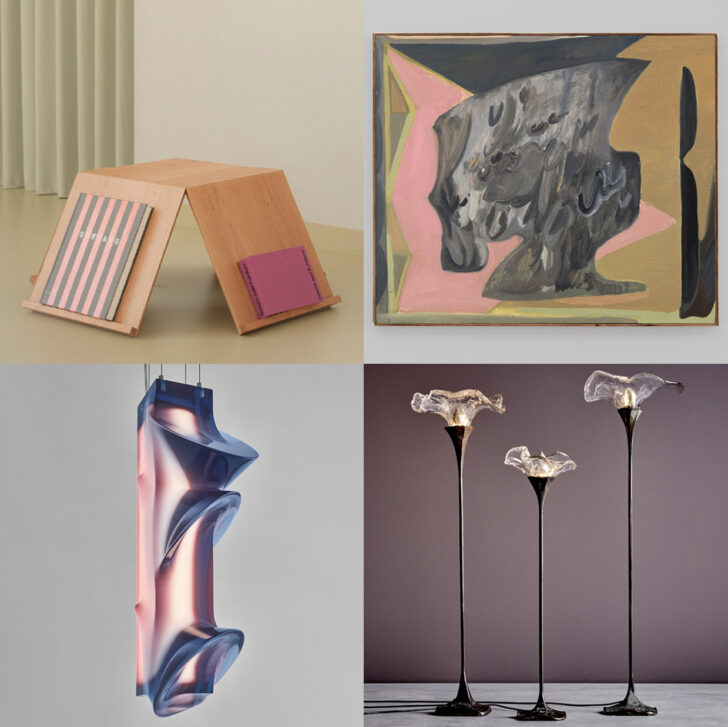
CLOCKWISE, FROM TOP LEFT:
–
My friends have all heard me rhapsodize about the ephemera stand that holds court in the living room of Luis Barragan’s home in Mexico City, which is beautiful but also just serves such a cool function — to show off books and things in a very intentional way. When the South Korean studio Seamlessnote pitched us their latest project recently — a folded form they’ve produced at multiple scales, the largest of which is the wooden table shown here, whose legs have little ledges for displaying books — that stand is what it instantly reminded me of. This one is a little more accessible, of course! It’s lovely.
–
There are only a few more days to catch the solo show of Jaik Faulk paintings that’s currently on view at Nationale Gallery in Portland. It’s small, just 11 abstract works of various sizes, but I’m quite taken with them. I’m a real lover of midcentury abstracts and somehow these works have that same appeal for me. I think the similarity lies in the combination of bright colors with dark, murky ones, plus the balance between the harder outlines of the organic shapes and the softly layered brushstrokes within.
–
I honestly don’t know how we lived before Google Image Search. My big thing these days is stalking pieces I spot in projects by my favorite interior studios — these 1980s Lothar Klute lamps came from an Instagram post Lumens recently did with Husband Wife, and the image here comes courtesy of the dealers Original in Berlin (though these are now sold, sadly). If you’ve got $400 to burn I’d actually recommend snagging this umbrella stand by the late German artist.
–
Fast forward to the present day, I’m also fully obsessed with a new series of epic pendant lights by Laurids Gallée, on view until May at Objects With Narratives gallery in Brussels. The columnar poured-resin lights have really unusual forms, super fluid yet almost barb-like at the same time, and with really pretty color gradients. “Beams, cones, and dish-like curves merge into continuous optical bodies, borrowing their orientation from satellite dishes and antenna masts that face in different directions, as if streaming to an unknown place,” states the gallery.
News
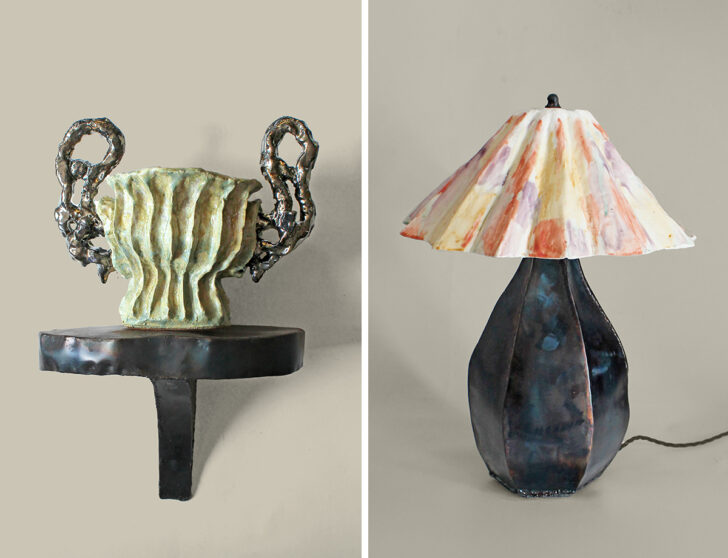 Collaborative works by Andrew Pierce Scott and Natalia Triantafylli, on view at Wondering People in London
–
The nice thing about Wondering People, a British online platform for contemporary art, isn’t just that its taste level is much higher than most, but that it seamlessly incorporates works of design and craft, which helps support the narrative among newer collectors that both are equally worthy of investment. The site has more functional works, like lighting by Studio Haos, but also more artisanal pieces like this shelf, vase, and lamp by Andrew Pierce Scott and Natalia Triantafylli, on view through April 17 at Soho Revue in London as part of a group show called Tracing Movement. This little collab is even more exciting given that Pierce Scott and Triantafylli are gearing up to launch a larger joint collection of furniture and lighting at Alcova this year in Milan — one of our shows to watch. (Maybe best to snag their work now via Wondering People before the rest of the world finds out!)
–
We’ve been a little heavy lately on projects by the Parisian interiors firm (and furniture design studio) Hauvette Madani, so we opted not to feature their latest project, a residence in the city’s Sablons neighborhood. But the combination of saturated greens and teals, the vintage from Galerie Gastou, and the vibrant art makes it worth peeping at regardless if you have a little time to kill.
–
Update your London map with the latest outpost of Holy Carrot, a vegan-ish restaurant whose charming new interior in Spitalfields was created by Faye Toogood, complete with mushroom-themed handpainted murals and curtains. World of Interiors interviewed the designer about the project, but I’m just as excited to eat the food on my next romp through the city.
The Collection
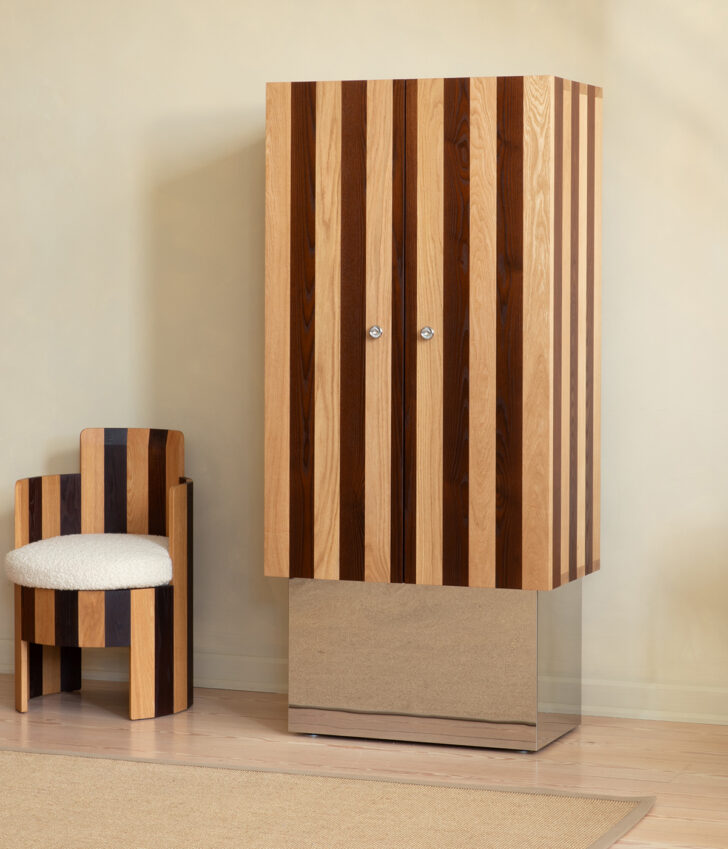
COOPERAGE CABINET BY FORT STANDARD
The Cooperage Cabinet brings the drama to a room with bold cabana stripes that aren’t painted, but rather created through the joining of alternating white oak and roasted-oak boards, which — along with its clean-lined, hardware-free silhouette — ground the piece in an elemental simplicity. A mirror-polished stainless steel base subtly reflects its surroundings, creating the illusion that the cabinet is floating in space.