05.14.26
The Weekly
Murano glass, plaster flowers, mosaic tables: All the hits from New York Design Month so far
Welcome to the new Sight Unseen, a weekly newsletter that delivers the best of the design world — news, trends, shopping advice, interviews, travel recs, and more — straight to your inbox. If you’re not subscribed, follow this link to sign up. Want to partner with us, advertise, or submit your work (guidelines here)? Email us at hello@sightunseen.com.
Two Major Collections Launched This Week in Collaboration With an Iconic Glassblowing Atelier
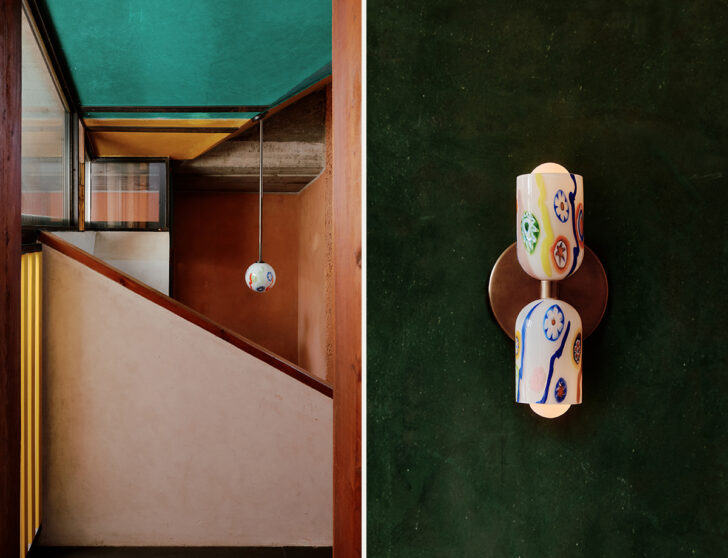
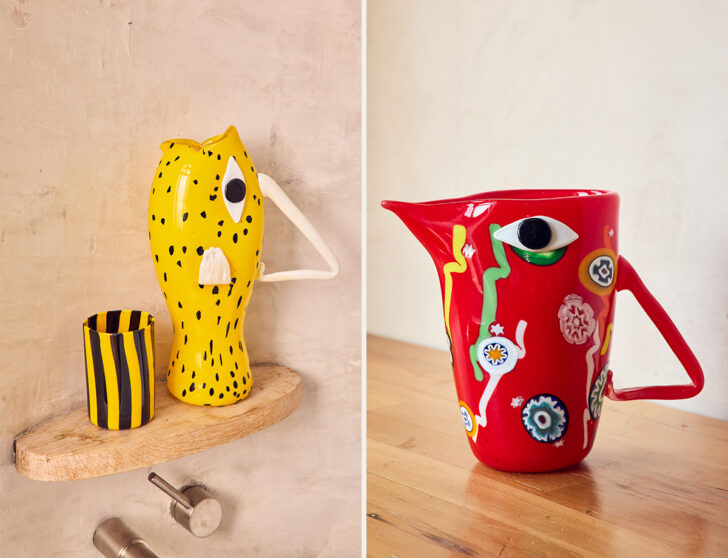
Top: The Lido series by In Common With deploys two iconic Murano glass processes; bottom: Ellen Van Dusen’s “mother and baby” pitcher and cup pairs were inspired by her maternity leave.
Is something literally in the water around Murano, the interconnected series of islands in the Venetian lagoon known as the epicenter of artistic glassmaking? It’s where all of your favorite glass collections were already made, from Dana Arbib’s to Sophie Lou Jacobsen’s. But lately it seems more and more American designers are spending time at the furnaces. First came Blue Green Works’ Garden series, and this month, two major collections launch in collaboration with the glassblowers at Laguna-B: the Lido series by In Common With, and Dusen Dusen x Laguna-B, a group of serving vessels suffused with Ellen Van Dusen’s playful spirit.
For Lido, In Common With founders Nick Ozemba and Felicia Hung worked with two iconic Laguna-B processes. Goti de fornasa is an improvisational technique where leftover glass is used to create vessels in unexpected colors, patterns, and shapes. Murrine, the more famous of the two, involves layering and stretching colored glass into rods to create patterns that are revealed when the rods are sliced into cross-sections. In Common With paired these more complex surface decorations with their simple, iconic forms, like an up-down sconce and a brass-backed flush mount, as well as new shape: the Cosmos Chandelier. For her part, Van Dusen came up with the idea for three pairs of jugs and cups — each representing an animal “mother,” like a fish, a zebra, or a bird, along with its corresponding “baby” cup — during her maternity leave in early 2025. Working with Laguna~B, known for its punchy patterns and saturated colors, was a natural fit for Van Dusen, who could deploy her signature stripes in a slightly more haphazard fashion. “Glass has a mind of its own,” Van Dusen says. “Chance became an important design element — it determines the final pattern and layout in a way that textiles never could.”
Two of Our Favorite Ceramicists Just Paired Up to Make a Floral Lighting Collection
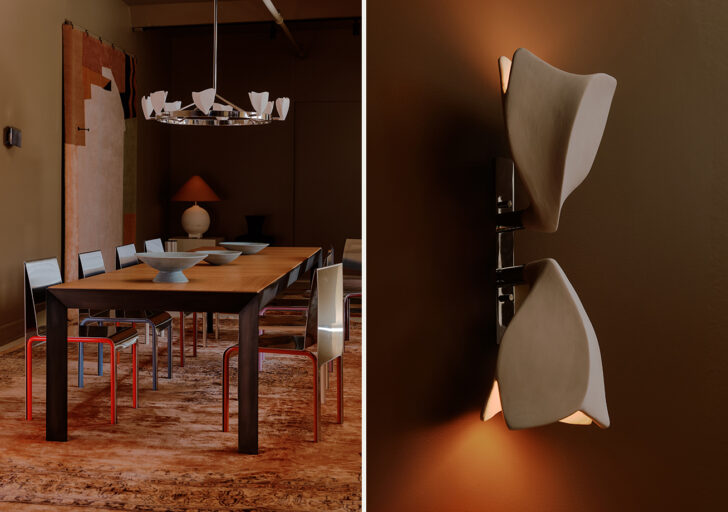
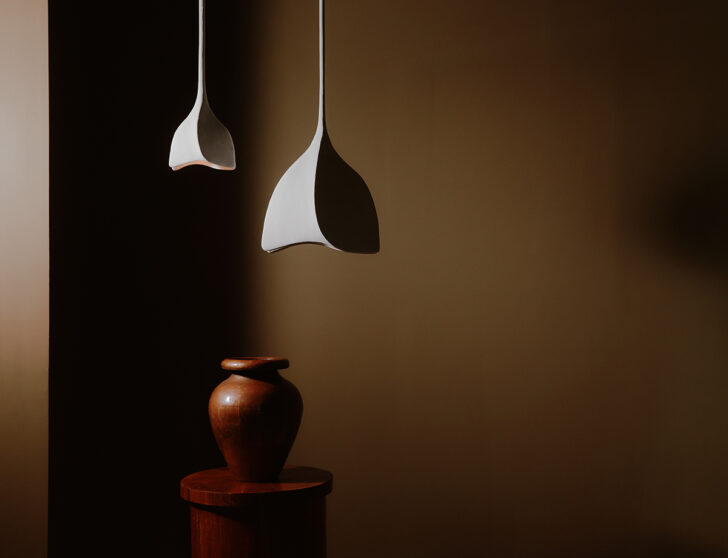
The new Foxglove lighting collection by Danny Kaplan and Kassandra Thatcher pairs plaster botanical flowers with architectural metal accents. Photos: William Jess Laird
When Danny Kaplan first opened his Noho showroom a year and a half ago, he filled it not only with his own designs — ceramic lights and vessels, metal-sheathed chairs, perforated sconces — but also with pieces made by and in collaboration with designers he loved: a beautiful tiled bedroom series made with Vince Patti of Lesser Miracle, a daybed by Thomas Barger, a resin mirror by Joseph Algieri, and a long, linear kitchen-island chandelier hung with plaster-white botanical pockets, meant to resemble the flower known as foxglove. The latter piece was made with the ceramicist Kassandra Thatcher, a longtime friend of Kaplan’s who had once shared studio space with him and had since become a trusted sounding board. That light this week became a full collection authored by Kaplan and Thatcher together, comprising circular and linear chandeliers, single hung pendants, directional sconces, a truly sick mirror, and a tension light that gets bolted into the floor and ceiling and has, as I referred to it on Instagram, major Parentesi vibes.
Foxglove marks the first time both Kaplan and Thatcher have worked in plaster, a material they love for its softness and malleability; it allows them to build “a tactile skin that feels organic and slightly imperfect in a good way,” says Kaplan. But the material I most responded to when I saw these pieces in person was the gleaming stainless steel that gives them a cool architectural edge. The tension light in particular balances hard and soft elements in equal measure, but I also loved the stainless steel hardware peeking out from behind sconces and creating an armature for a rather Arthurian-era chandelier.
These Hammered Aluminum Sculptures Appear, At Times, Like Draped and Folded Fabric
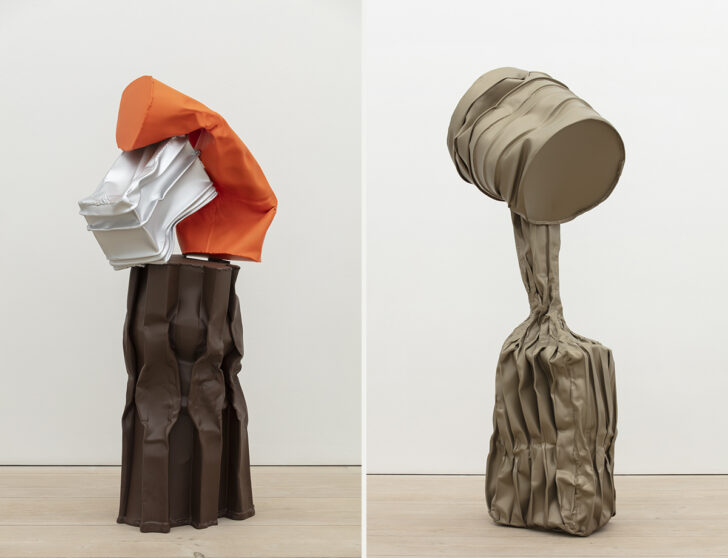
On view at Galerie Forsblom in Helsinki, a series of anthropomorphized sculptures by the German artist and welder Anna Fasshauer
I recently interviewed the designer and welder Hannah Kuhlmann — who makes beautiful, petal-like, powerful lights and furnishings in metal — and we spoke about the difficulties of being a female welder. It wasn’t, she explained, that the work is too dirty or too heavy or too dangerous for a woman, but rather that these are the corrosive ideas that tend to prevail in welding workshops, which are often run by men (and specifically by men of an older generation). It was against the backdrop of this conversation that I was introduced to the work of Anna Fasshauer, a German artist who is currently the subject of a solo exhibition at Galerie Forsblom in Helsinki, and who is among a current cohort of women defying these traditional expectations in metalwork. In a YouTube videoFasshauer made with the gallery a few years ago, she talks about how the constraints of her physical body in fact lend themselves to the making of this work. She uses aluminum because it is light and easily transportable but grows stronger the more you manipulate it, and she uses only her body and a rivet gun to form her sculptures.
These parameters directly impact the look and feel of her work. Each piece is more or less human-sized, but her works feel inextricably linked to the body in other ways as well. The metal is often folded or draped, like an item of clothing; in one sculpture, the top resembles a rubber mallet but the bottom looks like the kind of bustled and petticoated skirt worn by Mary Todd Lincoln, or like a particularly sculptural Issey Miyake garment. Her sculptures are often whimsically anthropomorphized as well, with some appearing like bodies on the verge of a Martha Graham-like interpretive dance. The colorful industrial paint she uses calls to mind the work of Carol Bove, who is also currently in the spotlight. Can we safely call 2026 the Year of the Woman Welder?
Holding Tight and Letting Go: A New Exhibition Explores the Element of Control
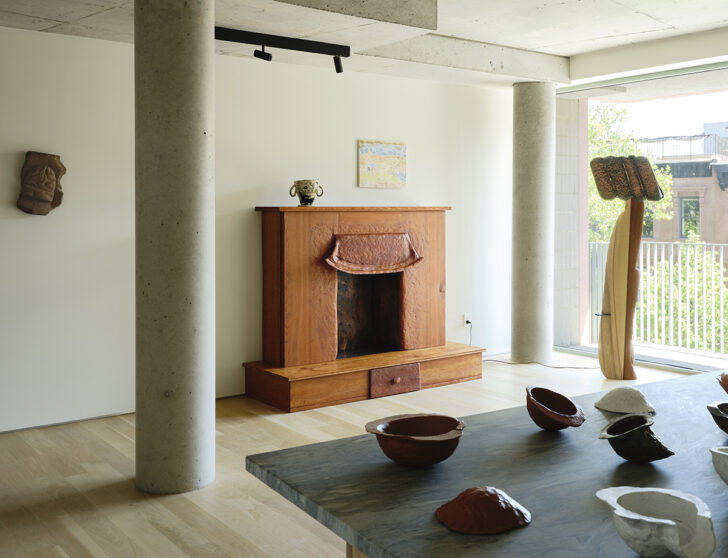
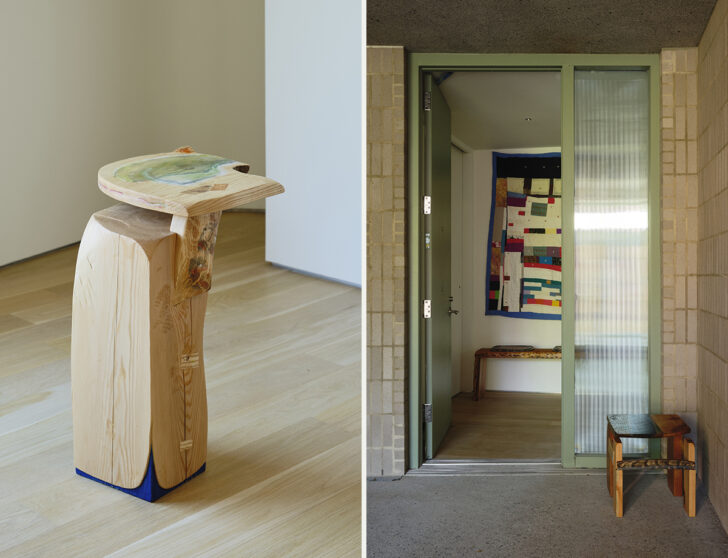
Pieces by Luke Malaney, Mia Morel, and Adam Cutts on view at 144 Vanderbilt this Sunday, as part of the Loose Grip exhibition. Photos: Jack De Marzo
When I wrote an essay last month detailing how Salone has changed and what I disliked about it this year, what was missing was perhaps an explanation of what I do tend to love most about a design fair. If reading Sight Unseen hasn’t taught you what that might be yet, take one look at the exhibition “Loose Grip,” which debuted this week in New York at 144 Vanderbilt, aka South Brooklyn’s pink building. It has all of the elements I love. It was curated by an emerging designer, Luke Malaney, in his first exhibition outing, and it brings together nine fellow creatives with whom Malaney feels a kinship in terms of the way they explore materiality and keep a “loose grip” on their artistic process. The title, Malaney explains, is a “phrase that suggests both control and release. It gestures towards a way of working that is tentative and not rigid, open to variation, friction, and discovery.”
In practice, that means a mix of old and new work, from photography to textiles, all centered around that central idea of working close to a piece but also perhaps allowing it to guide you. There’s a ‘90s-era “stove,” made from wonkily shaped lacquered wood by Richard Snyder, an undersung artist of ‘80s and ‘90s downtown New York. Several pieces are by Malaney himself, including a cherry and bamboo fireplace surround, a painting of a Zamboni, and a series of tables that wash his signature wood and copper aesthetic with deep swaths of color. Quinn Sherman contributed pointillistic landscapes in ink where the frame is as much a part of the piece itself, made from panes of hand-blown glass streaked with colors that result from a fusion with metal oxides and powders such as cobalt, copper, and cadmium sulfide. Ceramics, photographs, and quilts round out the show. On view this Sunday 11-6, and then by appointment only.
Editor’s List
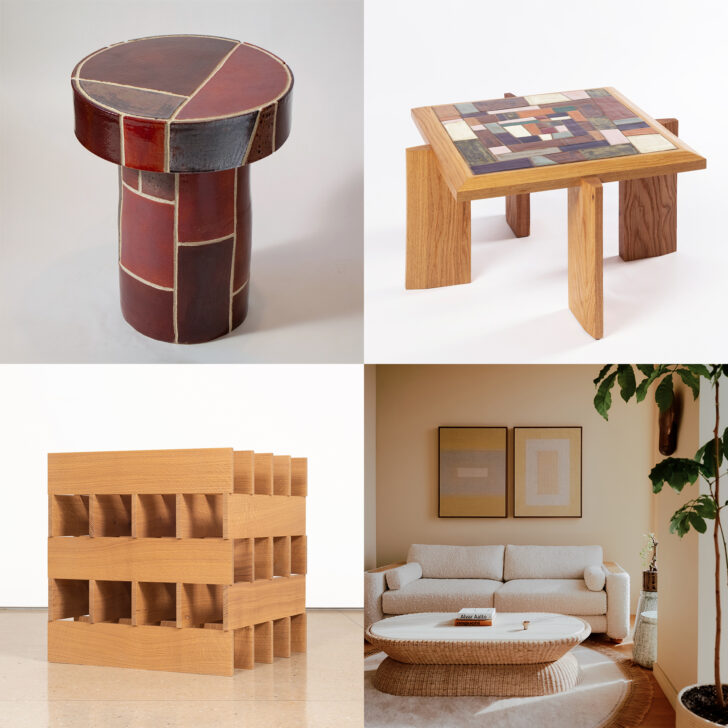
CLOCKWISE, FROM TOP LEFT:
–
Doing a loose grid/mosaic theme in today’s List, starting with this patchwork ceramic table launching this weekend at Afternoon Light by the Brooklyn-based designer Ethan Streicher. It’s part of a larger series called Floor Models, which Streicher will be presenting as if if were part of an everything-must-go liquidation sale.
–
We’ll be covering some of the other presentations at The Future Perfect next week but for now we wanted to highlight these wonderful tables by ceramicist Jane Yang-D’Haene and her late husband, Francis D’Haene, who sadly passed away during the development of this series. It’s the first furniture collection from Studio D’Haene, and it was inspired by a Korean jogakbo, or patchwork textile, that the couple encountered on a husband-and-wife trip to The Met.
–
I’ve always been a fan of Rachel Duvall’s Anni Albers–inspired weavings, and there’s a nice selection of them on view at Radnor Gallery’s new space in the penthouse of Brooklyn Tower. If these new works seem more saturated than usual it’s because Duvall has introduced a painted substrate beneath the woven surfaces, creating tension between the structural underpinnings of the piece and its soft overlayer.
–
On view until May 30 at Volume Gallery in Chicago is a selection of new works by perennial fave Jonathan Muecke. The gallery deploys the word “inscrutable” in the press materials, and that’s a decent descriptor for his work, which is always alluring but never easy to categorize. Unless of course you turned this into the chicest wine rack in existence.
News
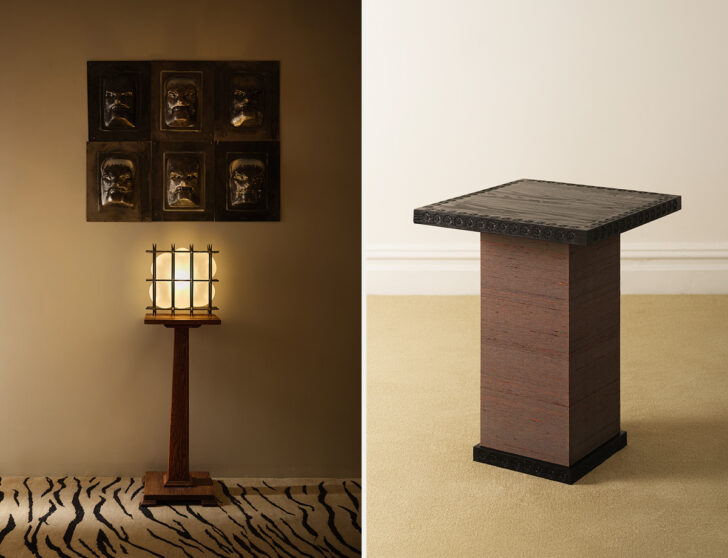
Left: The Wretched Flowers showroom in Soho; right: a side table from Ana Kraš’s Svila collection at Emma Scully Gallery, exploring the different qualities of silk. Photos: Joe Kramm
–
One of our favorite design duos, Wretched Flowers, recently opened a new showroom in Soho (which they share with Monica’s Petra!), and while pieces using their signature beaded chainmail abound, I especially loved this spiky, sculptural lamp having its own little pedestal moment here. By appointment only.
–
Emma Scully Gallery’s spring exhibition features the designer Ana Kraš, whose Svila collection explores how silk behaves in different contexts — in panels under the glass of a coffee table, hanging in front of a bulb that highlights the fabric’s irregularities; and sheathing side tables whose wooden tops have been carved by Balkan artisans in the designer’s native region.
–
This is the first year we can remember that the design and art fairs converge in a single week in New York, so while we may not be bringing you comprehensive coverage of the art scene this week, I did launch a big guide to actually buying art over on my Substack. It scratches the itch!
–
Related: I’ll be speaking at ICFF this coming Monday at 11:30AM with a few of my fellow design editors, in a panel discussion about the state of affairs in design media. Please come by and say hi!