03.19.26
The Weekly
A new design gallery opens in Copenhagen, Ellison Studios pops up in Melbourne, and more
Welcome to the new Sight Unseen, a weekly newsletter that delivers the best of the design world — news, trends, shopping advice, interviews, travel recs, and more — straight to your inbox. If you’re not subscribed, follow this link to sign up. Want to partner with us, advertise, or submit your work (guidelines here)? Email us at hello@sightunseen.com.
In a New Show, Laerke Ryom Approaches Upholstery Like a High-Fashion Couturier
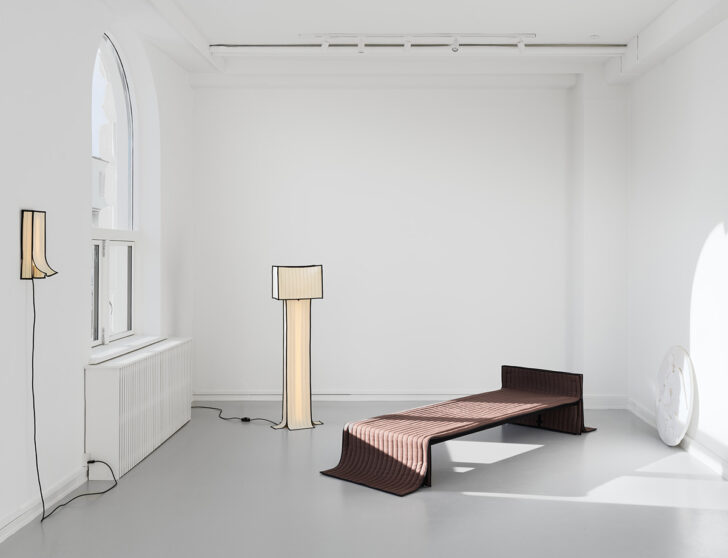
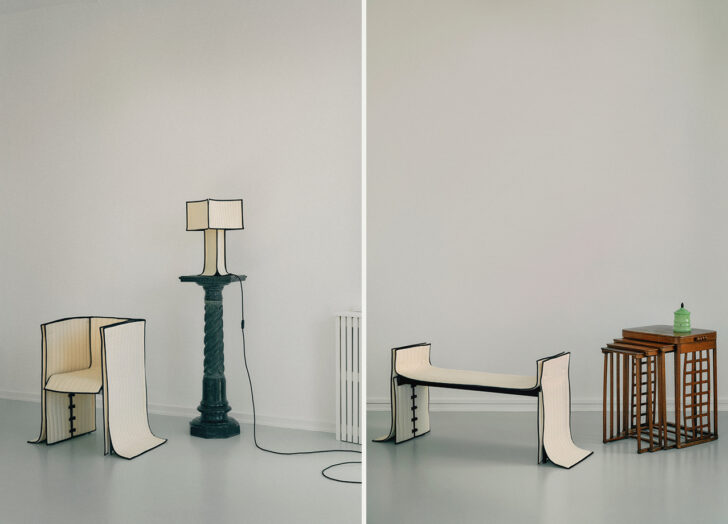
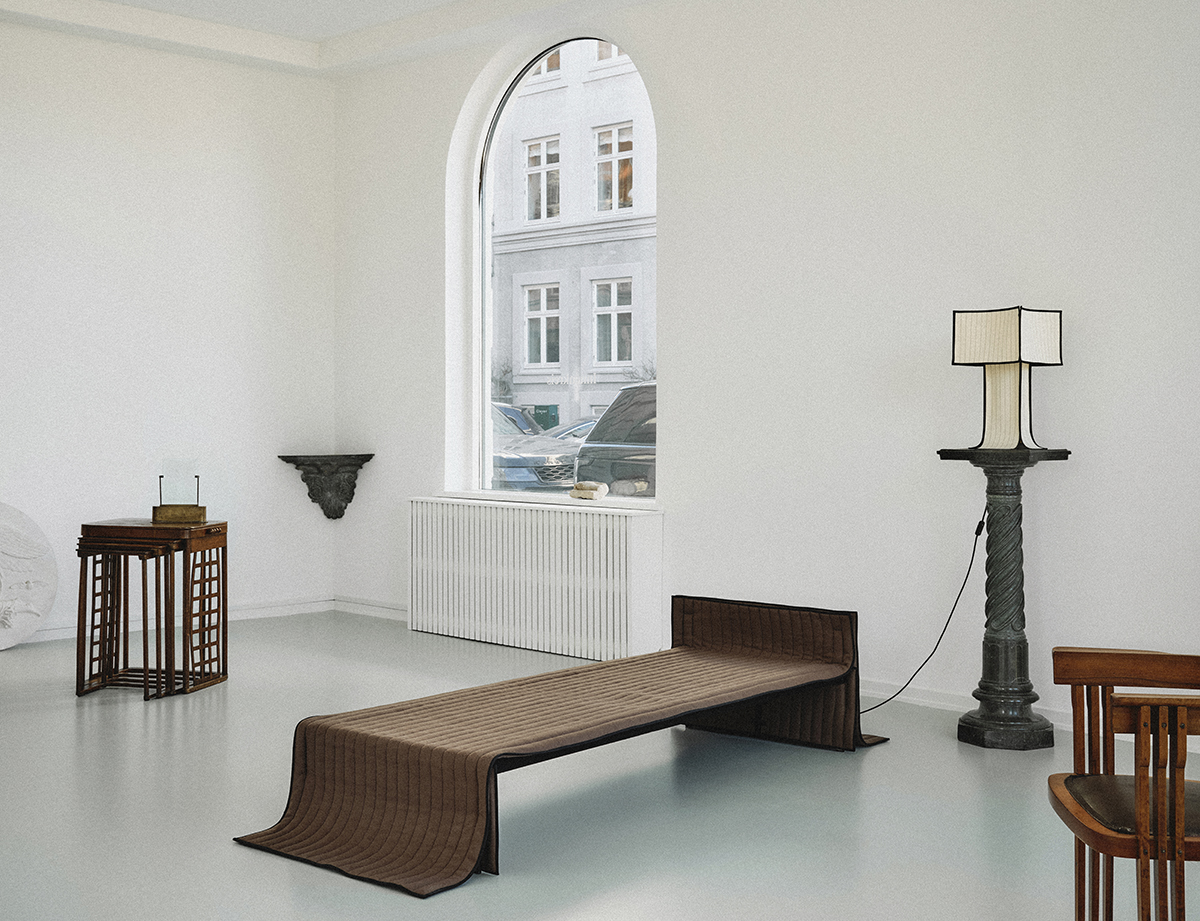
Danish designer Laerke Ryom, whose work challenges our conception of upholstery, is the subject of a solo exhibition at Innenkreis, a new Copenhagen design gallery. Photos: Line Klein
If you were paying attention, there are two pieces in Danish designer Laerke Ryom’s portfolio that might have clued you in to the direction she was headed. The first is a boxy, four-legged chair covered in chocolate brown canvas, its open flaps tied neatly with a ladder of bows. The second is a brick-red leather lounger, fastened with buckles, that the designer made in collaboration with Fredericia; its nearest aesthetic counterpart isn’t another piece of Danish modern furniture, but one of the new crop of bomber jackets by the likes of Khaite or Phoebe Philo. Now the designer is the subject of a solo exhibition at the brand-new Copenhagen gallery Innenkreis, founded by former Étage Projects gallery director Zeynep Rekkali Jensen. Innenkreis is dedicated to presenting functional artworks in conversation with pre-1940 decorative arts, and Ryom’s pieces — situated alongside 19th-century vernacular forms and early works by Josef Hoffman — make for a poetic first presentation.
Like her previous works, Ryom’s new collection, entitled Raiments, uproots our traditional conception of upholstery. Where traditional upholstery uses tension to stretch textiles into a strict form, Ryom works more like a tailor, the cut and drape of the fabric being a key to revealing the structure underneath. For this show, Ryom made six original works: three seats and three lights dressed in Kvadrat wool, ranging from a piano bench to a sconce. Each piece features a hand-stitched quilted pattern with contrast piping; the seats’ textiles are buttoned on the underside and each panel ends in a slight flare. The whole effect is very fashion, but Ryom was thinking more about chafing against the rules of modernism than chasing runway ideals when designing her collection. “I was educated within the language of Danish functionalist Modernism, where structure is often seen as truth, and textile as ornament,” says Ryom. “My work suggests a shift where softness is not surface, but substance, and where textile and frame meet as equals.” Through May 23.
Ellison Studios’s First Pop-Up Space in Melbourne Channels the Spirit of a Hotel Lobby
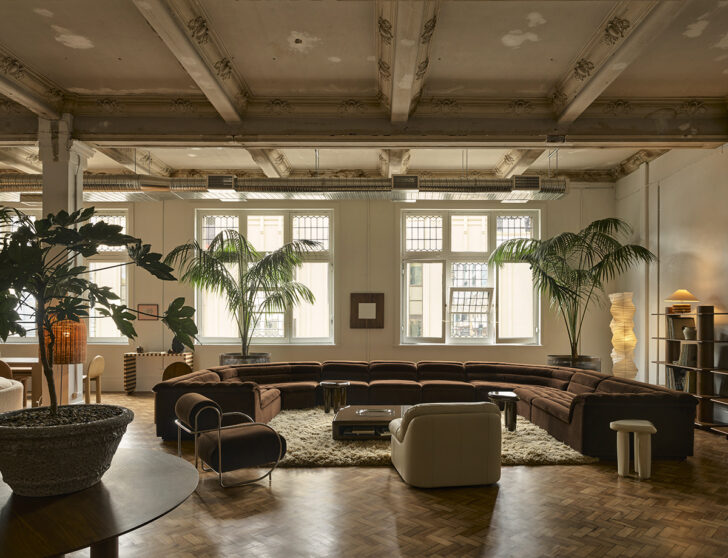
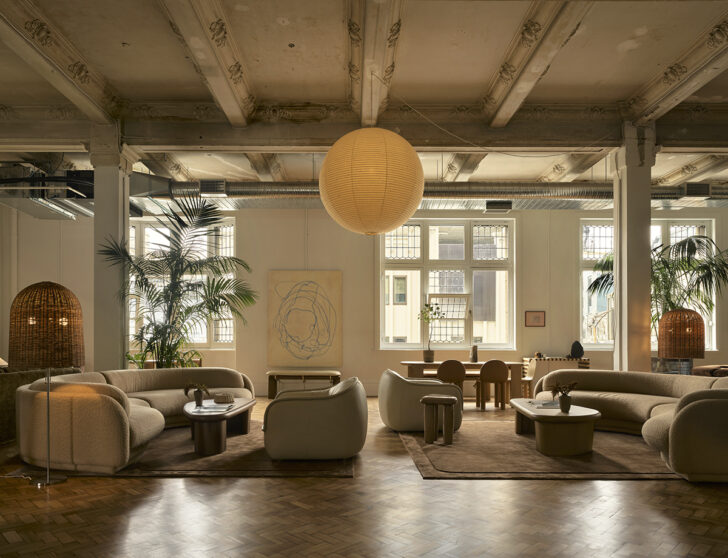
Inside The Lobby, a new temporary showroom for Ellison Studios in Melbourne. Photos: Anson Smart
What is a design showroom if not a place to sell clients on a vision of their best life? The most inventive showrooms don’t merely sell furniture, they sell you on a dream of what living with those pieces could be. In New York, at a place like Quarters, the dream is sumptuous; you can immediately envision a state of permanent luxury, greased by saturated neutrals and velvets. At Astraeus Clarke, the vibe is louche, sexy, and dark — a permanent after-party. In Australia, no one is creating aura better than Ellison Studios, who — after two successful spaces in Sydney, including a now permanent showroom — have popped up in Melbourne with a new temporary space called The Lobby. The vibe here is comfort and ease, lightness and fun — a place to host clients and discuss upcoming projects by day and listen to records, knock a few back, and shoot pool by night.
The Lobby is set inside the historic retail floor of a former Melbourne department store built in 1914 and originally designed by Tompkins and Tompkins, meaning there’s a kind of gracious hospitality in the spaces’ bones. Ellison Studios plays with that, envisioning their ideal meeting point as a hotel lobby whose atmosphere is charged with the coming and going of guests. The focal point is a gargantuan, 15-seat version of the studio’s iconic chocolate-brown Float sofa (their largest configuration to date), and it’s surrounded by more intimate nooks as well as dining areas that double as desk space. Art comes courtesy of Sydney’s Hake House, and a collection of rare books is curated by Melbourne’s Selected Objects. A chic selection of hotel-style merch — from branded key rings to stationery to matchbooks — completes the look. “There’s something universally relatable about that in-between, transitional space of a hotel,” says director Leigh Mckeown about the decision to frame the space in lobby terms. “It’s not quite public and not quite private. There’s a voyeuristic nature to it that I’ve always loved.” Check-in beginning this week.
Georgia Somary’s Veiled Memories Inform a Debut Collection Full of Chainmail and Mystery
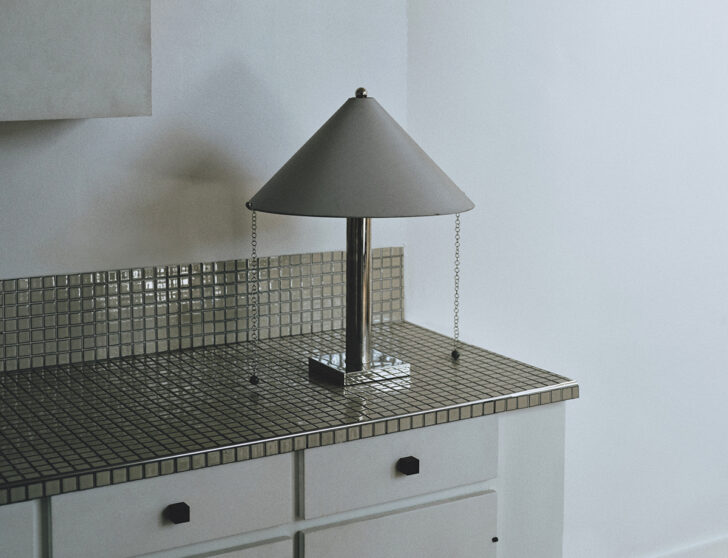
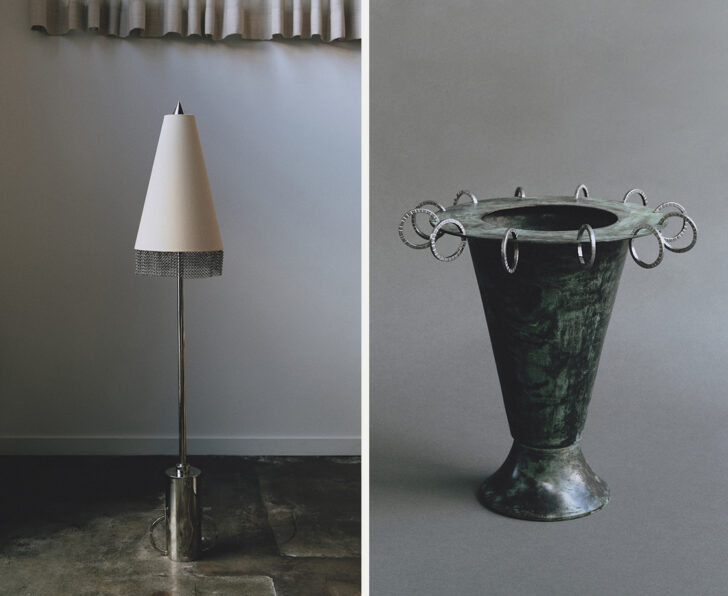
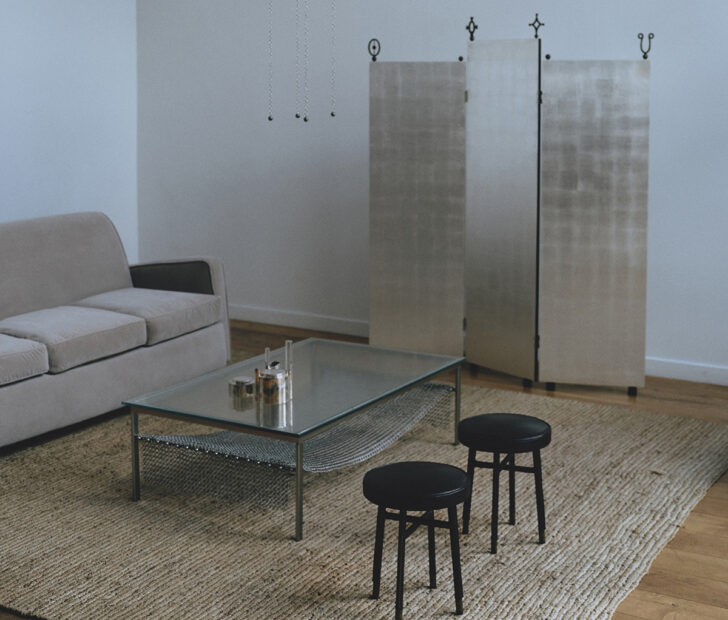
Georgia Somary’s stint as an armourer inspired a 14-piece debut furniture full of chainmail and mysterious symbols. Photos: David William Baum
Before she began her interiors and furniture practice, the British-born, LA-based Georgia Somary of Earl Grey Studio worked at an armory, restoring historic weapons for use as props on film sets, or for private collectors. “My time at the work bench was often rooted in fantasy, or a loose retelling of the past,” the designer recalls. “I’ve never had the greatest recollection, but I’ve also always had an intense interest in history, anthropology, and archaeology — subjects that are in conflict with a cloudy memory. It makes for some vague and often muddled thoughts: images of places lost, the words of people long dead, objects once found in the sand, and the crumbling ruins of once grand cities. They all conflate and split, and my dreams are filled with wonderful mis-remembered historical inaccuracies.”
For her debut furniture collection, which launched last week in Los Angeles, Somary wanted to harness that incapacity for total recall as a source of power, a way to approach design through the lens of veiled memories rather than via reference images. “I worked with what felt right — nothing quite accurate to a ‘true’ time, or place, or period, but still familiar, making the conceptual process seem like a great internal unearthing.” The result is a 14-piece collection with one of the strongest points of view we’ve seen in recent memory. Chainmail drips from sconces and swings underneath a coffee table, lending static forms a beguiling sense of movement; mysterious symbols sprout from a silver-leaf folding screen and the sides of an incense burner. Sometimes, in the case of a brushed-steel chandelier with Medusa-like swirls and a central stem that points like a dagger, the forms become almost menacing. The collection both taps into recent design trends and pushes them forward. It explores themes of protection and concealment. And it’s also, frankly, gorgeous.
A Surrealist-Inspired Table, By Eight Female Artists on the Rise
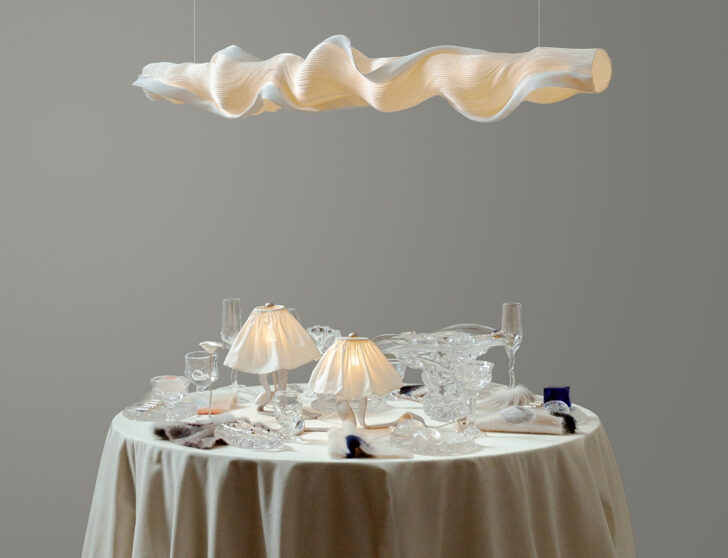
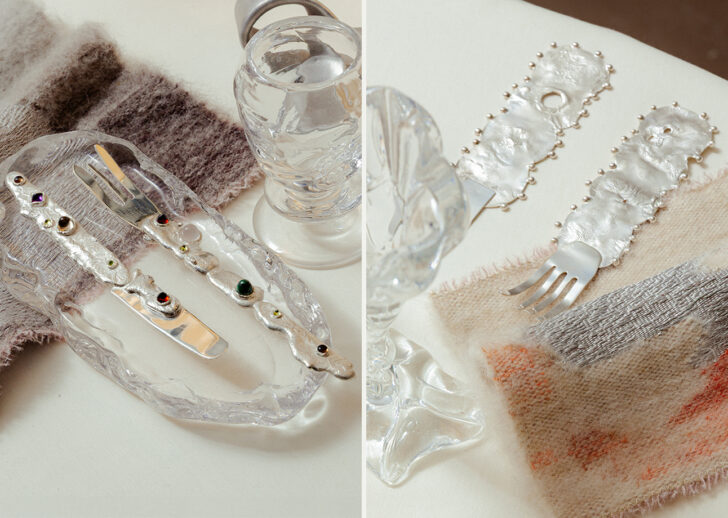
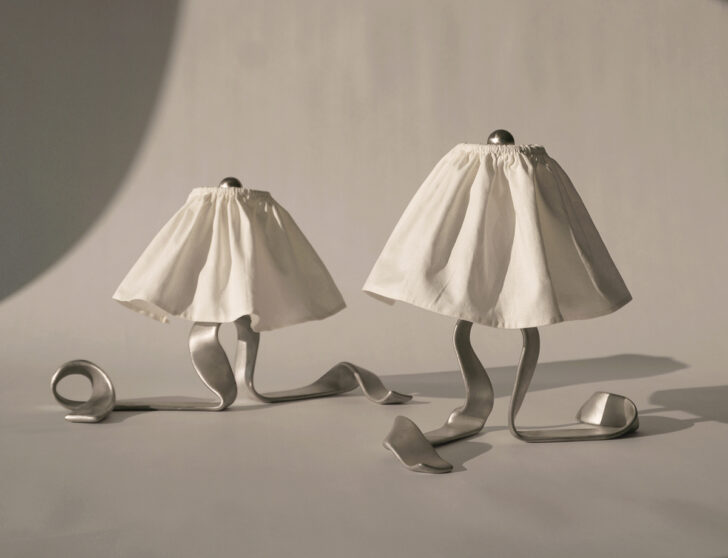
Szklo Studios presented a Surrealist-inspired tablescape at Collectible in Brussels, featuring works in glass, metal, and textiles by eight emerging female artists.
Collectible in Brussels closed this Sunday, and one of the standout exhibitions from the fair was curated by Aleksandra Zawistowska of the Warsaw-based Szklo Studio, who asked eight emerging female artists to create objects for a Surrealism-inspired tablescape. Karolina Pawtowska of Karla Studio made egg cups and spoons that sat atop slim silver rods ending in a flourish of petals. Basia Pruszyńska made a duet of lamps, with hand-sewn handkerchief shades paired with cast aluminum bases in the shape of twisted ribbons. Dutch designer Lindsey Fontijn created six unique sets of cutlery — one was shaped like sterling silver ribbons set with lapis lazuli gemstones, and in another, the handles were almost flat, surrounded by tiny globs of metal. Zawistowska contributed slumped serving platters in hand-blown glass, and a champagne glass anchored, Meret Oppenheim–style, by an explosion of upcycled fur. Dominika Gacka and Julia Piekarska of Rest Studio wove delicate textiles from alpaca, mohair and silk. And Marlou Rutten and Marieke van de Ven made a 3D woven lamp in paper yarn to cast a glow over the proceedings. “Early Surrealists rejected rigid intellectual frameworks in favor of instinct, intuition, collective action, and new forms of communication,” says Zawistowska. “This installation reflects on the idea of curating common moments — creating a space where multiple individual practices coexist, overlap, and converse — while allowing each participant to retain their own voice. The table becomes both a stage and a meeting point: a place for encounter, imagination, and unexpected relationships.”
Editor’s List
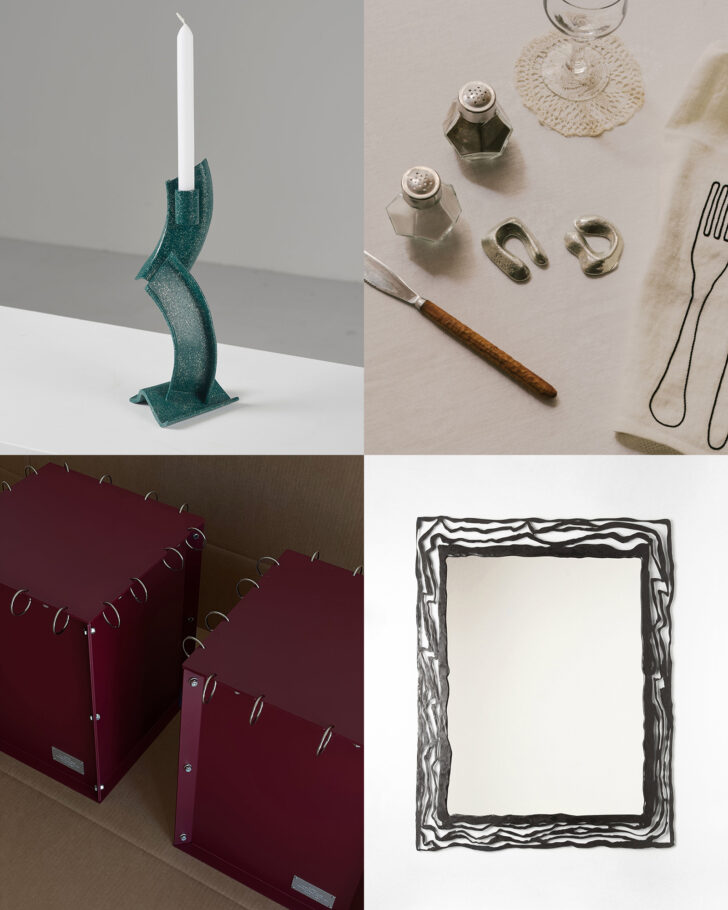
CLOCKWISE, FROM TOP LEFT:
–
I went through a real speckled phase a few years ago, so this ceramic candleholder by Pierre Castignola is both nostalgic and appealing. Castignola made each one in the series by molding segments of a plastic lawn chair in plaster and recreating them in clay.
–
Slightly superfluous but beautiful tableware is one of my favorite categories, so no wonder I’ve been drawn lately to knife rests. When I was doing a recent pewter deep-dive for my feature on Domino’s Home Front, I came across these beautiful ones by French artist Léa Bigot, sold on the website of fellow artist Sarah Espeute. The glass rests by Justine Ménard are also lovely.
–
I’m kind of into this patinated steel portrait mirror, made by London fashion designer Rejina Pyo in collaboration with the Edvard Munch Museum and the National Portrait Gallery; its erratic wavy lines were inspired by the painted borders in many of Munch’s iconic works. Does this mirror look even better reflecting a gorgeous row of painted tiles, like in the campaign imagery shown here? Yes, it does, but it would be a great addition to any bathroom with a little pizzazz.
–
Because I featured that vase by Georgia Somary up top, with the rings around its lip, I thought it would be fun to also show you this new table by the Swedish-American design studio Okej. Are rings a niche new micro-trend? You’re meant to hang things from the ones on Okej’s table, like a keychain, which renders the whole motif a bit more kitsch, but as they say — three’s a trend, so DM us if you spot another!
News
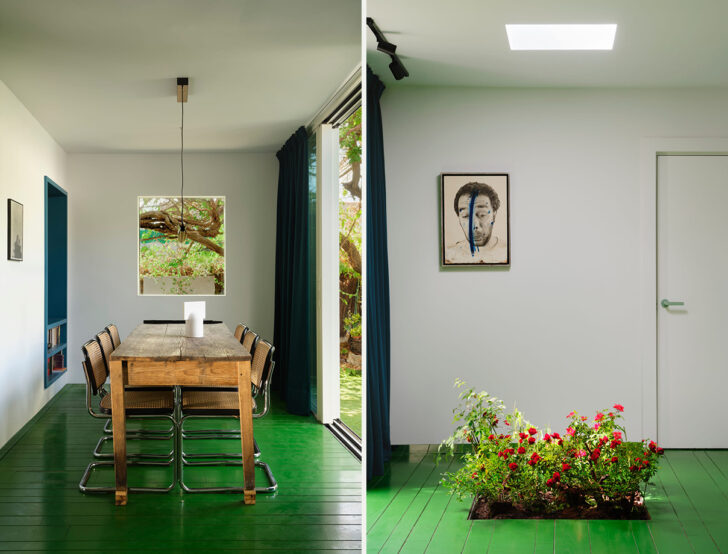
A Madrid renovation by David Pastor brings the garden inside — literally. Photos: Germán Saiz
–
This Yellowtrace article on a colorful Madrid renovation by David Pastor introduces two décor concepts that I’m obsessed with. The first is painted green floors — self-explanatory. The second is a mysterious garden void, a square plot of soil cut into the floorboards, erupting with flora. How is this achieved? Is the house not built on a foundation? Are there are no basements in Madrid? The Yellowtrace piece doesn’t address this at all, which is crazy! I need some investigative journalism! And then a service how-to regarding how to incorporate this into my Greenpoint high-rise.
–
Since this newsletter references the link between furniture and fashion, I must ask: Did anyone else catch the Hodakova show, where models were wrapped in antique rug–like skirts and shawls, wearing chairs as a kind of armor?
–
My jaw dropped to the floor when I saw the Shifted Rubber Pink, 001 light by Brian Thoreen on Instagram earlier this month. Thoreen has been making furniture in rubber for years now — in fact, his first show was with Sight Unseen in 2015 — but I’ve never seen rubber look so ethereal. If I had money and space for a giant rippling pink light, this would be my first purchase. (A really nice studio visit with Thoreen also dropped this week!)
–
The Kawai Kanjiro house in Kyoto was top on my list of things to visit during my first trip to Japan in 2024, but it was closed for the holiday week I was there. Perhaps the next best thing is the current exhibition at The Japan Society in New York of works from the folk potter’s personal collection, rarely see outside the confines of the Kyoto house. On view until May 10.
From the Collection
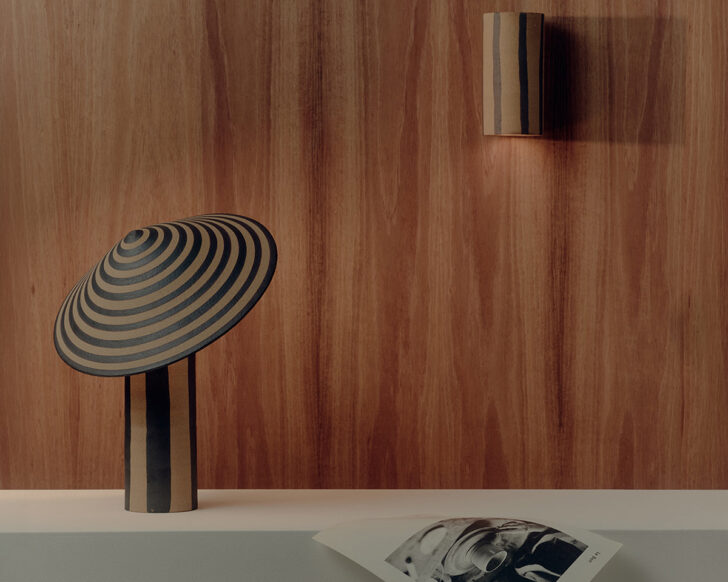
DANCER TABLE LAMP BY COCO FLIP
The Dancer table lamp, designed by Coco Flip with Melbourne-based ceramicist Belinda Wiltshire, takes inspiration from the Triadic Ballet by Bauhaus-era designer Oskar Schlemmer. Schlemmer’s ballet used fantastical, lampshade-like costumes and strong geometries to emphasize the dancers’ physicality. Here, Wiltshire’s use of black iron oxide stripes, available in varying widths, echoes that sense of movement. Each piece is wheel-thrown, hand-finished, and fired using warm brown clay and brushed with black iron oxide, available in three striped finishes — wide, thin, or spaced. Find out more here.
Jobs
Nurture by Nature, an interior design studio and gallery in Burlington, Vermont, is seeking an intern to work remotely
House of Honey is seeking a full-time interior designer to work in Los Angeles
Ringo Studio is looking for a senior architecture designer