09.25.26
The Weekly
How does an artist live? A new exhibition shows us in Technicolor detail
Welcome to the new Sight Unseen, a weekly newsletter that delivers the best of the design world — news, trends, shopping advice, interviews, travel recs, and more — straight to your inbox. If you’re not subscribed, follow this link to sign up. Want to partner with us, advertise, or submit your work (guidelines here)? Email us at hello@sightunseen.com.
Inspired by Vintage Frames, Lynda Keeler Painted Her Newest Series From the Outside In
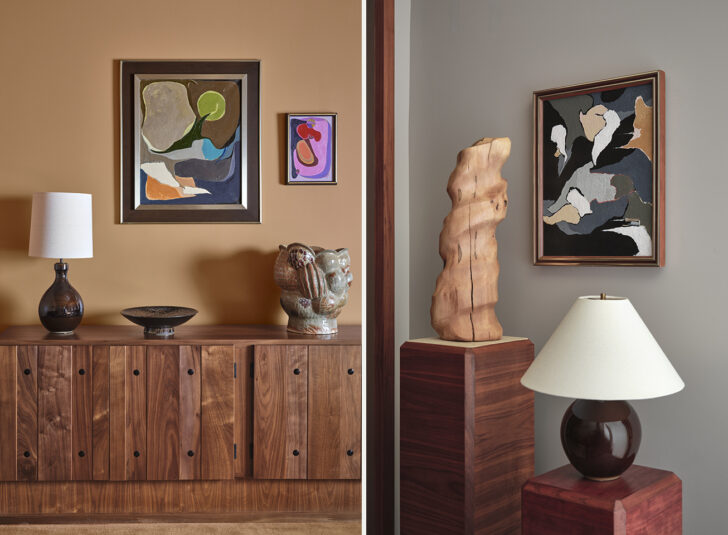
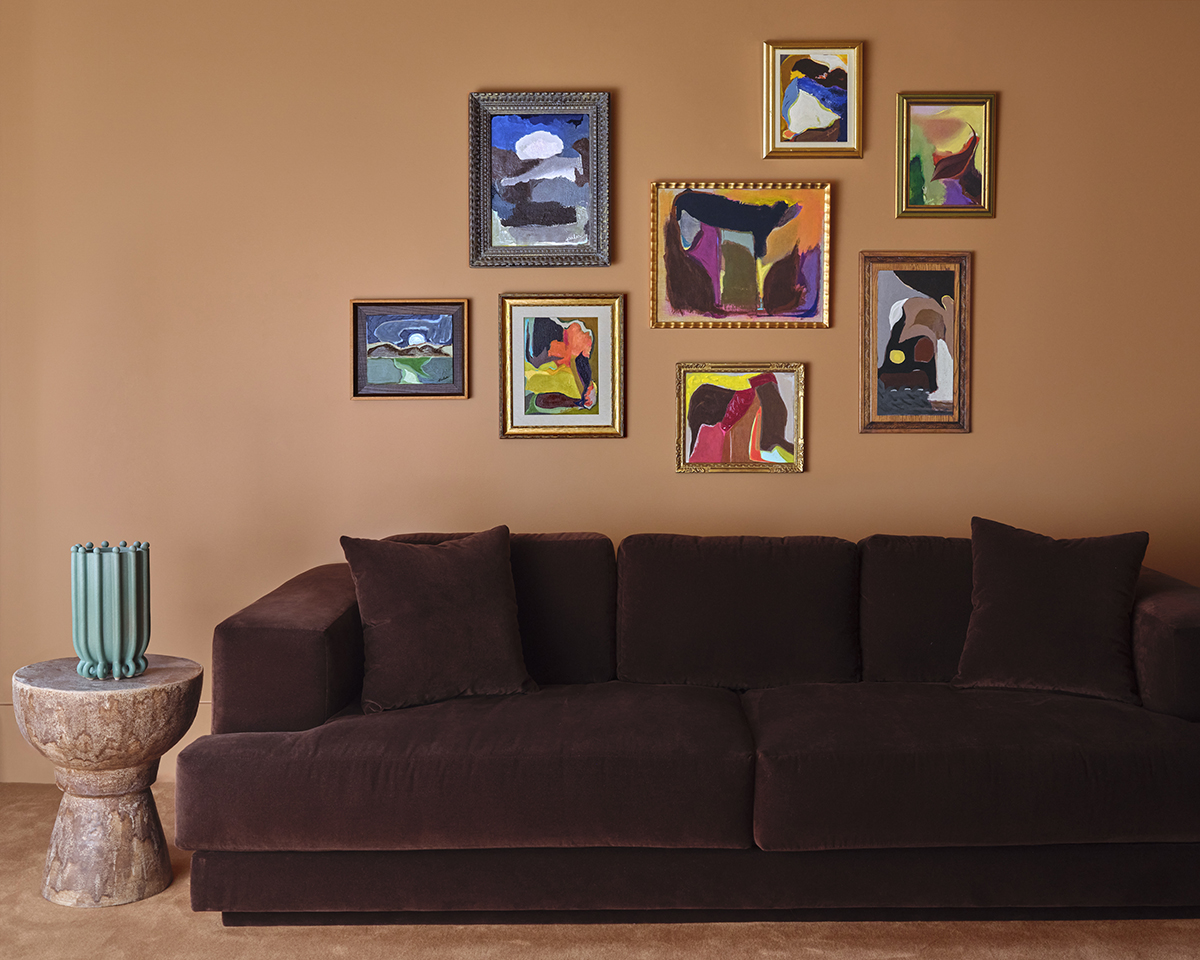
Guided Forms is an exhibition of paintings by Lynda Keeler on view at Lawson-Fenning in New York through October 30, curated by Rhett Baruch Gallery and creative directed by me (Jill)! Photos: Alexis Salas
When she was a child, the artist Lynda Keeler’s parents often traveled the world but never took Keeler or her brothers with them. Instead, they’d give the children maps of their destinations, so they could follow along at home. Keeler’s subsequent love of cartography goes so deep that when she became artist later in life — going back to school for her MFA at the age of 55 after a career as a Hollywood exec — Keeler’s paintings focused primarily on mapping. Not in a literal sense, of course, but more like a document of how it feels to metabolize the world around you. Based between Los Angeles and Palm Springs, she’d take daily walks with the dog and return home to translate the colors of a jacaranda, the shifting roofline of a mid-century remodel, or how it felt to watch grass struggle to pop through a crack in the asphalt. “I was interested in mapping my neighborhoods, but not in a typical grid and streets way,” says Keeler. “When you’re walking the same routes, you see changes. People are painting their houses, they get a new car, it’s getting hotter earlier, people are planting gardens with a different aesthetic because there’s less water. To me, that was interesting because in the bigger picture, politically and environmentally, things were changing.”
For her latest series of paintings, however, Keeler started from a different place. For years, she’d been gathering vintage frames from thrift shops and Facebook marketplace, and for Guided Forms, an exhibition at Lawson-Fenning in New York — curated by Rhett Baruch Gallery and myself! — she used those frames as a guide. Carved wood, gilded surfaces, gleaming chrome, and unexpected colors inform the palette, composition, and character of each painting as does Keeler’s secret weapon: “I have probably 200 bottles of nail polish,” Keeler laughs. “The shiny sections, the ones that have a high gloss, are typically Essie or OPI. The colors are just spectacular.” On view through October 30.
Studio Carefree Developed a Collection of Modern Matrimonial Objects Over Their First Year of Marriage
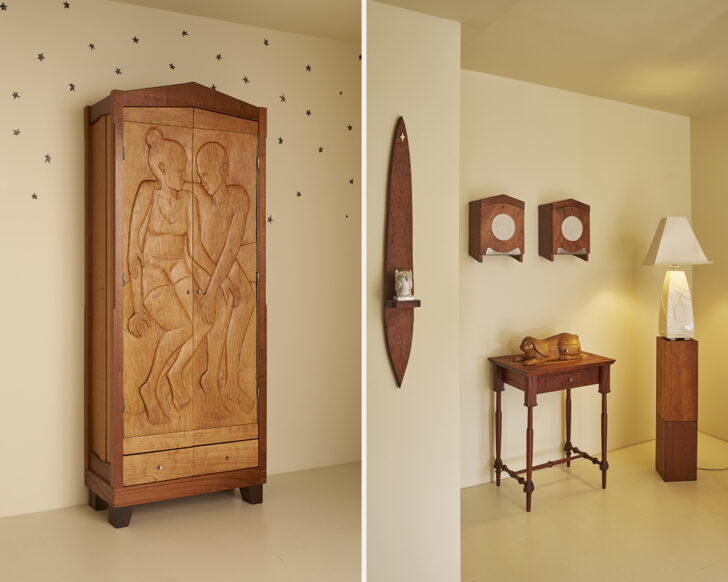
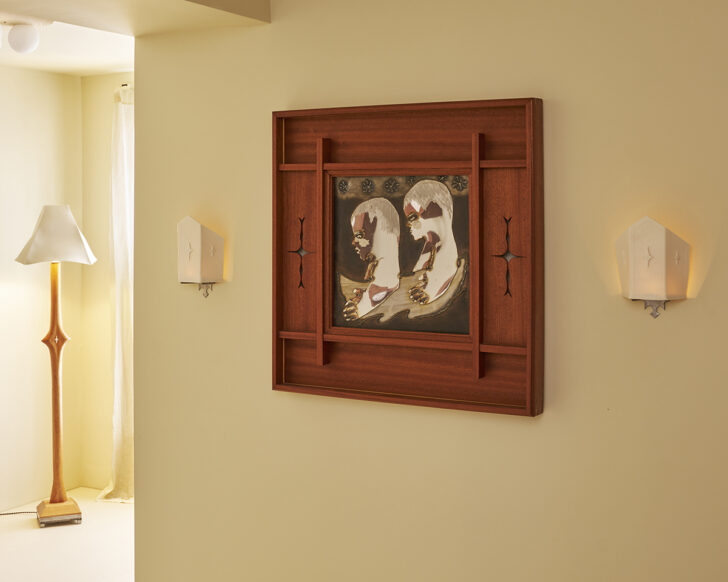
At Piscina’s revamped Red Hook showroom, Studio Carefree is showing a new body of work inspired by its founders first year of marriage.
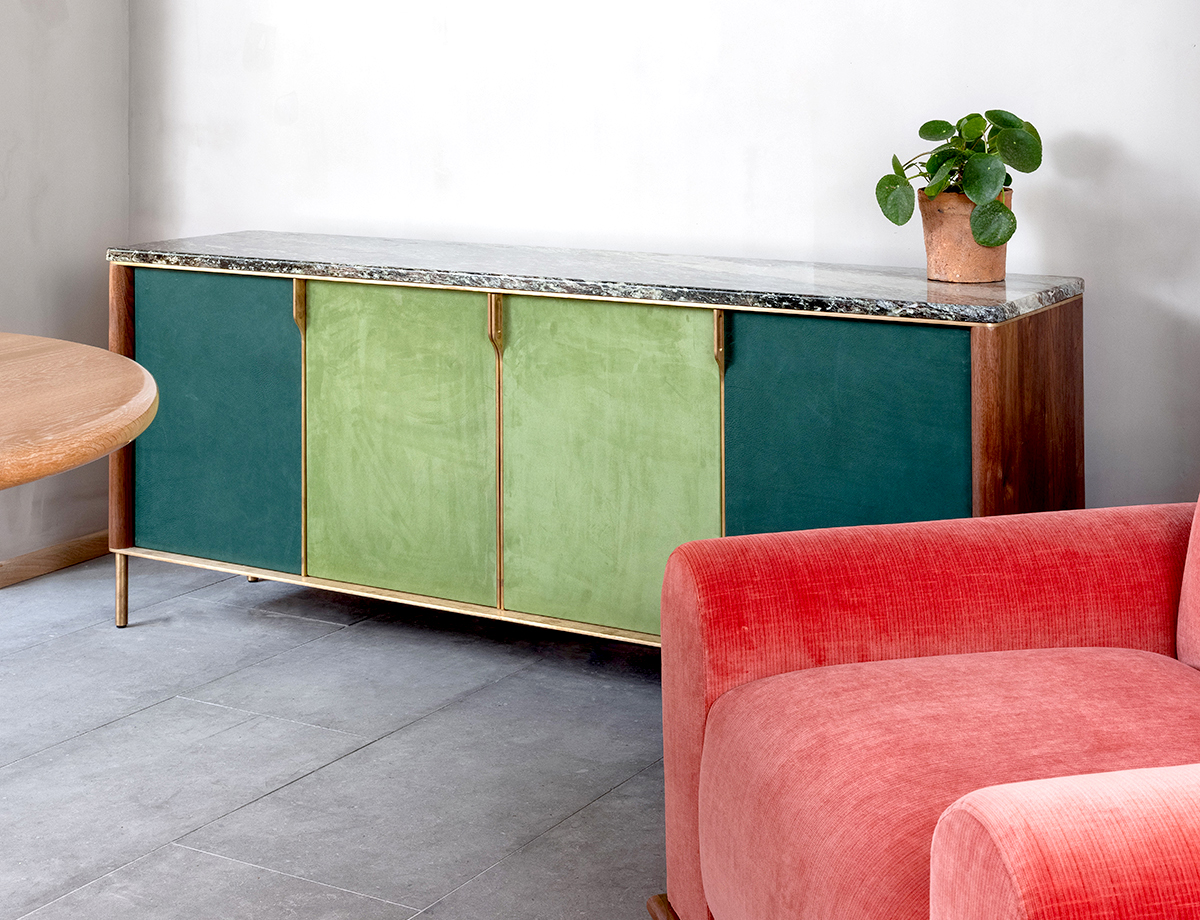
Is the first year of marriage the most generative prompt in design? I’d argue so on the basis of the fact that there are two exhibitions opening this month in New York that take wedded bliss as a jumping-off point. The first, by Sunfish, I wrote about on Curbed this week; that exhibition opens at Assembly Line Annex next month, so stay tuned. The second we’re featuring here today, and it’s the work of two names who were new to us: Caroline Doyle and Free Tripp of the Brooklyn-based Studio Carefree, whose exhibition, “Anniversary,” opens at Piscina’s newly revamped showroom in Red Hook this week. Anniversary draws upon the traditional furniture typologies of union: a cabinet in which to hang a wedding dress, ceremonial candle sconces, a daybed, a carved rabbit table with a drawer for rings, and two sapele and steel lockers, which are perhaps the modern-day design equivalent of a Filofax for love letters. The pieces use traditional materials and methods — cherry and sapele woods fused with old joinery techniques, aluminum and steel, English porcelain reliefs — and yet the effect is quite modern. You might say it’s almost exactly like a 21st-century couple navigating the age-old custom of matrimony.
Five Highlights from the 2026 London Design Festival
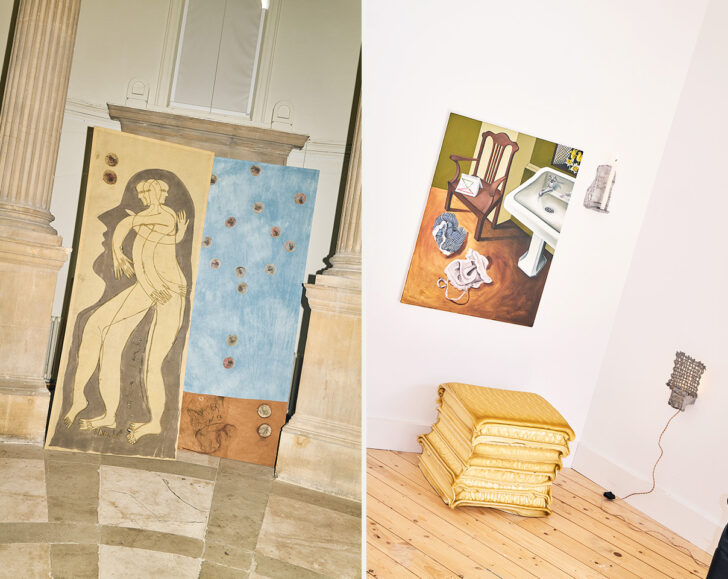
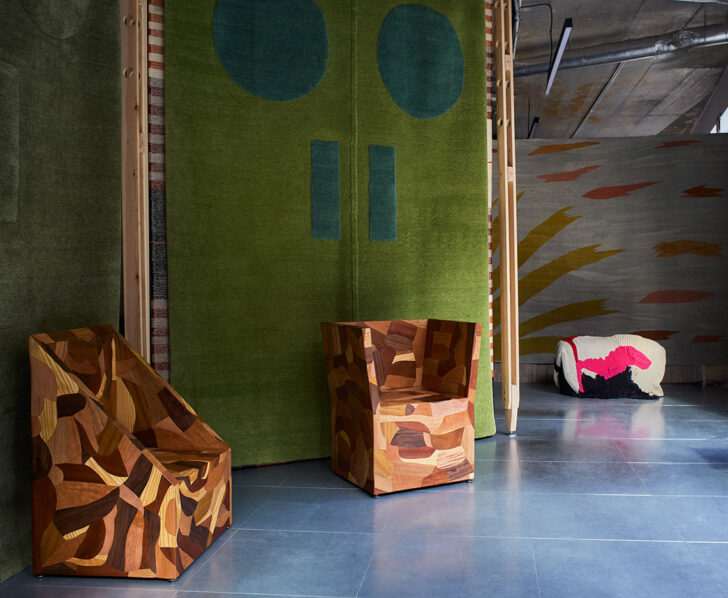
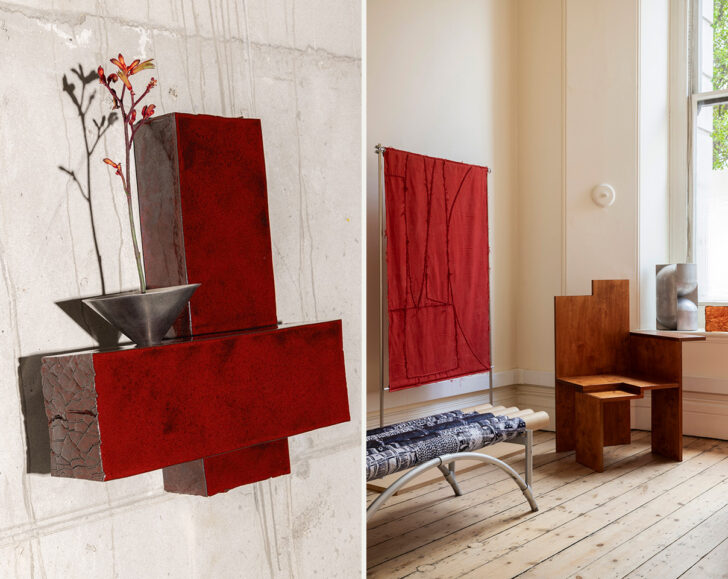
Top: Brompton Cemetery Chapel with scenography by Fiona Campbell and Anousha Payne (left) and a Reading Room with stools by Nicolas Zanoni and paintings by Zach Toppin (right). Middle: Max Radford Gallery x Christopher Farr (photos by Edward Rollitt). Bottom: Hanging Baskets and You Can Sit With Us (photos by Slancha and Megan Taylor)
It can be hard for us to assess the London design scene considering how long it’s been since we spent a good chunk of time there; our last official visit was when Sight Unseen showed at the London Design Festival in 2017, if you can believe it. To the outside observer, it’s appeared as if the annual design fair has lost its footing in recent years, which is why I was especially heartened to see articles like this and this covering the 2026 edition. I’d love nothing more than for LDF to feel as electric as it did in earlier eras, spurred on the young talents who continue to flow to the British capital. Here are five of our favorites who brought the juice this year.
The Brompton Design District, curated by Alex Tieghi-Walker, was again a high point, featuring new work from RCA grads, installations by favorites like Jesse Butterfield, and two major installations we loved. The Reading Room, conceived by Tieghi-Walker and dedicated to queer design and cultural history in London, included objects by designers like Nicolas Zanoni and Tino Seubert, paintings by Zack Toppin and Henry Svendson, and a selection of books by Soho’s Tenderbooks. And the Brompton Cemetery Chapel transformed into a performance space for opera, by Ushara Dilrukshan and Sonnie Carlebach, with scenography by Fiona Campbell and Anousha Payne.
In Shoreditch, Max Radford Gallery teamed up with Christopher Farr to present a series of work by regulars like Carsten in der Elst, Lewis Kemmenoe, Tessa Silva, and LS Gomma against a backdrop of historical textile designs from Anni Albers, Gary Hume, Gunta Stölzl, Louise Bourgeois, and Romeo Gigli. Elsewhere, the interior design studio 2LG curated another edition of You Can Sit With Us; we were particularly taken by this vignette, with a chair by Mara Bragagnolo, table by Studio Brocky, lamp by Hanna Fastrich, bench by Yakubu Paul, and textile by House of Quinn.
Finally, the contemporary design studio and gallery Slancha invited 10 designers to reinterpret the hanging basket; my favorite was this wall-hung piece by Hanna Fastrich, which criss-crosses two ceramic slabs and drenches them in a glossy red glaze. Til next year!
A New Exhibition Captures the Life of an Artist at Home
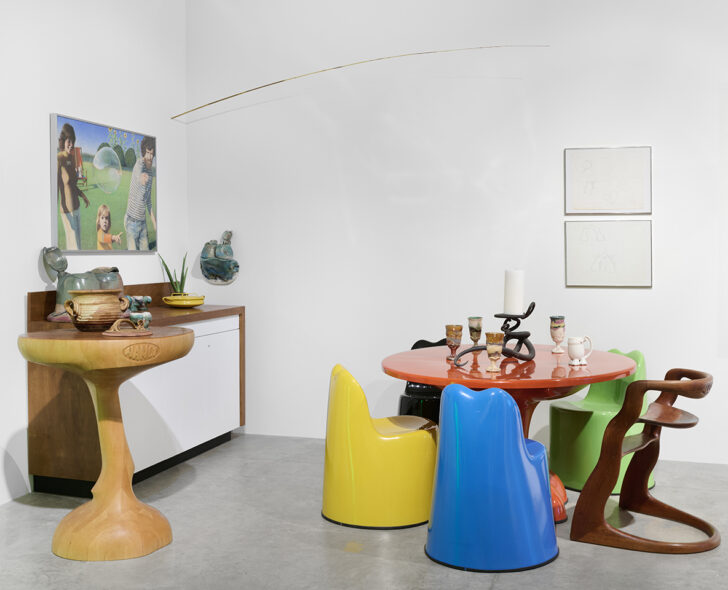
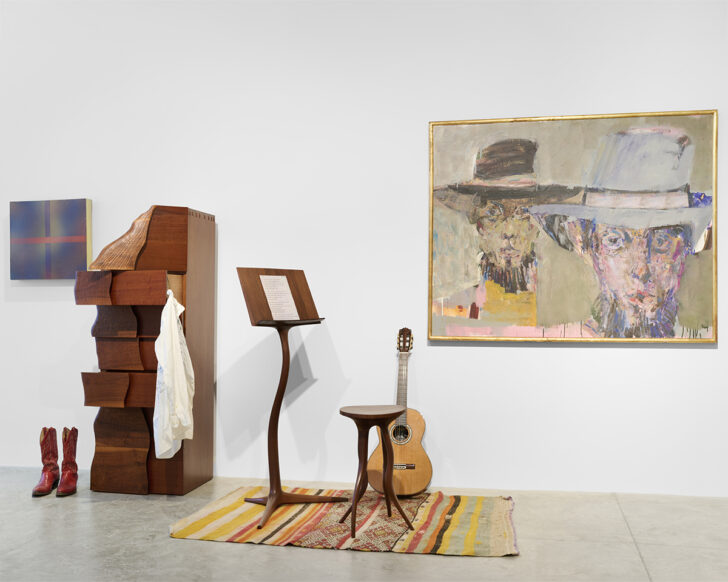
A new exhibition at Friedman Benda in New York attempts to recreate the art-filled, early 1970s home of Wendell Castle and his wife, the ceramicist Nancy Jurs. Photos: Izzy Leung
In the entrance to a new exhibition at Friedman Benda in New York, which attempts to recreate the art-filled home of the late artist and sculptor Wendell Castle and his ceramicist wife, Nancy Jurs, there’s a text by the couple’s daughter, Alison, who curated the exhibition: “For the first years of my life, I lived in a soaring, art-filled loft in a converted bean mill, with my father’s workshop and my mother’s ceramics studio on the floors below. It was a lovely home, full of joy and creativity and the fruits of my parents’ practices. I didn’t know that my house was unique, but I knew that it was magical.” The family moved from that Scottsville, New York, home when Alison was six, and for years she tried to reconstruct it in her memory. A few years ago, she came across a 1973 House Beautiful article, in which the Castles’ home had been captured in its original glory. That article became the catalyst for this exhibition, which turns the canonical artist into something far cozier.
There are many things to be expected in “Wendell Castle: Living”: a table encircled by Castle’s fiberglass Molar chairs; a large wooden bench that unfurls like Maleficent’s cape; an instance of his iconic 1969 neon Benny light. But there are also jaw-dropping artistic feats on loan from the family — like a door that’s been hand-carved with rivulets of wood and a bed whose headboard curves around to form a child’s desk — and familial ones, too. You see how Castle liked to carve his loved ones’ names into the furniture — Alison’s appears on the back of a wavy-legged high chair (which I christened “a fully freaked Tripp Trapp”), while Nancy’s is etched into the side of a high kitchen table that appears to have once doubled as a cutting board. Personal touches abound, like sheet music for a folk song Castle was learning on guitar, and tureens and goblets by Jurs. Regardless of whether you’re a fan of Castle’s work, it’s a treat to see it in this context. Through October 17.
Editor’s List
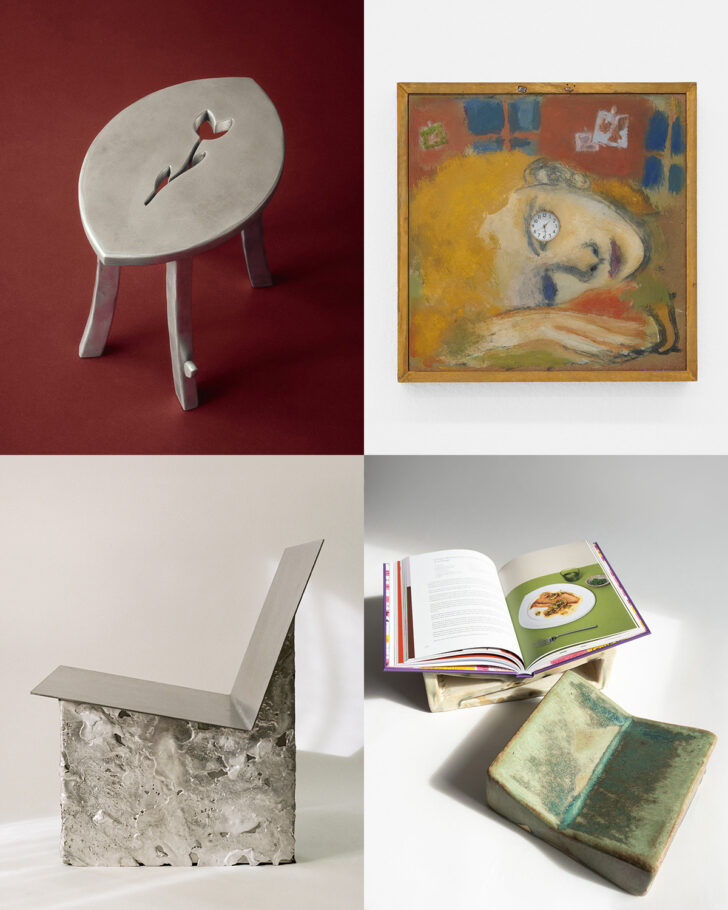
CLOCKWISE, FROM TOP LEFT:
–
The designer Basia Pruszyńska grew up in a small Polish town, studied at Design Academy Eindhoven, and moved to New York to work in the studio of Giancarlo Valle. Her first solo exhibition, at Objekt Gallery in Warsaw, is called Polecie, an Old Polish term for the period between summer and autumn. But it could describe any number of hazy in-between states — between her homeland and New York, folk art and industrial design, even a hard metal stool whose legs are meant to resemble the soft stalks of a plant.
–
Eddysroom was a gallery that operated in Greenpoint between 2015 and 2017, run from a spare coat closet in artist Austin Eddy’s apartment. Through October 31, the Queens gallery Mrs. has invited Eddy to resurrect his former gallery at its Maspeth space, and on view is a collection of truly bonkers art clocks, called On Time. My favorite is “Insomnia” by Ted Gahl, which replaces one eye of a half-awake woman with a Quartz watch face. So good.
–
If you’re a longtime Sight Unseen reader, you might have noticed that your editors have an unwavering devotion to book and record stands. What can we say, we’re Gen X! Analog ‘til we die. The latest is by Brooklyn ceramics studio Mondays; the studio’s co-founder Nina Lalli is the sister of chef Carla Lalli, and she was inspired to create this stand to host her sister’s new cookbook.
–
In our big Paris Design Week round-up last week, we somehow left out Paris-Athens, the debut furniture collection by Jonathan Stene and Elena Alexopoulos. “Here, color is never applied; it emerges naturally from the materials themselves,” the designers write, and that means lots of marble, travertine, and walnut, as well as this chair, which pairs a stainless steel seat with a hand-cast pewter base. Lovely!
News
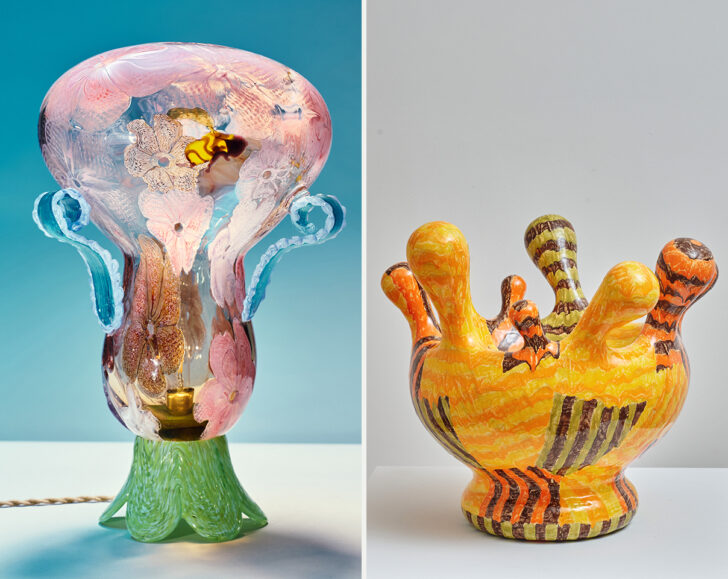
Left: A Millefiori lamp by Lucia Massari, part of The Future Perfect’s fall group show, “Use Me, I’m Fragile;” right: a sculpture by Joél Brodovsky-Adams, on view at Superhouse until October 17, photo by Matthew Gordon
–
At The Future Perfect in New York, the big fall group show, “Use Me, I’m Fragile,” revolves around glass in all its forms. Expect new work from many of the gallery’s regulars, like Lucia Massari, who contributed millefiori lamps, and Alexis & Ginger, whose fused glass experiments have yielded a mirror, side table, and sconce. One of my favorite pieces is a cast glass chair by John Hogan, working at a scale I’ve not seen from him before. On view through October 23.
–
Closing this weekend at Jousse Entreprise in Paris is a selection of Philippe Starck furniture, brought together for the occasion of a monograph that looks back at the designer’s most prolific years, from 1970-2000. Never tire of looking at Starck’s older work, tbh!
–
There’s a great exhibition up at Superhouse in New York by the artist Joël Brodovsky-Adams, inspired by queer club culture. A lot of, well, knobs in this exhibition for lack of a better word. The forms are wonderful, and the accompanying essay by writer Michael Bullock is very much worth a read. “His objects bulge, bend, reach, and spread themselves out. They put on outfits and lean into one another. Some seem perfectly aware that they are being looked at. Their relationship to the body is as much behavioral as physical. The vessel has acquired manners, though not the kind boys are typically taught to have.”
From the Collection
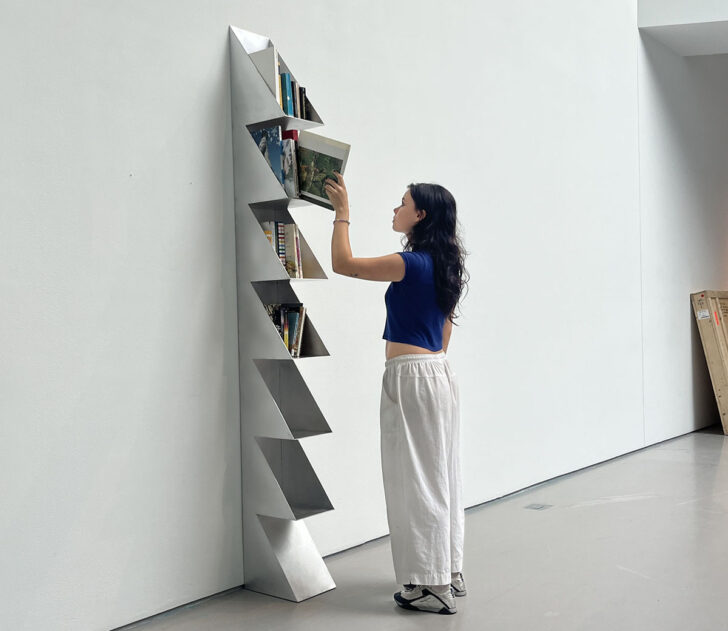
1234567 SHELF BY CLAY BROWN
Though Virgo season has come to a close, Clay Brown’s 1234567 Shelf remains the perfect vessel for anyone who loves to organize systems. Standing at 8 feet tall, its sawtooth silhouette is a striking example of minimalist and economical design. Constructed from 1/8-inch water-jet cut waxed aluminum, it features 75 hand welds that seamlessly unite thin pieces of sheet metal. Rack ‘em up to create a kind of space-age Billy bookcase, or place a single one like a sculpture in the room, $7,000. Find out more and purchase here.