Between the two of them, Julie Ho and Nicholas Andersen had designed clothing, jewelry, movie sets, music videos, and Martha Stewart shoots, plus dabbled in painting, drawing, pattern-making, sewing, and crocheting before teaming up creatively in 2008. Ho had even been a studio assistant for Tom Sachs, making foam Hello Kittys with a medical scalpel (and slicing open her hands almost weekly in the process). So it took a particular kind of alchemy for the pair to decide that — out of all their talents and interests — they would devote their days to making paper party decorations, the kind you’d expect to find in a dollar store if they weren’t so uniquely beautiful. “With our backgrounds in set design and prop styling, Nick and I always loved transforming spaces for our friends’ parties,” says Ho. “We saw how it changed people’s moods, and that’s when we had the idea. We started it as an art project, making party objects like a piñata, blindfold, and necklace.”
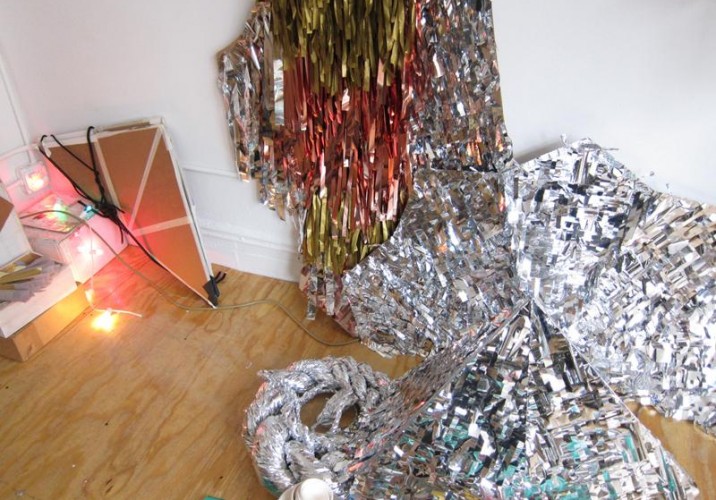
As Confetti System, the pair have since built a business around such festive accoutrements, constructing shimmering backdrops for United Bamboo fashion shows and decking the halls of Yeah Yeah Yeahs frontwoman Karen O.’s birthday party. Last winter, their Mylar-fringed piñatas and party hats became an Urban Outfitters capsule collection, and later this month, the band Beach House will embark on a six-week tour with custom sets crafted by the duo. They make everything themselves, spending hours slicing 20 x 30-inch sheets of tissue paper into streamers with a rolling fabric knife, or distressing cardboard piñata bodies so they take just the right amount of time to burst open, spewing out handmade confetti in various shapes and colors.
It’s a labor of love for Ho and Andersen, who say they’re primarily motivated by a desire to sculpt things with their hands. Ho grew up in New York taking tons of extracurricular art classes and soaking up inspiration from all the shelter magazines her father brought home from his job as a color corrector. She studied fine art at MICA, where she met the friend who would eventually introduce her to Andersen; he had been raised in Hawaii, his grandmother in charge of the original Jams factory. “I grew up visiting her there, looking at all the fabrics and helping her sew and clip threads,” Andersen says. “My parents had a company that made sails and sailboat cushions. Everyone was always making everything all around me.” Among many other shared obsessions, the pair bonded early on about the fact that they had both kept curated, rotating collections of things on their bookshelves as kids. Now they keep a collection of inspirational objects at their Manhattan studio, which they share with graphic designer Alex Lin, and which they offered us a glimpse at on a recent March afternoon.
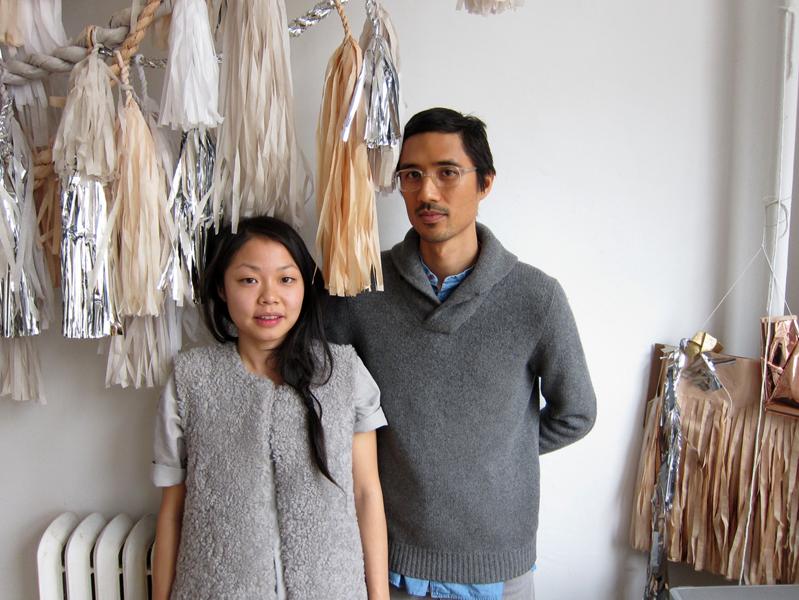
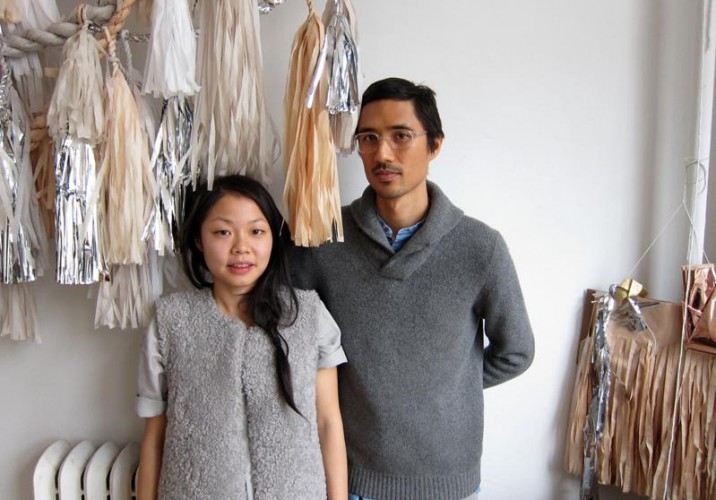
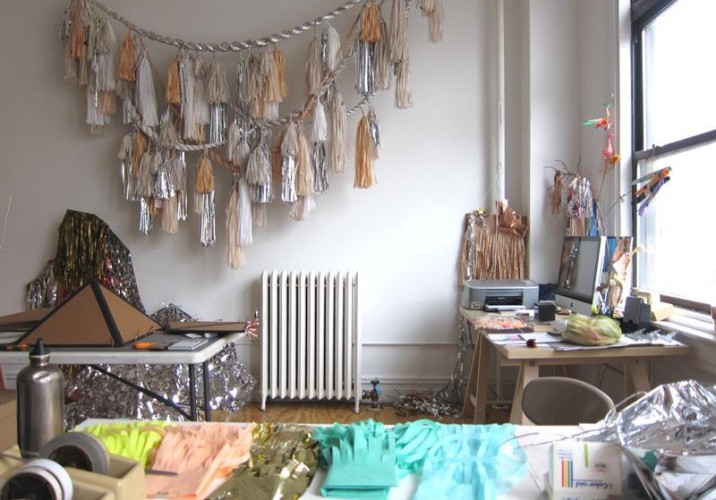
Julie Ho and Nick Andersen in their Manhattan studio, which they share with the graphic designer Alex Lin. On the fourth floor is New York’s only veterinary dermatologist, which is “why you see all the weird-looking dogs in the lobby,” they joke. Behind them is one of their large party garlands, a design they originally developed for their very first project, the Spring ’09 United Bamboo fashion show and lookbook.
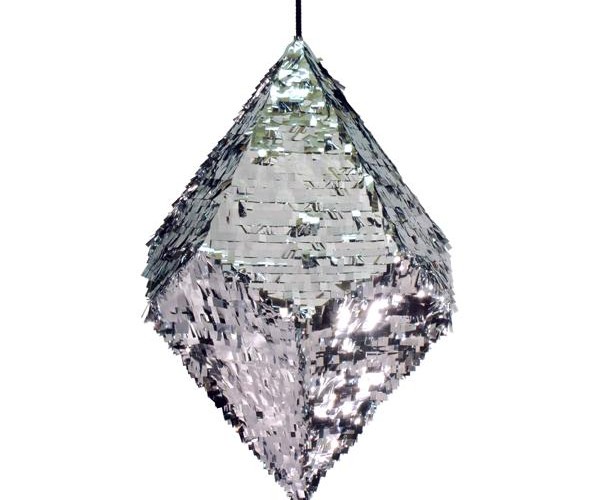
In addition to garlands, party hats, blindfolds, and party necklaces, the duo makes large geometrically shaped piñatas, which are covered in hand-cut fringe made from tissue paper or Mylar. This one was made for a celebratory Cinco de Mayo window installation at the New York store Opening Ceremony last year. “You think oh, it’s just a piñata, but if you go to, say, Walmart, they’re made really differently and look completely different,” says Andersen. “This is our dream of what a piñata should be.”
The idea behind Confetti System generally is “to play with the idea of celebration, and what objects can come out of that — to make it something new,” says Ho. For Andersen, “this is all about memories of celebrations, and all of their textures and colors. Growing up in Hawaii was a very multicultural experience: Japanese, Chinese, and I’m Filippino. I was inspired by all of the objects that go along with those different rituals.”
Because they make everything themselves, by hand, they spend a lot of time in the studio. They laugh when we bring up the possibility of hiring interns, because the work is difficult to delegate, especially when Ho can now slice paper into perfect fringe at lightning speed.
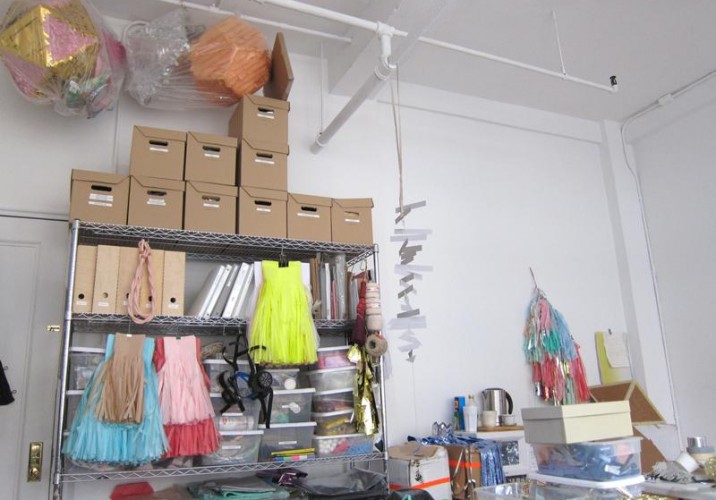
Various paper types and samples are stored in boxes on their shelves, along with an archive of all the different types and colors of confetti they’ve ever produced. So far, most of it has been in combinations of pastels and neons, but they’re interested in soon expanding that palette to include darker colors and more experimental contrasts.
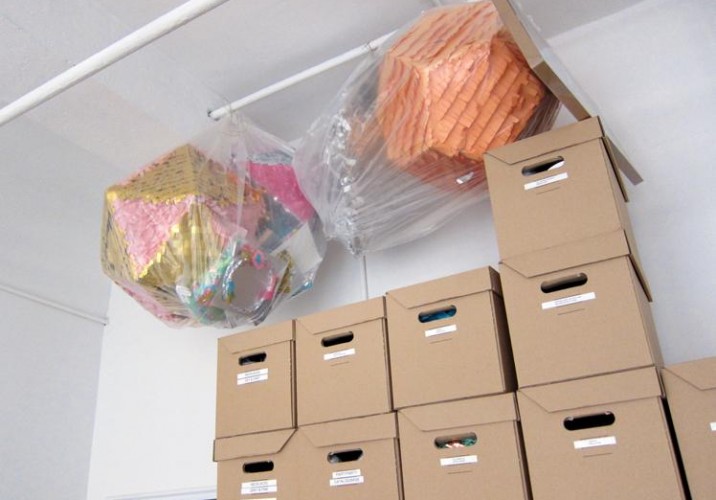
Some of their larger piñatas hang from the ceiling in storage. Developing them “took a lot of practice,” says Andersen. “The secret is that you have to do a lot to a piñata so it breaks properly. Cardboard really strong. We did a lot for friends’ parties, which is how we figured it out, but the first time we made one, it took way too long and too many people to break it. It was trial and error.” Adds Ho: “We didn’t buy a bunch of piñatas and research them, we just made what we wanted them to be.”
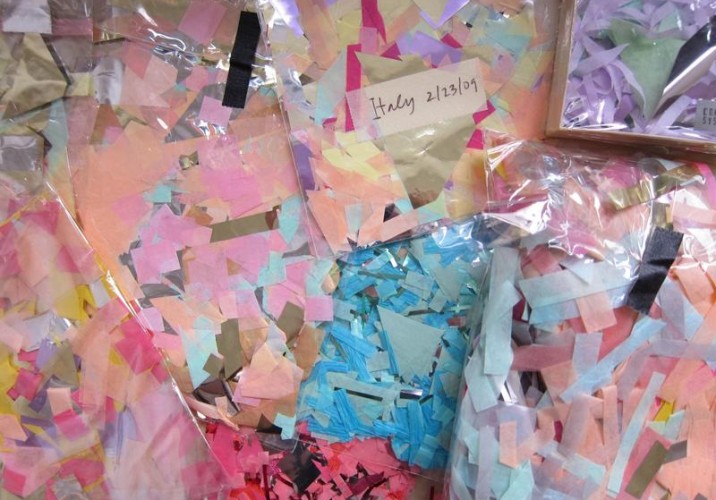
While Ho and Andersen do leave a little door cut into each piñata so clients can load them up with candy or other small items, all of them come filled with hand-cut confetti as a rule. Above, bagged and labeled samples from the aforementioned archive.
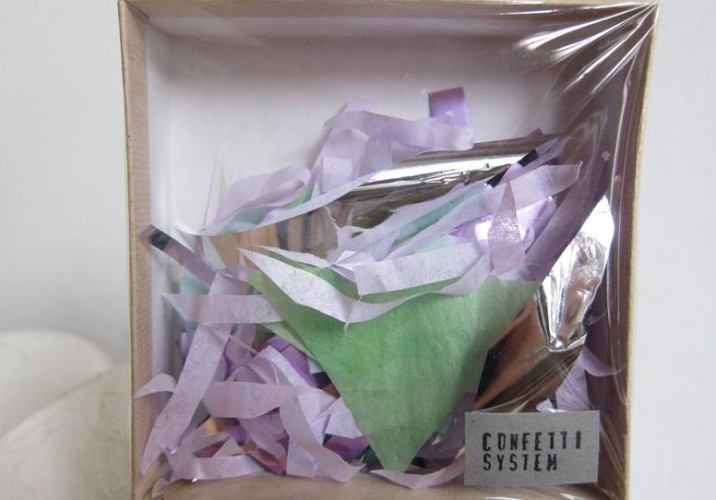
From the Urban Outfitters catalog: “Nothing shouts PARTYPARTY quite like a box full of colorful crepe paper confetti, sure to turn any moment into a celebration (we like to always have some in our pockets, just in case).” The pair are currently at work on a second holiday collection for the retailer.
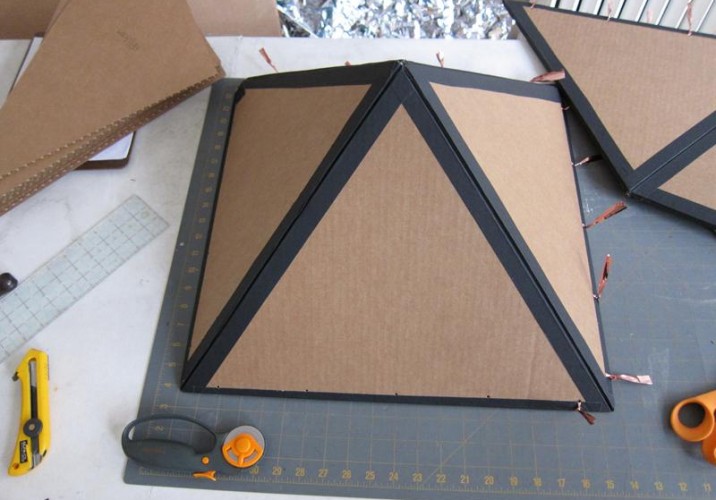
Also on the Confetti System worktable at the moment are these cardboard piñata sections, which are for the upcoming Beach House tour. Because all of the 37 venues are so different, the set design has to be completely scalable, not to mention easy to pack up between shows.
When making streamers and garlands, the duo begins with standard 20×30-inch sheets of tissue paper, “working with how it flows, how the tissue sways, and the way it moves,” explains Ho. “Sometimes you make it longer, so it’s shaggy and it sounds really nice.” “It sounds like the woods,” adds Andersen.
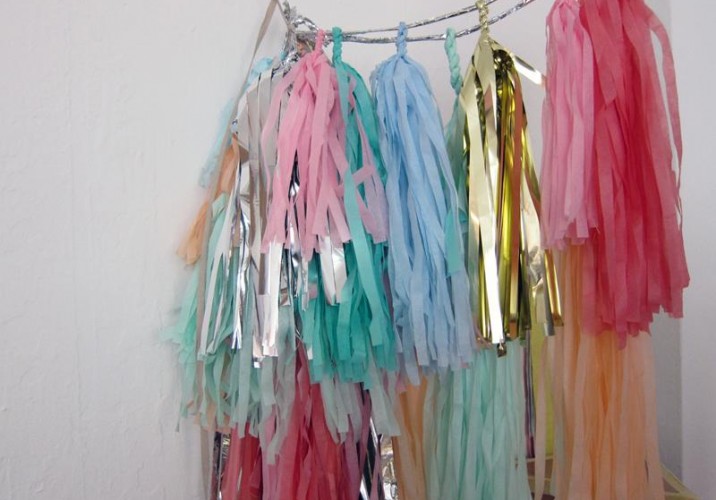
These garlands were made for a temporary installation at Partners & Spade, Andy Spade’s quirky New York boutique. For another recent project, a United Bamboo afterparty, Ho and Andersen hung rows of fringe all the way down a long, narrow hallway leading to the main room of a local bar. Set in 6-inch intervals, the streamers got longer and longer as guests approached the party, and several of them told Confetti System how much they liked the experience. “It felt so different,” says Ho. “In the end that’s what we love, putting these in spaces that make people feel something you can’t put your finger on.” “It is really emotional,” Andersen agrees. “We want it to be beyond just paper hanging from the ceiling.”
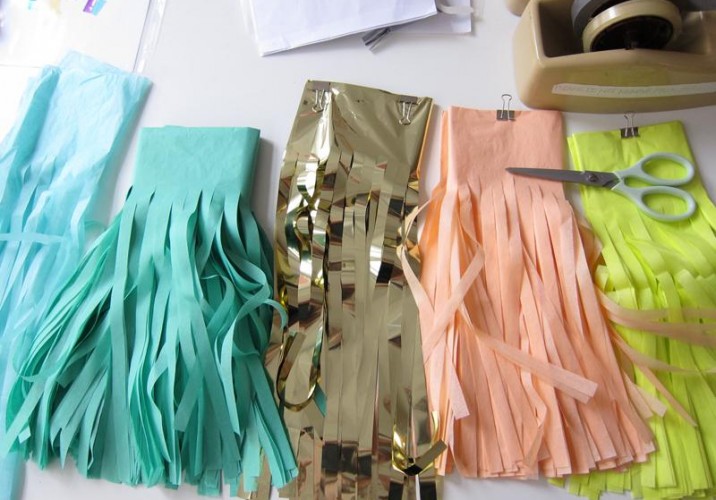
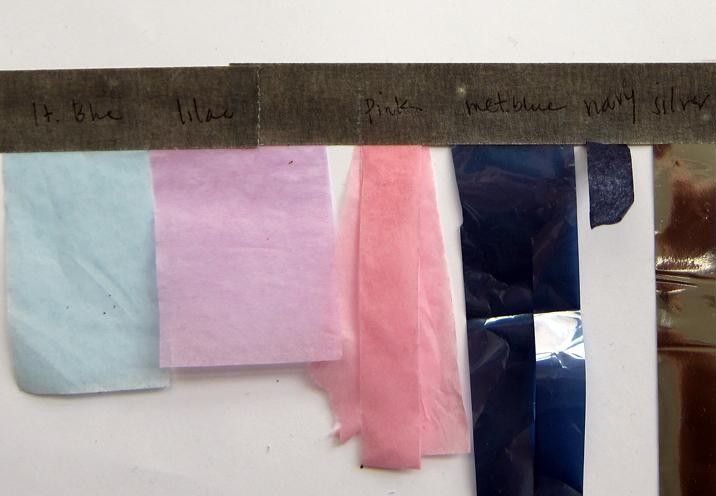
A color palette for a current tissue garland commission.
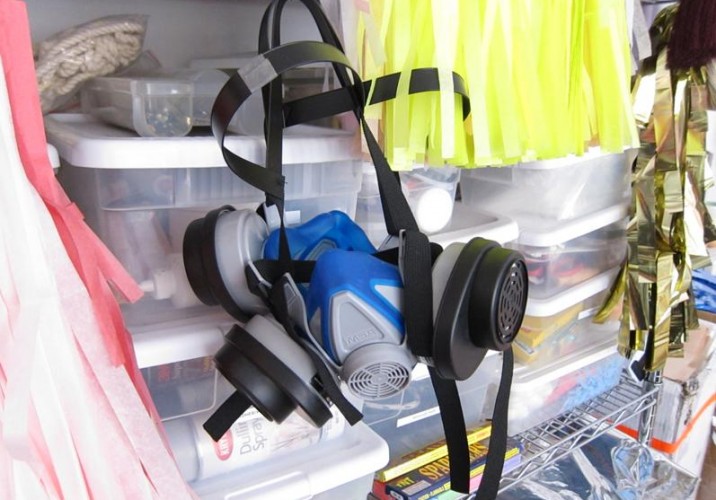
Though their process is otherwise quite low-tech, occasionally a project requires the use of strong adhesives. “Safety first!” says Ho.
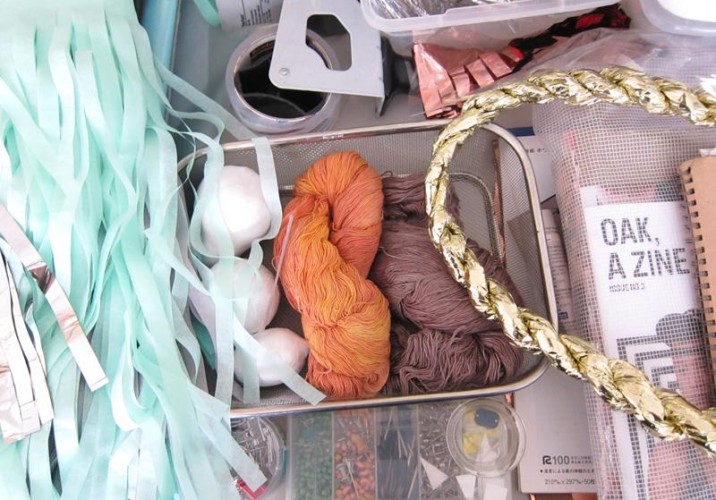
More tools of Confetti System’s trade. The gold rope at right, which Ho and Andersen twist by hand from Mylar, is of the kind they use for their large garlands.
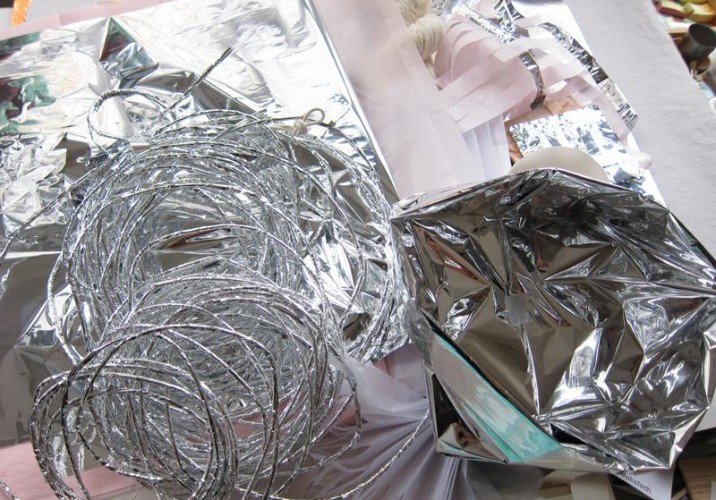
The skinnier rope at left is for the Beach House sets. It’s also made from Mylar, an insulating polyester film which was developed in the ’50s for use in audio and video tapes, industrial packaging, and batteries. For Confetti System, its key quality is strength — it can support the weight of their garlands, and it won’t rip or split, unlike the tissue paper.
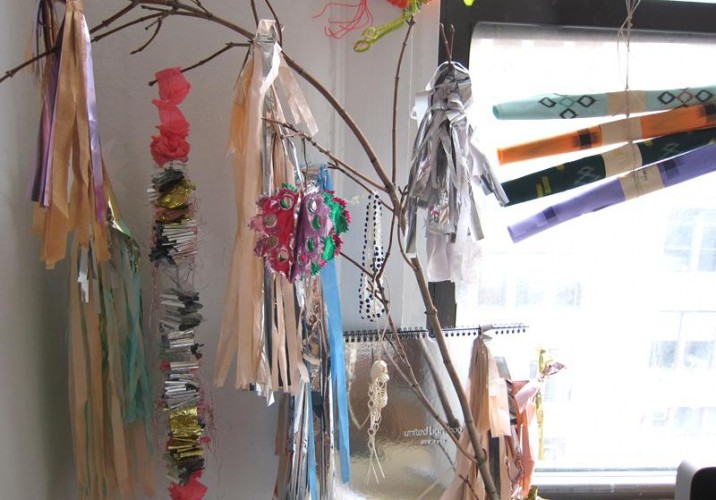
Part of what makes Confetti System so fascinating is the subtle irony of their creation process — they make by hand, with exacting care, the kind of party decorations you’d expect to be shoddily constructed in some factory in Asia. And in fact, when Ho and Andersen were first getting to know one another, they bonded over their shared love for such dime-store trinkets. They still keep a collection of their finds in the studio. A selection is strung up in the corner above their computer; the lei-inspired necklace at left, however, was actually one of their first products.
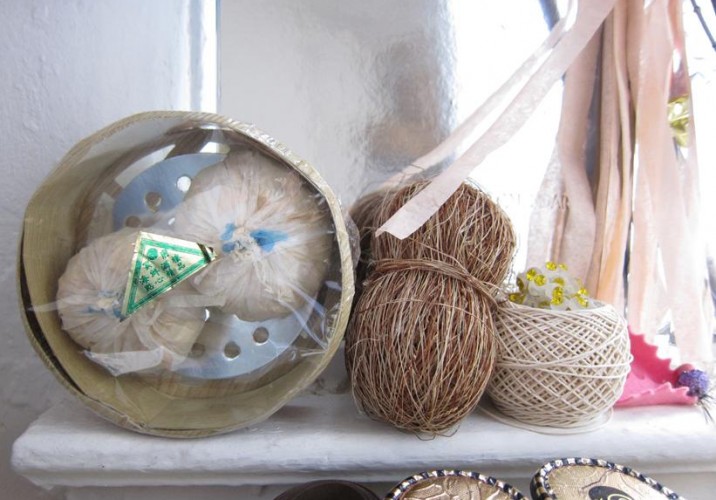
“What we get really inspired by are, when you go into old 99-cent stores, the bulk supplies that are shitty but look beautiful in the way they’re packaged or the graphic design,” Ho explains. “We always buy junky things and funny ephemera, these things you don’t really do anything with.” One of their favorites is the paper faux–dim sum at left, which is meant for the Chinese tradition of burning paper objects — even in the shape of things like boom boxes and cigarette cartons — to commemorate a loved one who’s passed away. “It’s something no one else would care about but us,” laughs Ho. “And it looks delicious,” adds Andersen.
One of their favorite sources is a store in Chinatown whose owner goes back and forth between New York and China/Hong Kong. It’s where they found these metallic sandals, as well as a series of colorful little birds sculpted from telephone wiring.
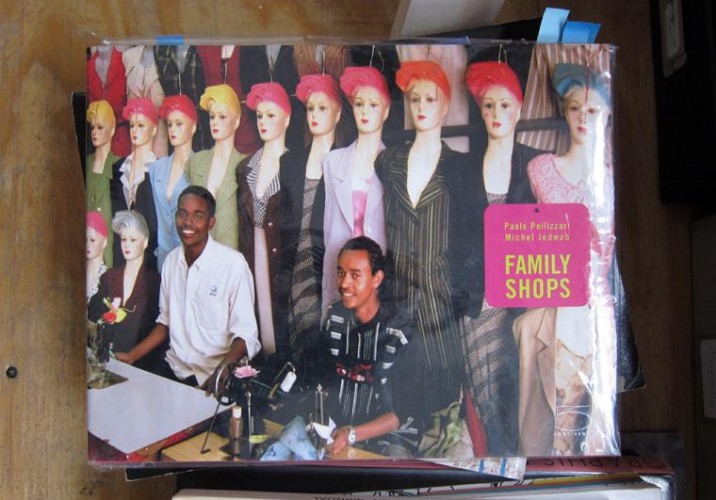
There are books in small stacks all over the studio floor, on subjects like Japanese packaging and paper dolls, rocks and minerals, and the geometric forms they use for their piñatas. This is one of their favorites: “It’s photos taken of small family-run shops all over the world,” explains Ho. “There are images of bulk bags of rice, sandals, and anything else you can imagine displayed in the most beautiful way.”
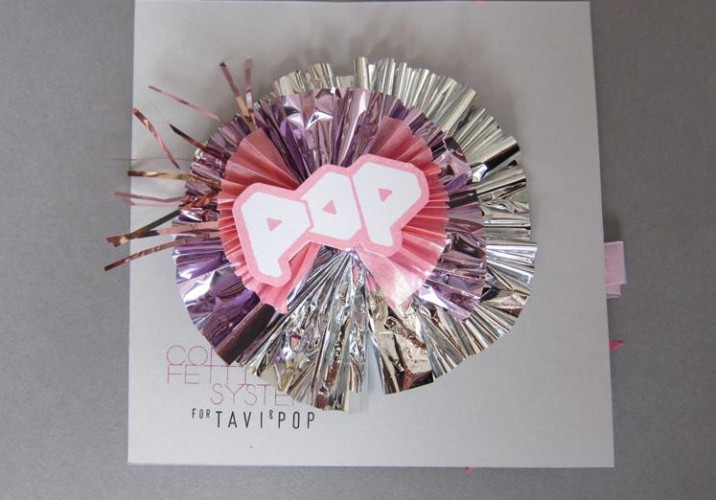
Pop magazine recently commissioned Ho and Andersen to make wearable party favors for a fete at Larry Gagosian’s house in honor of teenage style-blogging phenom Tavi. They created this hair bow — or bowtie, for guys — that came packaged with a handful of confetti, secretly hoping it would end up blanketing Gagosian’s floors. But it turned out the favors were actually given to guests as they left the event.
They were also recently asked to helm one of Partners & Spade’s Avant Garde Preschool workshops, where they taught young children how to make these streamer ornaments. “Their designs were so innovative, they took it to another level,” Andersen says of the pupils.
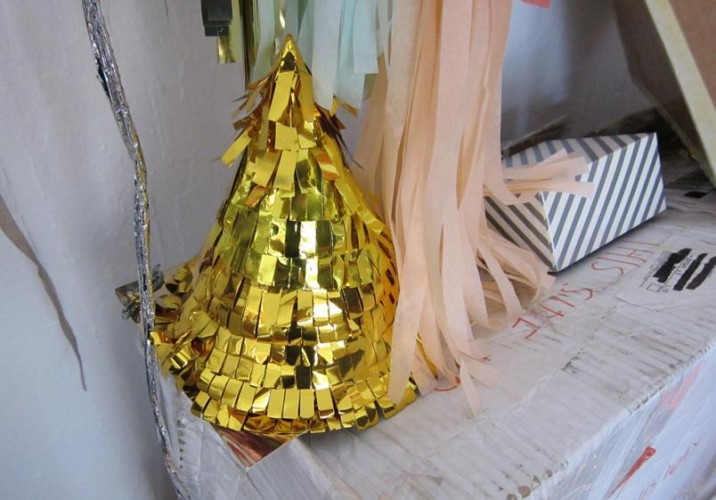
A fringed party hat from the first Urban Outfitters collection.
Also for Urban Outfitters, Confetti System produced a small, limited-edition run of necklaces made from silk, string, and metal rings, which evolved from the Mylar leis. The series quickly sold out, but these are the latest models, which are available for purchase — along with various piñatas — through the pair’s own website.
The story of Stefan Scholten and Carole Baijings began, like many Dutch stories do, in a church. In the late ’90s, Baijings was working for an agency whose headquarters were located inside one of the country’s many abandoned houses of worship. Scholten, a graduate of the Design Academy Eindhoven, had a burgeoning design practice nearby. Scholten was asked to design a small bar for the agency’s office, and “the rest is history,” says Baijings.
When you're a graphic designer and an aircraft engineer with zero fashion training, and yet you find yourself becoming the go-to clothing line of Melbourne — worn by the likes of Patti Smith, LCD Soundsystem, and Jamie Oliver — you learn to get really good at improvising. And trusting your instincts. So it goes for Alex and Georgie Cleary, the brother-and-sister duo behind Alpha60, who base its designs not on fashion trends but on whatever random pop-culture reference they happen to be into at any given moment.
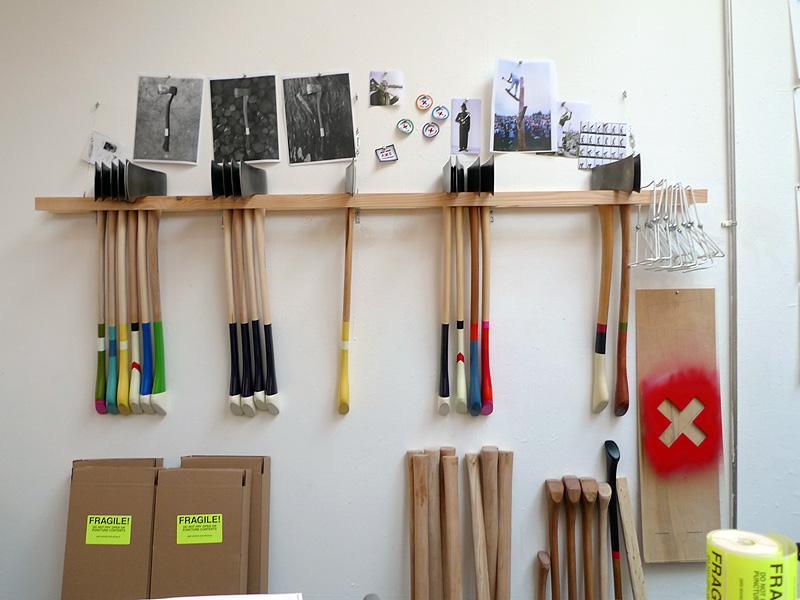
Ah, the impotence of the urban dweller. Ever since the Best Made Company axe debuted this spring, you’d be hard-pressed to find a New Yorker who isn’t dying to snap open that wooden case and heave the Tennessee hickory–handled thing at… well, what, exactly? “At first I thought a lot of New Yorkers would buy them,” says Peter Buchanan-Smith, the New York–based graphic designer who founded the company along with his childhood pal Graeme Cameron. But it turns out the best audience for an axe — even one with a handle saturated in gorgeous shades of spray paint — is a person who actually might use an axe.