02.19.26
The Weekly
A rare archive of mid-century design, on view in New York
Welcome to the new Sight Unseen, a weekly newsletter that delivers the best of the design world — news, trends, shopping advice, interviews, travel recs, and more — straight to your inbox. If you’re not subscribed, follow this link to sign up. Want to partner with us, advertise, or submit your work (guidelines here)? Email us at hello@sightunseen.com.
A Brooklyn Interiors Studio Took This Renovation From Cookie-Cutter to Utterly Compelling
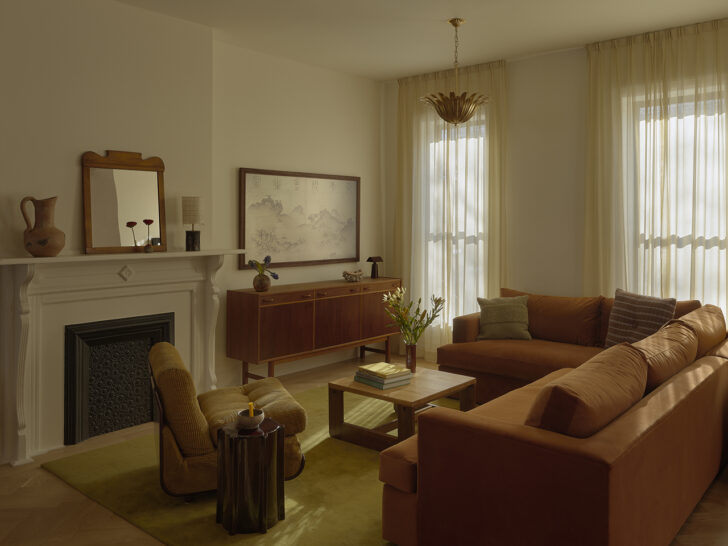
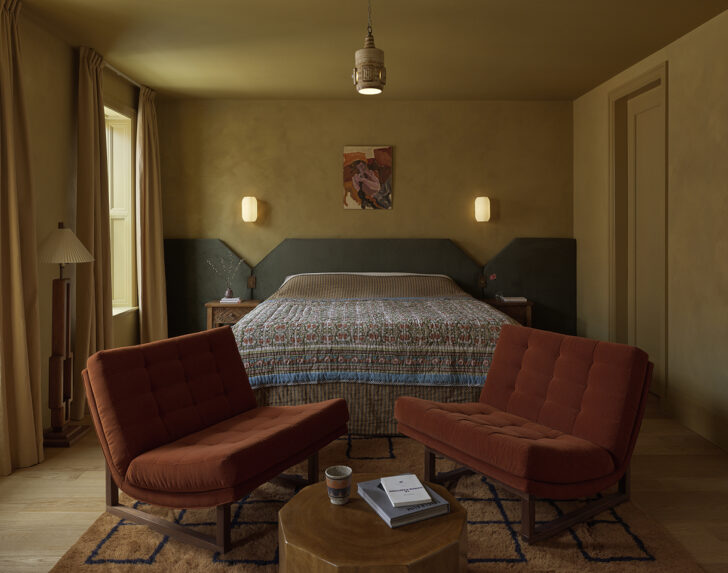
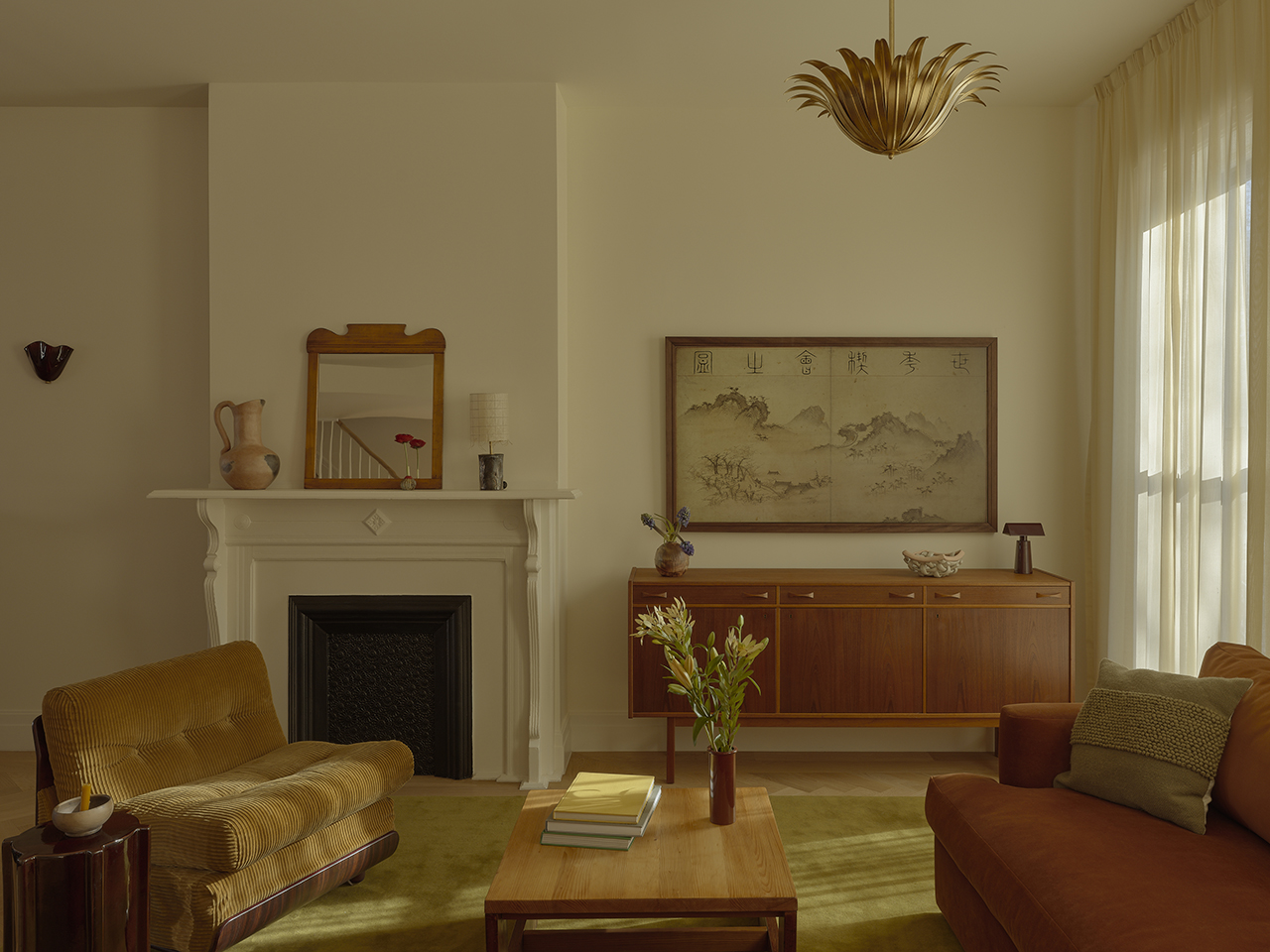
Wall treatments, floor-to-ceiling curtains, and a perfectly calibrated mix of vintage and contemporary pieces make this Brooklyn apartment move-in ready. Photos: Sean Davidson
Having toured my fair share of new builds in Brooklyn, the phrase “newly developer-renovated” sends a particular chill down my spine. And yet this Bed-Stuy apartment, by Vincent Staropoli and Kiki Goti of The House Special Studio, shows exactly how far you can take one of those renovated cookie-cutter interiors, making it cozy, lived-in, beautiful, and — most important — of a piece with the 19th-century homes that surround it. The two mostly achieve this through color and texture: a yellow-green limewash in the bedroom, a deeply brick-red ceiling in the kitchen, floor-to-ceiling curtains throughout, lots of velvets and corduroys, and even a dash of folkloric whimsy in the bedroom, courtesy of a Scandinavian–style coverlet. But the mix of vintage and contemporary objects and furniture here is also perfectly calibrated to the point where even I had trouble figuring out which was which. The couch is new from Quince; the Ellen Pong ceramics look aged by wear (in a good way); and the Mario Bellini chair in the living room (which was, incidentally, recently rereleased by Hay), is vintage but spiffed up and reupholstered to look like it was just purchased this week. Actually timeless pieces like the Borge Mogensen dining chairs, and Paavo Tynell pendants, complete the look.
A New Building Outside of Paris is Giving Municipal Modernism

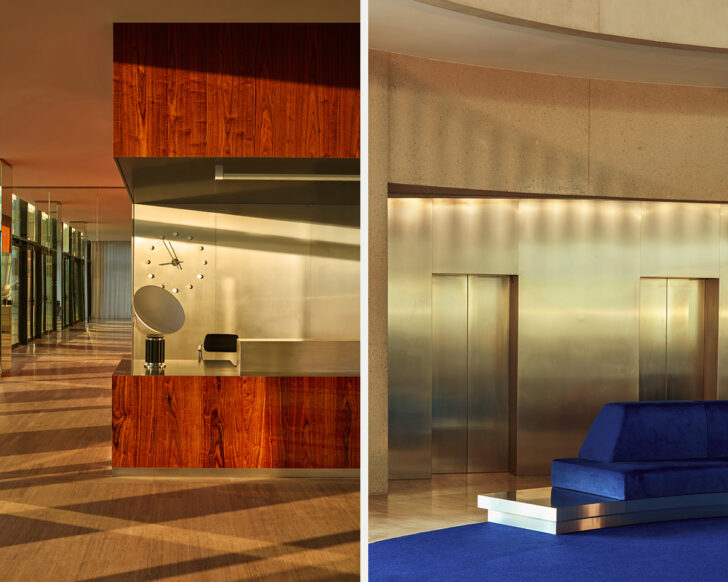
With its integrated clock, swirling staircases, and tightly edited palette, this new research building outside of Paris looks like it could have been designed at the height of the modernist era. Photos: Gaëlle Le Boulicaut
Speaking of blurring the line between what’s old and what’s new, would you believe it if I told you these photographs were from a building constructed just this year? They’re the interior photos from BYOS, a new building at Campus Grand Parc, a growing biotech complex on the outskirts of Paris. Outside, it looks like an undulating Aalto vase; inside it looks like a modernist Scandinavian municipal building, or an Italian teatro, all swooping spiral staircases and glass-walled atria. The Parisian firm Biehler-Graveleine are behind the look of the interior, which pairs lacquered rosewood and travertine with the cooler tones of deep blue carpet and stainless-steel accents. (Since you can’t source rosewood new anymore, the paneling was plucked from an archive dating back to the 1970s.) Perhaps our favorite element is the integrated stainless-steel clock keeping watch over the proceedings. The designers say they were inspired by the idea of the lobby as something more residential or hospitality-oriented, but the vibe we’re getting is of Saarinen’s TWA terminal — and that’s never a bad thing.
SOM’s Furniture Designs Should Be as Celebrated as Knoll or Herman Miller. A New Exhibition is Looking to Change That
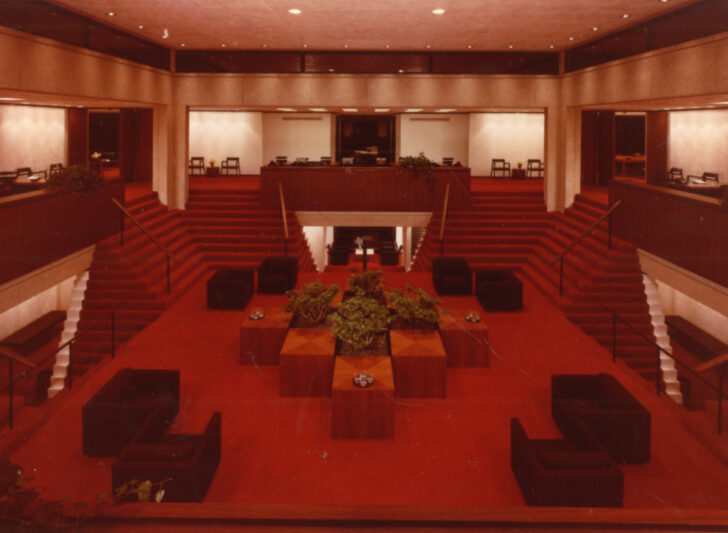
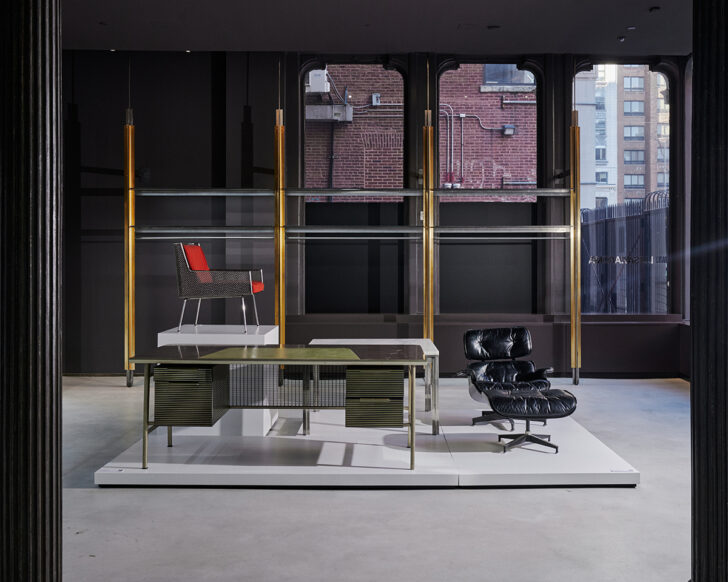
Top: An archival photo of the SOM-designed Illinois Bar Association by Orlando R. Cabanon. Bottom: Rarify x SOM installation photo at Luisa Via Roma, by Lucas Blair Simpson
The vintage furniture purveyor Rarify was founded in 2021 by David Rosenwasser and Jeremy Bilotti, two design obsessives who were college classmates at Cornell. But their acquisition of vintage icons began decades earlier, and in fact a murdered-out Eames lounge chair that was special-ordered by the iconic American architect Gordon Bunshaft — a partner at Skidmore, Owings, & Merrill for more than 40 years — was one of the first pieces Rosenwasser acquired as a teen. That piece is part of the new exhibition Skidmore, Owings & Merrill: Hidden Furniture Masterpieces, which opened last week at Luisaviaroma in New York. The exhibition is devoted to the vast — and until now, mostly overlooked — archive of primarily bespoke furniture that SOM created for its corporate interiors from 1950 to 1991, and the exhibition would have been interesting enough if it included only those pieces. But the presence of the Eames lounger is indicative of the exhibition’s larger aspiration, which is to create a full and beautiful and contextual portrait of one of the biggest forces shaping corporate interiors — and, by extension, the entire modernist design canon — in the second half of the 20th century.
The exhibition brings together around 60 pieces of SOM furniture, many of which were sold to Rarify for cheap by dealers who didn’t know what they had; they were often labeled “in the style of Knoll,” or something similar. “These are not prototypes or side projects; these are meticulously designed, project-specific works that defined how modern corporations looked, felt, and functioned,” explains Rosenwasser. But the exhibition also presents archival photographs of SOM interiors — which helped Rarify’s founders source and identify the works — as well as original drawings and rare personal artifacts, like a trio of Gordon Bunshaft’s pipes, or the letter he received inviting him the reception where he would receive the Pritzker. Some of the items went on to mass production — like David Allen’s Andover chairs — but some are harder to find, like this boss bitch desk designed by Bunshaft himself. Hugely inspiring for the modernism-obsessed creative in your life. On view until April 30.
The Still Life Gets a Digital Upgrade at a New Exhibition in Warsaw
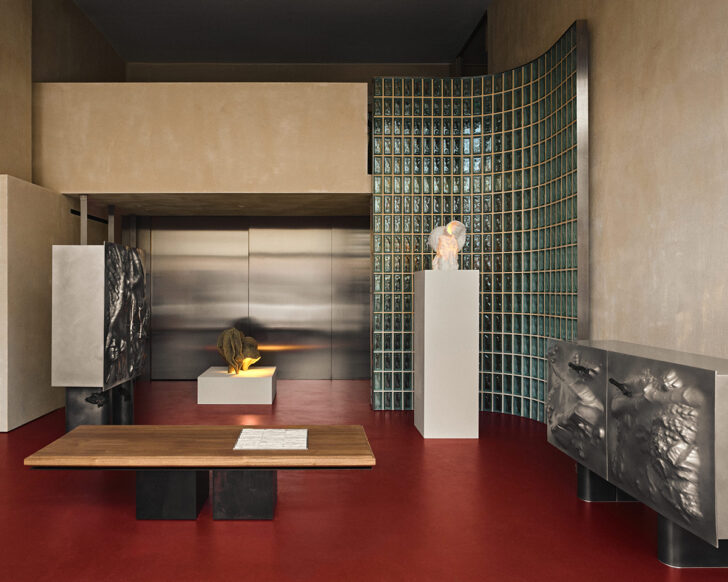
A group show at Objekt Gallery in Warsaw, curated by Aleksandra Krasny, asks artists to reconsider the still life.
What, traditionally, composes a still life? A piece of fruit? Bits of bark or bone? Dead flowers or deceased insects? In a new exhibition at Objekt Gallery in Warsaw, three groups of artists deconstruct and reconceive the traditional still life in three dimensions. The final results often bear only the faintest resemblance to their inspirations but therein lies the fun. For a series of metal cabinets, Wiktoria and Filip Bielicki collected fragments from nature, then scanned them to create a digital archive. From there, they used a robotic arm to sculpt traces of the archived objects into thin metal sheets, leaving behind a ghostly relief. For their Corpus Ornamentum series of tables and wall reliefs, Zuzanna Spaltabaka and Igor Jansen rendered motifs from the natural world in ceramic: “bark beetle trails, ivy tendrils, or the texture of a trunk etched by parasitic fig growths, forms shaped through struggles for light or space.” A collection of bulbous lamps rounds out the exhibition, crafted from sand or things like mollusk dust by Agnieszka Mazur. The material is applied using her own technique which, although reminiscent of 3D printing, remains manual, built up layer by layer. In this way, Mazur’s lamps also function, metaphorically, like an hourglass — a record of the time spent in the service of their making as well as the centuries of tradition that preceded her. Through April 10.
Editor’s List
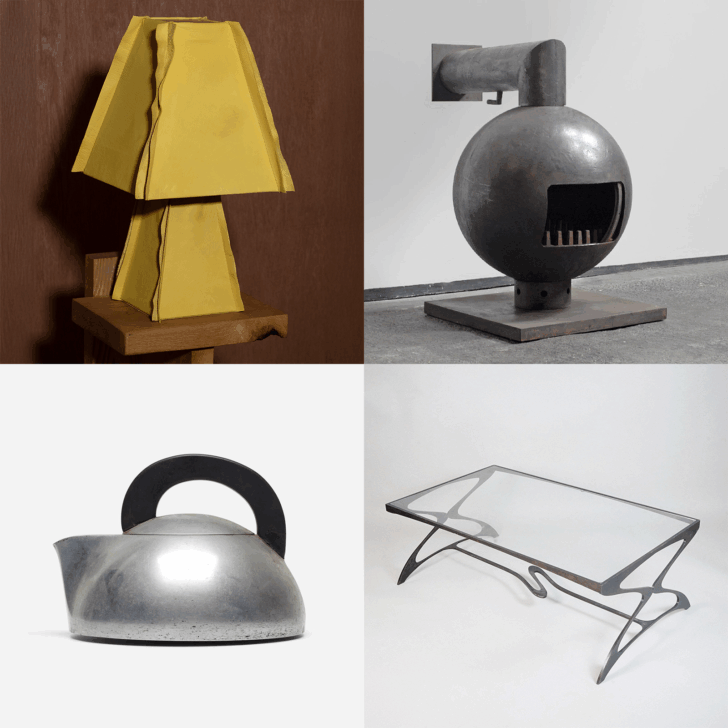
CLOCKWISE, FROM TOP LEFT:
–
I couldn’t attend DesignTO in Toronto last month, but there was one exhibition that caught my eye, curated by the Quebec design collective Ensemble. Lots of excellent things on view but my favorite might be this sweet yellow lamp, a collaboration between Séjour x Studio Jeta. Something about its proportions reminds me of this lamp, which was once destined for greatness but now seems to have fallen out of the public eye? Hoping this one sticks around.
–
I don’t remember what internet wormhole led me to this spherical cast-iron fireplace by Dutch designer Dries Kreijkamp, but I think we should all be adding it to our moodboards, no? I’m very interested in free-standing fireplaces, and this one — which can rotate 360 degrees and comes complete with the smoke channel, andiron, and pull-out ashtray — is just about perfect. A slightly different one for sale here, if you’re in Europe.
–
The UK vintage dealer who goes by Myakin is doing an exhibition of 20th-century pieces that “balance monumentality with fragility” in his hometown of Norwich, England, and I can’t get this table out of my head. If I were based in Europe, I’d rent a truck just to bring it home, but until then, let us peruse Myakin’s Instagram for inspiration.
–
Speaking of personal obsessions, I also came across this vintage Art Deco Magnalite tea kettle this week — apparently it’s food icon Ruth Reichl’s fave — designed by John Gordon Rideout in the 1930s. Don’t let that Town & Country headline fool you into thinking you ought to have known this kettle if you didn’t already. We are each on our own journey to absolute design knowledge and your canon is not my canon! Anyway, it’s here and here.
News
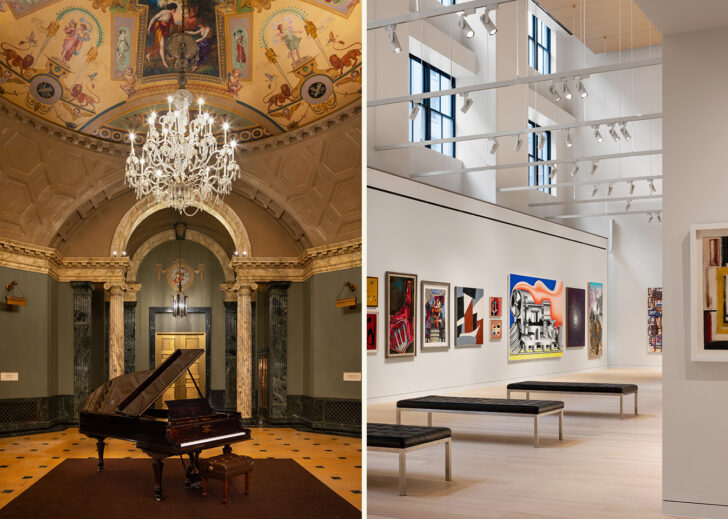
The new Bonhams flagship in New York marries the iconic 1925 neoclassical Steinway Hall with a slim Gensler- and SHoP Architects–designed skyscraper
–
Sometimes I think about dying, and how sad it will be not to have found or listened to all of the good music in the world by then. I also feel this way about buildings! How many will I not have visited, and how many good ones exist without me even knowing about them? The new Bonhams just opened in New York and while the Gensler addition is cool, it’s the Steinway Rotunda — built in 1925 by Grand Central architects Warren & Wetmore for the piano-maker Steinway & Sons — that’s a revelation. It’s been hiding in plain sight on 57th Street for years, but hasn’t been open to the public in more than a decade. Along with Sotheby’s at the Breuer building, Bonhams is bringing back architecture-peeping to auction house visits in New York.
–
Something interesting is happening regarding the future of design. For years, independent design studios slowly scaled back or fully shut down their smalls production in favor of producing increasingly expensive, gallery-style work. (The closure of Areaware feels related.) But recently I’ve noticed in uptick in designers making their own smalls in the studio — think Six Dots making jugs and magazine racks, or any one of the designers from my egg cups story. The latest Snake (worth a subscribe if you haven’t already) posits that smalls are the future of design. Do you believe that’s true? Whether this just means vintage, who knows; I know the pricing structure often doesn’t support this kind of production in the studio for contemporary makers. But the demand is there! To be continued…
–
The sisters behind Block Shop recently opened Family Workshop, selling ceramics in-store only at their LA flagship. It’s described as “a new family poterie operated by the Stockman sisters and their children, modeled after the collaborative ‘pot shop’ at Black Mountain College during the mid-twentieth century. Our pots celebrate the communal nature of ceramic work and the collaborative bonds between the sisters and the next generation learning at their side.” Actually crying at how sweet it is.
From the Collection
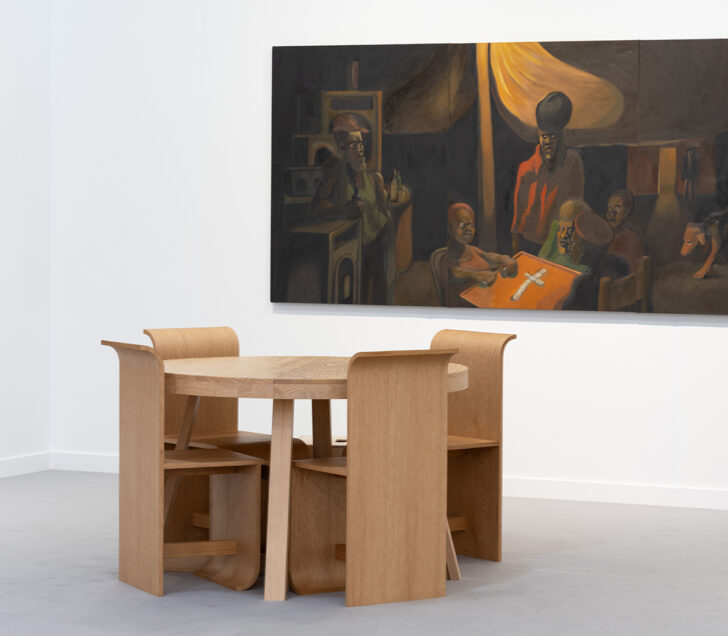
DRY KISS CHAIR BY REST ENERGY
Los Angeles-based Caleb Engstrom of Rest Energy roots his practice in material exploration and the tension of contrasting forces. With DRY KISS (named not for an unsatisfying romantic interlude, but rather a motivational acronym — Don’t Repeat Yourself, Keep It Simple Stupid) — strict linearity gives way to curves in the gentle arch of the back and softly rounded foot. A gorgeously simple dining chair with just enough intrigue to keep things interesting. Buy it here.
Jobs
The interior design firm House of Honey is seeking a full-time interior architectural designer to be based in South Pasadena, CA
New York’s Ringo Studio is seeking a senior architectural designer and project manager for its immersive retail and wellness environments
Leroy Street Studio is seeking a full-time interior designer in New York