02.12.26
The Weekly
The post-industrial German design collective whose work you need to know
Welcome to the new Sight Unseen, a weekly newsletter that delivers the best of the design world — news, trends, shopping advice, interviews, travel recs, and more — straight to your inbox. If you’re not subscribed, follow this link to sign up. Want to partner with us, advertise, or submit your work (guidelines here)? Email us at hello@sightunseen.com.
Hakmin Lee’s Surreal New Series is Good Fun
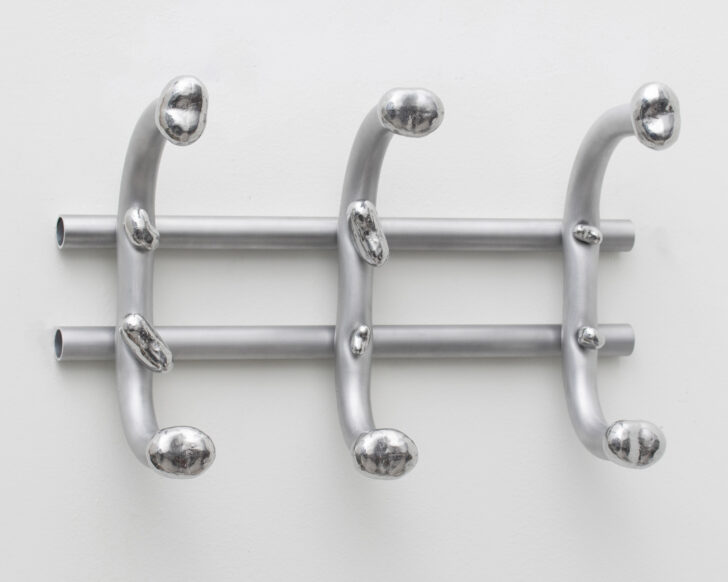
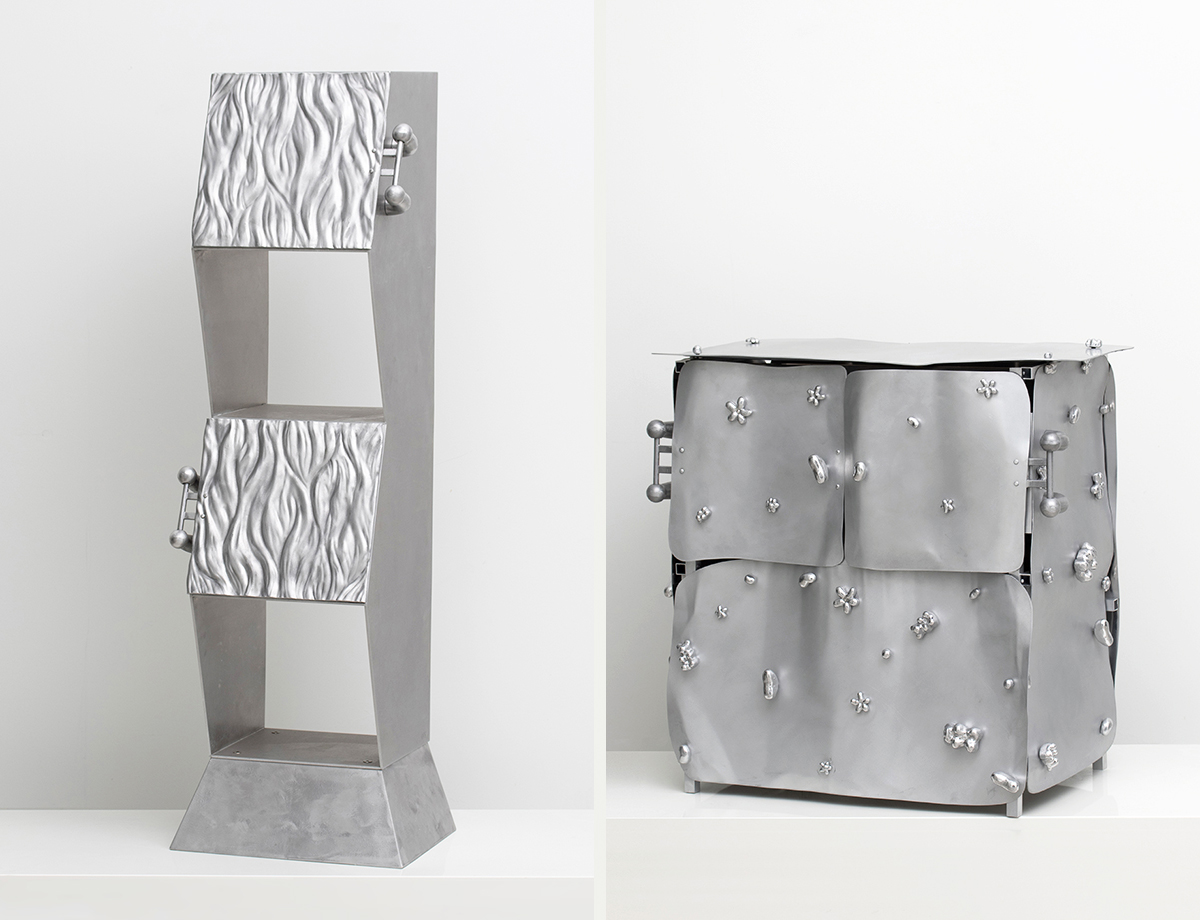
Clockwise from top left: The Woolly Cabinet, Crumpled Cabinet, and Jellybean Hook Rack by Hakmin Lee, part of his Bold Bolts series
Korean designer Hakmin Lee has always made furniture with a sense of humor. In 2021, he debuted a series of roughly textured, sand-cast aluminum tables whose limbs ended in thick animal paws. That was followed by a collection of wavy table lights whose name cheekily recalled Rene Magritte: “This is not a lamp.” (Lee’s penchant for the surreal might be best seen here.) In his latest, Bold Bolts, launched earlier this year at the Seoul gallery Noncontempo, Lee turns his attention to an oft under-sung aspect of furniture design: the hardware. In Lee’s hands, the boundary between function and decoration collapses; there’s no delineation between more structural elements like hinges, bolts, rivets, and handles, and actual adornment. Sometimes he’s more subtle about it — a slim coat rack’s arms end in polished, jellybean-shaped knobs — while at other times, the bolts, shaped like gummy bears, flowers, crosses, fleur-de-lis, and more, spring at random from flat metal sheets. From afar, there’s something almost fungal about these embellishments, which are modeled by hand, then cast in sand, preserving their subtle irregularities. They give the pieces an air of mischief and, just when we need it most, merriment.
A New Exhibition Attempts to Course Correct by Reframing Historical Themes in Decoration and Design
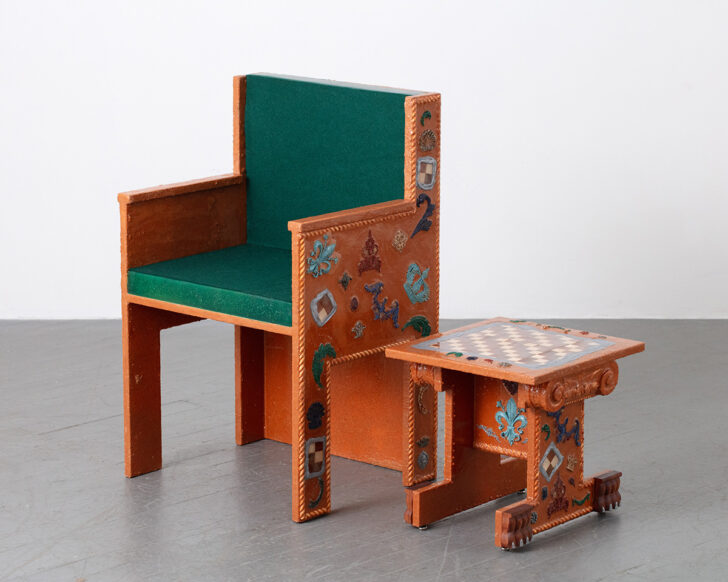 Sandcastle Nesting Set, a new piece by Luam Melake on view at R&Company in New York, uses faux ornamentation to reckon with our past acceptance of European design canon primacy.
San Diego–based designer Luam Melake is currently having her second solo exhibition, “Resemblance of Things Past” at R & Company in New York and, like her last — which proposed ways to alleviate the loneliness of digital culture — this one also provides a commentary on our current cultural climate. With our lack of collective vision for the future contributing to “a culture of despair,” the exhibition responds with four vignettes, each re-contextualizing a historical theme in design and decoration with the idea that if we understand the sins and mistakes of our past, perhaps we can find a way to carry forward.
The themes — ”Florals and Femininity,” “Vanity,” “Power, Class, and European Antiques” and “The Aesthetics of Comfort,” are executed with varying degrees of success. (I love the idea of using materials like fiberglass and metal to depict florals in a way that highlights ideas about resiliency, but don’t love the way they’re rendered.) But my favorite work, both conceptually and aesthetically, is the one pictured above. Melake explains: “In retrospect, I realize the home I grew up in contained Regency, Chippendale, Victorian, and Queen Anne–inspired furniture. It was not apparent to my family that our furniture reflected the tastes of the British Empire, or we might not have selected those options… We shouldn’t think of nice furniture as the furniture associated with power, class, and bloodlines, as I once did. But there is something pleasantly twisted and perversely democratic about imitation antiques.” Her nesting chair and table, made from marble sand inlaid with semi-precious minerals, includes the faux ornamentation of those pieces, here realized as a hodge-podge of European symbols from different eras; what first resembles a throne-like chair can be flipped to come down to the height of the table, quite literally leveling the playing field. On view through April 2026.
Two Designers Play With the Architecture of Space in Brussels
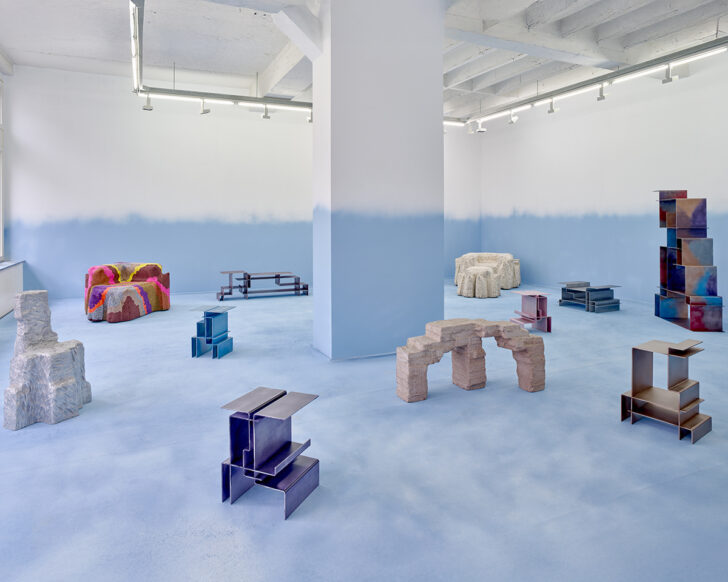
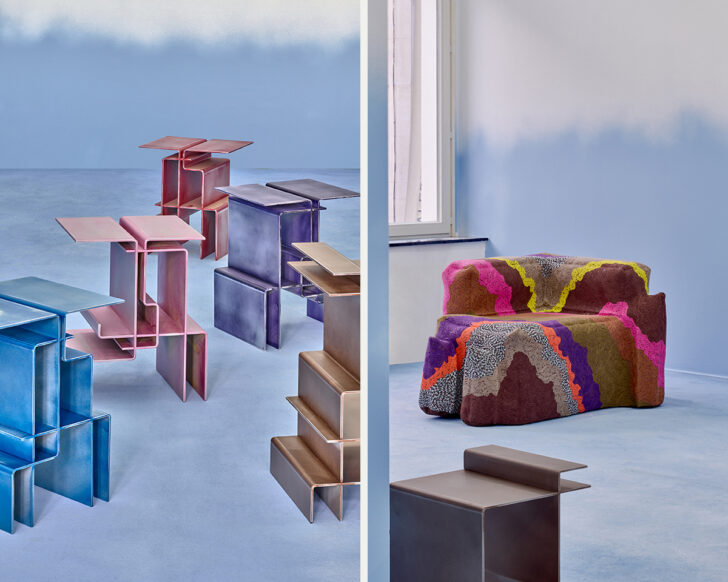
Uppercut Gallery was invited by Rodolphe Jansson to show a collaborative exhibition of works by Bram Vanderbeke and Wendy Andreu. Photos: Pim Top
Two more weeks to catch a dual exhibition at Rodolphe Jansson Gallery in Brussels featuring Bram Vanderbeke and Wendy Andreu, two designers who share a longtime friendship and a fascination with pushing materials to their limits. Vanderbeke and Andreu met more than a decade ago on their first day at the Design Academy Eindhoven and went abroad after graduation for internships in London. When they returned to the continent — Vanderbeke to Ghent, and Andreu to Paris — they resolved to one day work together. The show at Rodolphe Jansson, organized by Scott Lippens of Uppercut Gallery, shows work by each designer as individuals; Vanderbeke, for his part, shows lumpen sculptures and furniture cast from brick molds, while Andreu shows glass works and monumental chairs whose surfaces are covered in thin ropes of cotton, glued to a foam underbelly with resin. But the centerpiece of the exhibition is a series of collaborative tables whose bent aluminum strips are threaded together in an asymmetrical stack; they have the faded surface treatment of a car that’s been left in the sun. Through February 28.
The Post-Industrial Works of a Cult, 1980s-Era German Design Collective, On View in Paris
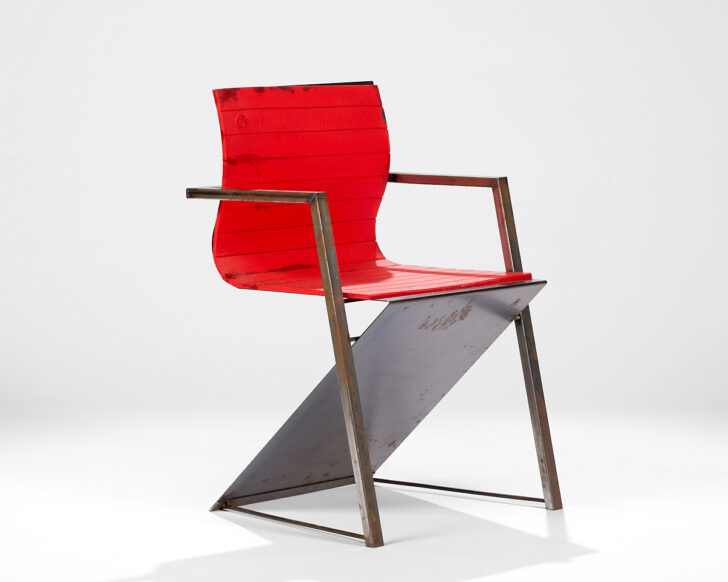
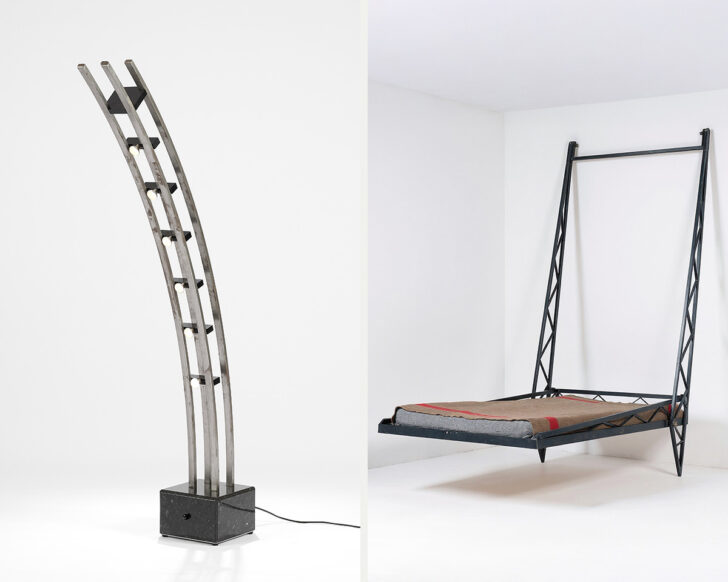
Two works by the Pentagon Gruppe, a German collective that was the design equivalent of a Throbbing Gristle song
Among our favorite kinds of exhibitions are those that pluck some obscure designer from history and thrust them and all of their jagged, experimental works into the spotlight. I’m thinking, of course, of Paolo Pallucco, the 1980s visionary who was the subject of an incredible retrospective at Ketabi Bourdet a few years ago. But now here comes another, featured in the inaugural show at Pulp Galerie’s first exhibition space, opening its doors next Thursday in the heart of Paris: the Pentagon Gruppe, a collective of German designers who were active from the 1980s to the 2000s. The collective, founded in Cologne in 1985, featured five members — Gerd Arens, Wolfgang Laubersheimer, Reinhard Müller, Ralph Sommer, and Meyer Voggenreiter — who remixed punk and Postmodernism into something completely original. They didn’t believe an object needed to be functional, nor did it need to be particularly nice-looking; it simply needed to have style and express an idea. (Unspoken, of course, that the idea must be a good one.)
The Pulp Galerie show, called Silent Brutality, will feature more than 20 works that highlight Pentagon Gruppe’s aesthetic, all raw metal, visible welds, sanding marks, and humble materials. In one truly bonkers work, looking like the unholy union of a Murphy bed and a Jeanneret chair, a bed with a lacquered steel fold-up frame leans against (or I assume is bolted to) the wall, perched on two dangerously pointy compass feet. In another, the Arc Floor Lamp (much cooler, I can assure you, than the Arco Floor lamp), bends a ladder of thick steel struts into a sort of drunken salute. Other works sneak in a bit of romance, including a series of desks with bodies of water carved into their tops (the Rhine, the Venice Canal, the Amazon). A must visit.
Editor’s List
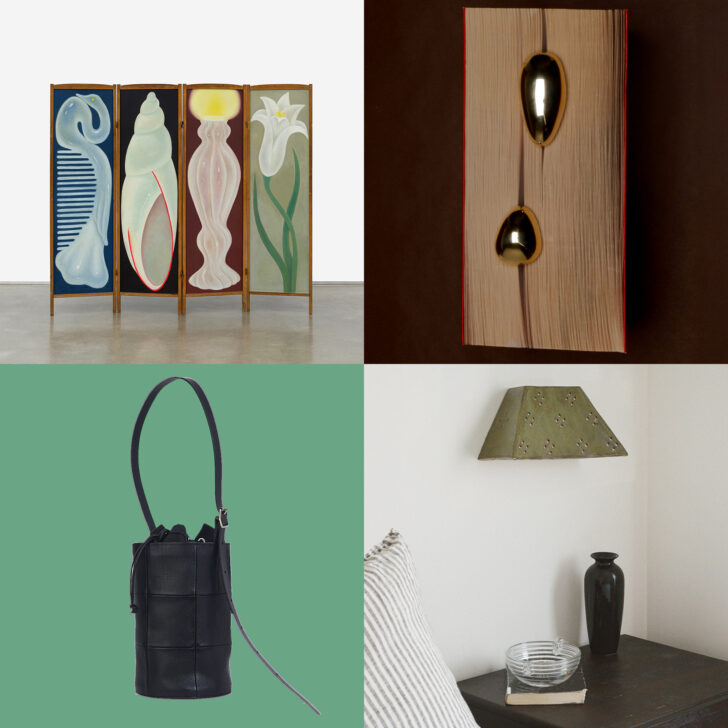
CLOCKWISE, FROM TOP LEFT:
–
Hand-painted room dividers have become something of a thing in recent years — some of our favorites are still these woodland ones by Sunfish — but a new entrant to the divider-as-art category is Shuo Hao, a Chinese-born, French-based artist who shows with Galerie Derouillon in Paris. She recently painted this screen for a group show curated by Whitewall. On one side, it depicts a chimera — the fire-breathing female monster of Greek mythology — and on the other, the ritual objects required for transformation.
–
I’m not sure how these Maha Alavi sculptural brass or bronze bookmarks would look sticking out of a scrawny paperback like Munari’s Design as Art, or Martyr. But if you’ve got a hardcover, or a thick-ass mass market paperback like The Executioner’s Song, or The Brothers Karamazov — which, if you haven’t heard, are going the way of the dodo — let ‘er rip.
–
Clarissa Guzman of Platform Studio made one of our favorite objects of 2025 (the Ceremonia candelabra for Lyle Gallery) — so color us interested in nearly any path she goes down. Her latest release is a series of sconces, inspired by the Mexican folk art technique of Hojolata — hand-carving, bending, and punching tin — but here translated into her preferred medium, ceramic. My favorite is the awning-shaped Sabinas sconce, glazed to resemble patinated copper.
–
I went kind of deep on the London-based fashion label Cawley’s most recent collection, partly because I was obsessed with the fish brooches and the quilted, structured hats in buttery leather and apple-colored silk. But while I might look ridiculous(ly amazing?) in the hats, a safer bet is this patchwork leather bucket bag. It’s very much giving the Bottega look for less, but secretly, I think this one is much better.
News
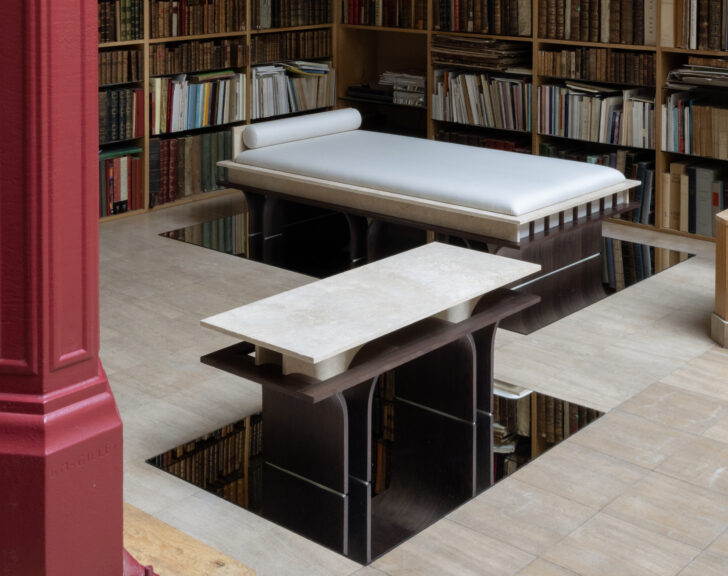
New works from the Arcus series by Haydn Von Werp
—
We didn’t attend the January design shows in Paris, but one thing that stood out from afar was this collection in wood and stone by Haydn Von Werp, an American designer living in Milan. Called Arcus, it includes a daybed, a bar cart, and a bench, all inspired by Roman archways and Deco detailing. Von Werp calls it “what remains when architecture is reduced to its bones.”
—
When Food52 filed for bankruptcy last year, design enthusiasts worried what fate would befall the other companies they owned, like Schoolhouse and, in particular, the beloved American dinnerware company Dansk. This week it was announced that Dansk was acquired by Form Portfolios, who has been working with the estate of designer Jens Quistgaard since 2023. Finally some good news!
—
I am really feeling the turquoise and yellow color combo in Alex Tieghi-Walker’s temporary TIWA Select set-up at Sadie Coles HQ in London, but I also love the haphazard nature of the exhibition; it’s up through March 7, during which time it will also serve as a functioning office. Lots of pieces here I would happily furnish my own office with, including Rooms Studio’s brushed aluminum floor lamp with silicone-dipped parts; EJR Barnes’s Parasol Lamp (a perpetual fave); and the source of that turquoise, Nicolas Zanoni’s drippy Chair Brûlée.
—
Would you wear Birkenstocks to your wedding?
From the Collection
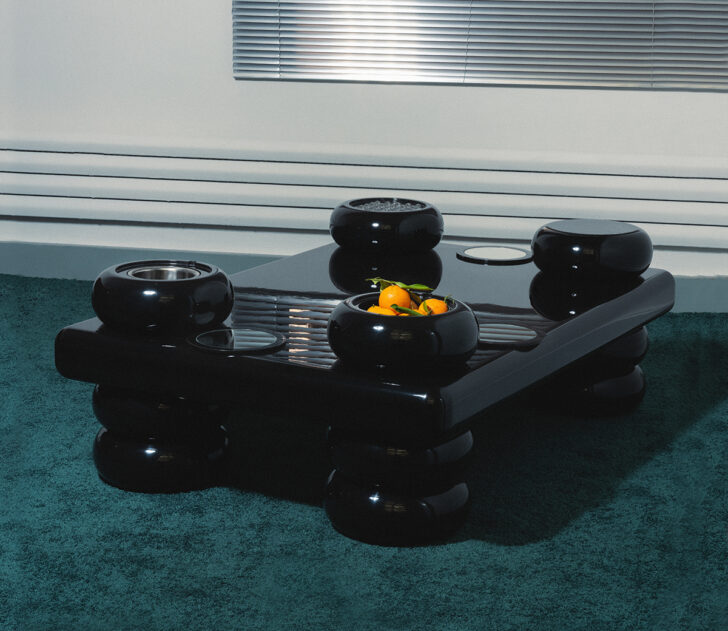
TAAROF TABLE BY KOUROS MAGHSOUDI
Kouros Maghsoudi’s modular cocktail table is inspired by Taarof, the Persian system of etiquette and hospitality. The piece’s design incorporates four chubby discs at the corners of its tabletop that appear to be extensions of its legs — they can be made plain (sealed closed), lopped off entirely for a flat top, or inset with custom vessels designed for party-maxxing: a fruit basket, a pewter ashtray, a double-walled ice bucket. Go for sexy lacquered black, goes-with-everything white, or color match your favorite RAL or paint color for no additional charge. Like guac, chrome is extra.
Jobs
The LA interior design firm Night Palm is seeking a full-time project manager and design assistant
Brooklyn-based Bower is seeking a freelance 3D modeler to assist with design and production
Leroy Street Studio is seeking a full-time interior designer in New York