Lex Pott’s True Colours Series

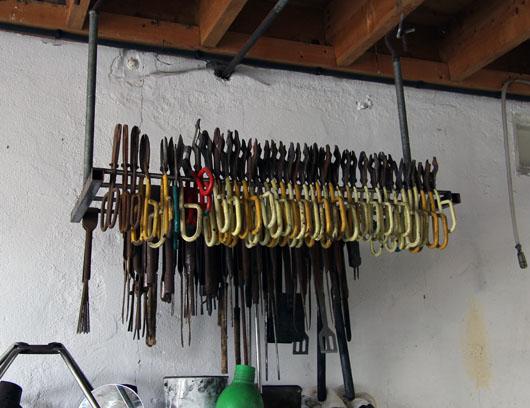
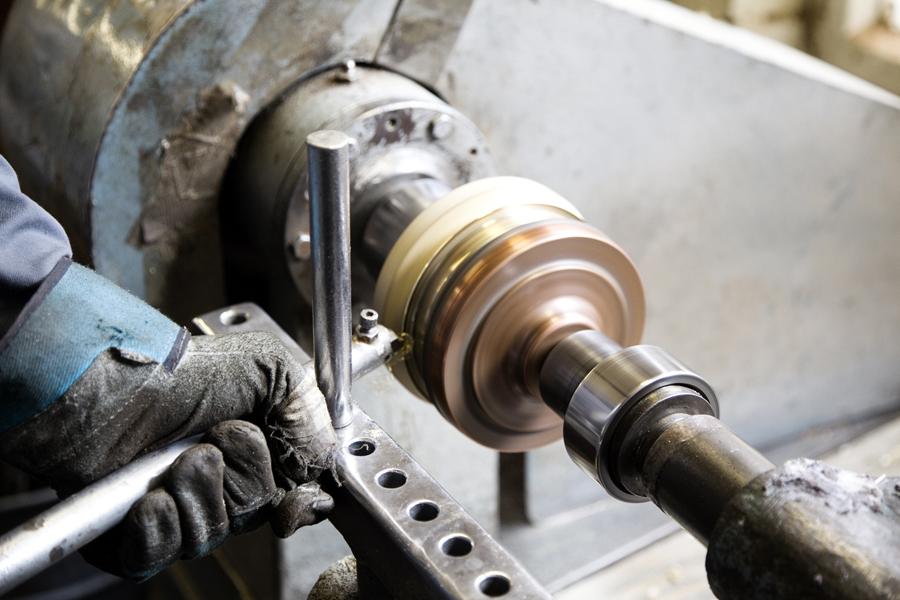
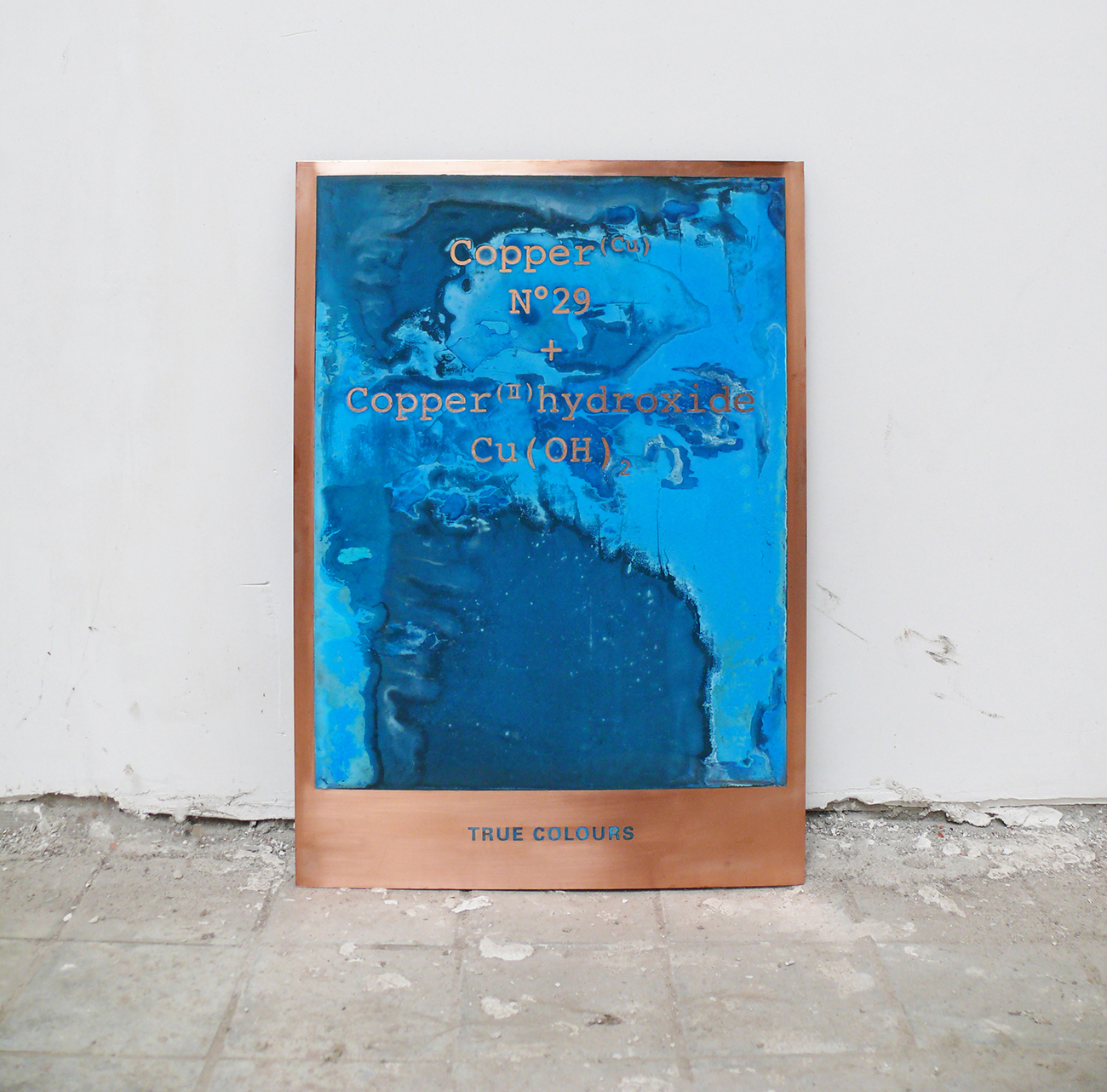
In some ways, it seems fate that Dutch designer Lex Pott would end up working in a studio housed in an old shipyard in the northern precincts of Amsterdam. As a child growing up in Hilversum, 30 miles outside the city, Pott was obsessed with boats, constantly crafting miniature ones from the natural debris he’d find in the forest around his house, and using old plastic bags as sails. And in the short time since he set up his studio, after graduating from Design Academy Eindhoven in 2009, he’s built up a small body of work centered around the very phenomenon that’s known to wreak havoc on seafaring vessels: oxidation. Pott has shot to fame in recent months on the basis of Transience, a series of silvered geometric mirrors designed in collaboration with fellow Eindhoven grad David Derksen. But the project that started it all, True Colours, was less a product than an investigation into the nature of color: Pott took standard sheets of industrial metals — copper, brass, steel, and aluminum — and played with oxidizing them by various methods, in the process creating a highly individualized palette he could, in theory, apply to any metal object.
More

Clemence Seilles in PIN-UP #12

Berlin's many charms are hardly lost on your editors. After a sunny, weeklong trip five summers ago, we both fell in love with the German capital — the wide open spaces, the well-situated swimming pools, the way clubbing unfolds as an actually enjoyable activity. But while my partner in crime has returned to the German capital each consecutive summer, I've never been able to find the time to go back. This summer, then, I was lucky enough to visit by proxy through the eyes of Felix Burrichter and his staff of Berlinophiles over at PIN-UP Magazine, which devoted its entire Spring/Summer issue to the changing metropolis. "For very long, Berlin was this one thing: You went when you had no money," says Burrichter, who serves as both editor and creative director of the architecture biannual. "But there’s a cultural elite — a moneyed elite — that has developed there over the past 10 years. Mostly people from out of town or in the art world. So there's an interesting friction right now. When that moneyed elite takes over, the city will lose a lot of its charm. But right now it still feels very raw and budding." The issue was in some ways a homecoming — Burrichter grew up in Düsseldorf — but in the end, the Berlin depicted in the magazine's pages bears more of a resemblance to Burrichter's adopted home in New York. "What fascinates me about Berlin right now is that it's very international," he says; hence the features run to a British architect who recently remade the city's Neues Museum (David Chipperfield), a West African transplant (Francis Kéré), and Clémence Seilles, a Frenchwoman who arrived in Berlin with a singular goal — to assist in the studio of designer Jerszy Seymour — and who never left. We've been fans of Seilles' work for some time now, and her conversation in the magazine with fellow Sight Unseen friend Matylda Krzykowski was too good to confine to print. Burrichter has graciously allowed us to excerpt it today on Sight Unseen.
More

Jerpoint Irish Glass for Makers & Brothers

Anyone who was in New York for our annual Noho Design District event this spring should be familiar with the Irish online homegoods brand Makers & Brothers; they would have been the ones making a beautiful mess on the floor of the Standard East Village hotel, as their woodworker James Wicklow carved stools made from Catskills-grade green ash by hand over the course of four days. But most of what namesake brothers Jonathan and Mark Legge do to showcase their particular brand of native handcrafted goods takes place a bit closer to home — which in their case is a shed located on the same property as their parents' home and architectural practice in Dublin. Since founding their online retail venture less than a year ago, the two have made a point of visiting and documenting the workspaces of the people who create products for them — the basketweaver who grows her own willow on the banks of the River Boyne, the Irish RCA grad who knits stool covers from a warehouse in East London, and, most recently, a family of glassblowers in Kilkenny whose Jerpoint brand drinking vessels the brothers grew up with. When we wrote Jonathan to ask if we could reprint some of their text and photos on Sight Unseen, he confessed he hopes to collaborate soon with Jerpoint — so perhaps a follow-up story will be in the offing for fall. Until then, if you're in Dublin, you can pop by the brothers' shed this weekend for a summer opening. If not, live the Makers & Brothers life vicariously through our excerpt after the jump.
More

Prince Ruth for Urban Outfitters

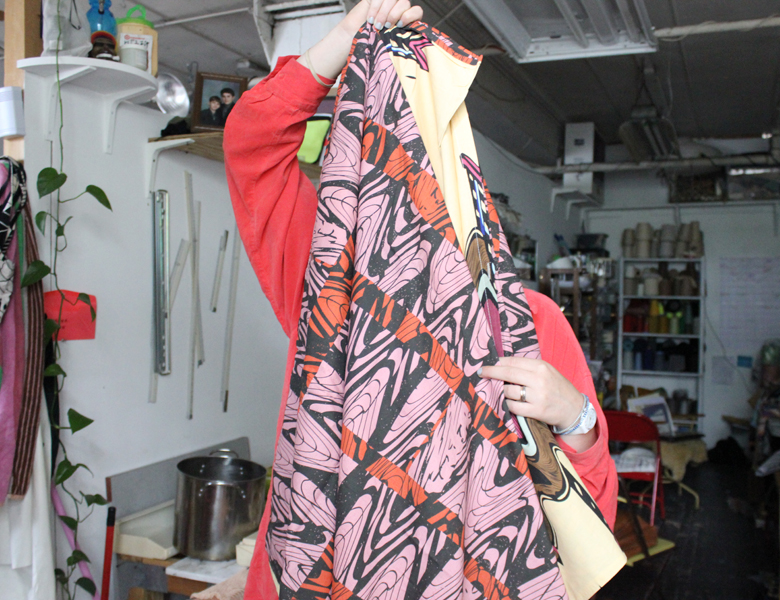
When we first got wind of the new Scandances by Prince Ruth textile collection for Urban Outfitters, we had two questions: Who is Prince Ruth? And what the heck is a scandance? The latter question, we found, was easy to answer: It’s that jittery, seismograph-through-the-lens-of-an-acid-trip effect you get when you manipulate an image while it’s in the process of being scanned. As for the former, we assumed that Prince Ruth was some under-the-radar designer we somehow weren’t cool enough to have noticed. And in a way, that’s exactly what it is: Prince Ruth is the name of a Brooklyn-based surface design studio run by Zoe Latta, a 24-year-old textile artist and RISD grad whose work is more famous than her pseudonym would suggest.
More

At Design Miami/Basel 2012

When Design Miami rolls around each winter, it’s hard to resist the siren’s song of sunshine in December, no matter how much you've decided you hate standing in line for parties or how high the hotel rates might balloon during that frenetic week. We’ve been known to pool resources with friends far and wide in order to hop on flights and hightail it out of New York on the promise of a stolen afternoon at the Standard’s pool, or even a press brunch at some Collins Avenue hotel du jour. But we’ve never made it to the event that started it all: Design Miami/Basel and its legendary accompanying art fair. Lucky for us, then, that we alighted this year on the perfect correspondent: Marco Tabasso, known in design circles as Rossana Orlandi’s right-hand man, who took advantage of a rare two-day break (the gallery sat this year out, after having debuted a massive Nacho Carbonell installation in 2011) to zip around the Swiss metropolis, capturing everything he saw for us on proverbial film.
More

Tools for Everyday Life, by the Designers in Residence at Northumbria University

It seems ironic that the design school at Northumbria University's two most famous graduates would be Max Lamb and Jonathan Ive. At one end of the spectrum is Lamb, a designer so consumed with the act of making and the transparency of process that he films himself fabricating each piece from start to finish and posts the results on his website. On the other is Ive, who’s responsible for an object that’s more of a cipher, one that conceals its mechanics within and successfully erases any questions about how the way it works or the context in which it was made. But perhaps the difference between the two designers is as simple as the difference between their concentrations at university: Ive graduated from a Northumbria program known as Design for Industry, which focuses on consumer experience, while Lamb finished a course called Three-Dimensional Design, where the act of making is as paramount as the artifact itself. It’s the latter program that's yielded the Designers in Residence who have exhibited at ICFF, for two years running, a collection of products known as Tools for Everyday Life, and it’s in Lamb’s footsteps that those designers follow.
More

At New York Design Week 2012, Part III: The Noho Design District

The question we get most often about curating and producing three years' worth of Noho Design Districts isn’t “Can you spare an invite to the VIP party” or even “How can I show my work with you?” but “How on earth do you two do it?” This year was our biggest and best event yet: We had two new hubs (the empty former print lab at 22 Bond Street and The Standard, East Village hotel on Cooper Square); two new international partners (London’s Tom Dixon took over the basement of the Bleecker Street Theater while DMY Berlin hit the American circuit downstairs at 22 Bond); and exhibitions so big that one of them stretched across two different venues (The Future Perfect’s showcase busted the seams of its Great Jones flagship, continuing up the street at 2 Cooper Square).
More

At New York Design Week 2012, Part II: Hotel California

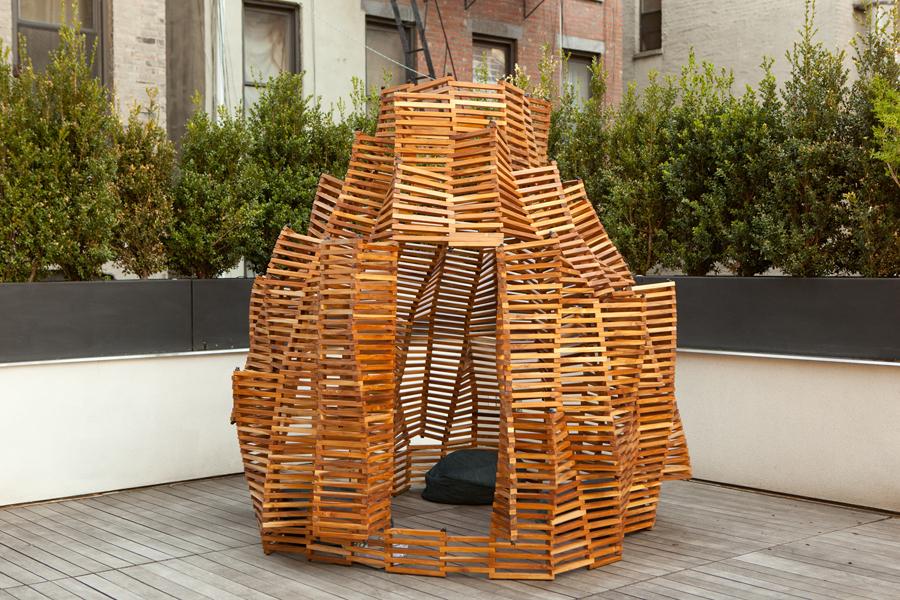
How could we have possibly known, when we first decided to host an exhibition of California design during our third annual Noho Design District, that we would be blessed with four straight days of glorious, Los Angeles–style sunshine? (Followed, of course, by a day of downpours, but more on that tomorrow.) Springtime in New York is a fickle beast, and when we first began to plan how best to use the gorgeous second-floor terrace space we’d been given at the new Standard, East Village hotel, we said a prayer for mild climes but also engaged in fretful what-ifs with our hotel ambassadors, talking of contingencies like awnings, tarps, and the possibility of moving everything — save for a nearly 50 square foot teak and rubber fort constructed on-site by Matt Gagnon — inside.
More

Areaware’s 2012 collection

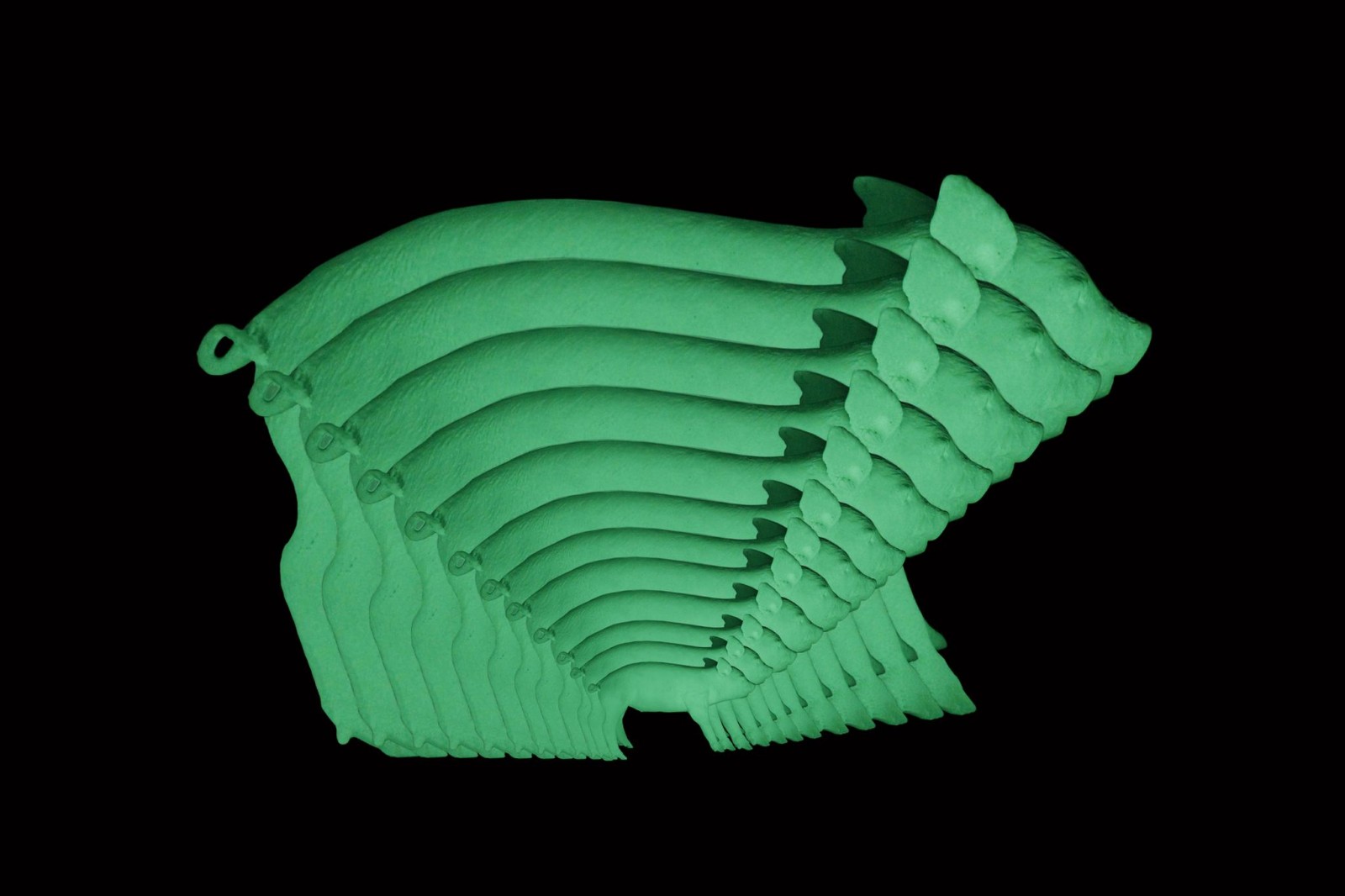
This morning we introduced you to one of the key exhibitions from our Noho Design District hub at The Standard, East Village hotel. But before we take off for the weekend, we wanted to direct your attention three blocks south to our other hub at 22 Bond Street, where for the next four days you can view an immersive, conceptual installation by Areaware featuring the launch of Harry Allen's Bank in the Form of a Pig GLOW and the debut of yet another amazing video from filmmaking duo Grave of Seagulls. If you're in New York this weekend, we highly recommend you go and experience the disorienting video for yourself, but if you're not, don't fret - we snagged the online debut of the film below and spoke to Areaware creative director Laura Young about how it came to be.
More
Roll & Hill Jonah Takagi Silk Road

An Exclusive First Look at Roll & Hill’s 2012 Collection

Three ICFFs ago, when we launched the Noho Design District, our biggest exhibition was the debut of Jason Miller's highly anticipated new lighting company Roll & Hill, which took over the top floor of our beloved former lumber building (RIP) and cozily lit its dilapidated interior with a string of gorgeously modern chandeliers. It's hard to believe how far both of us have come since then. With the imminent redevelopment of the NDD's former hub at 45 Great Jones, we went hunting for a new home, and instead found two. And Roll & Hill — in addition to showing its new collection at the Javits Center — will join up with us once again in Noho, this time spreading out over 3,500 square feet on the ground floor of 2 Cooper Square, where a monthlong showroom will showcase the brand's full collection in addition to its new products for 2012.
More

The Best of the 2012 Milan Furniture Fair, Part II

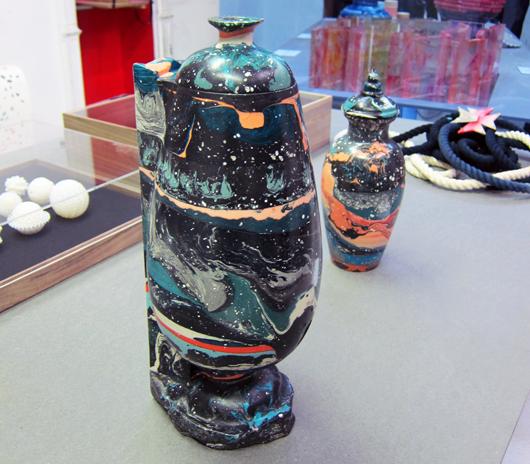
We'd scarcely pressed "Post" on last week's Milan Furniture Fair recap when another round of photos arrived in our inbox, this one featuring the jaw-droppingly amazing Sedimentation vases pictured above, which could be our favorite thing to emerge from the weeklong festivities. The fact that they're the work of a student — the Swedish-born Royal College of Art up-and-comer Hilda Hellström — makes them even more exciting, especially when the fair can sometimes seem dominated by glitzy launches from the megabrands. "I am OBSESSED with these," wrote The Future Perfect's Dave Alhadeff. "The forms feel well beyond student work and the 'on-trend' marbling technique." We couldn't agree more, and Hellström's urns were just one of the products we fell in love with by proxy; as the weekend wore on, we received picks from Mary Wallis, a designer at Lindsey Adelman's studio, and the American designer Jonah Takagi to round out our second wrap-up from the year's biggest furniture event. Mirrored crates, portable terrariums and zinc-coated screens are now tops on our wish lists. What's on yours?
More

At the 2012 Milan Furniture Fair

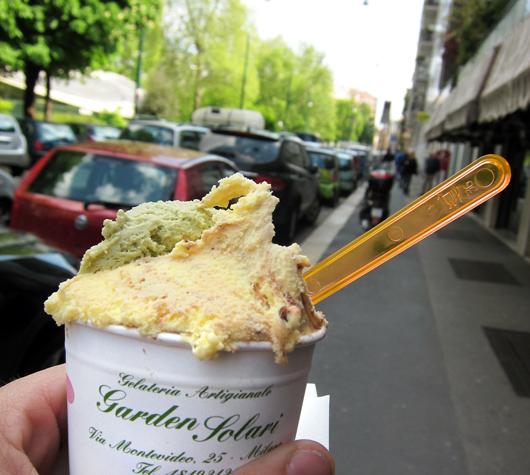
While nothing will ever compare to the Great Ash Cloud of 2010 in terms of strange events surrounding the Milan Furniture Fair, there seems to be a fair amount of juju going on with this year's festivities — or at least with the members of our hand-picked street team, who were meant to upload photos from their bases around the Italian metropolis all this week. Pin-Up editor Felix Burrichter reported a suddenly collapsed eardrum, which stranded him in Berlin and prevented him from attending the fair entirely, while designer Sam Baron confessed his attempts to take photos at a dinner for Fiat's Lapo Eklann were sadly thwarted by bodyguards. Lucky for us, then, that we've been able to follow along on Instagram, Twitter, blogs, and a steady stream of photos arriving in our inbox from The Future Perfect's Dave Alhadeff, who's been firing off everything from potential products for his store to OMG moments to jealousy-inducing images of gelato. We'll be bringing you more photos as they roll in, but for now, here's a sampling of the first few days from one of our favorite fairgoers.
More